MKSE
MKSE stands for the Macedonian Stock Exchange (Makedonska Berza), the primary organized securities and equity exchange of North Macedonia, headquartered in Skopje.
The acronym MKSE (commonly abbreviated as MSE in regional contexts) designates the Macedonian Stock Exchange (Makedonska Berza AD Skopje, ISO Market Identifier Code: XMAE). Headquartered in the capital city of Skopje, the MKSE is the sole institutional exchange for trading equities, corporate debentures, and sovereign government bonds in the Republic of North Macedonia.
Established in September 1995 following the transition of North Macedonia to a sovereign market economy, the MKSE operates under the regulatory supervision of the Securities and Exchange Commission of the Republic of North Macedonia (SEC NM). The exchange serves as the primary capital formation mechanism for domestic private enterprise, hosting benchmark blue-chip corporations across banking, pharmaceuticals, construction, and energy distribution.
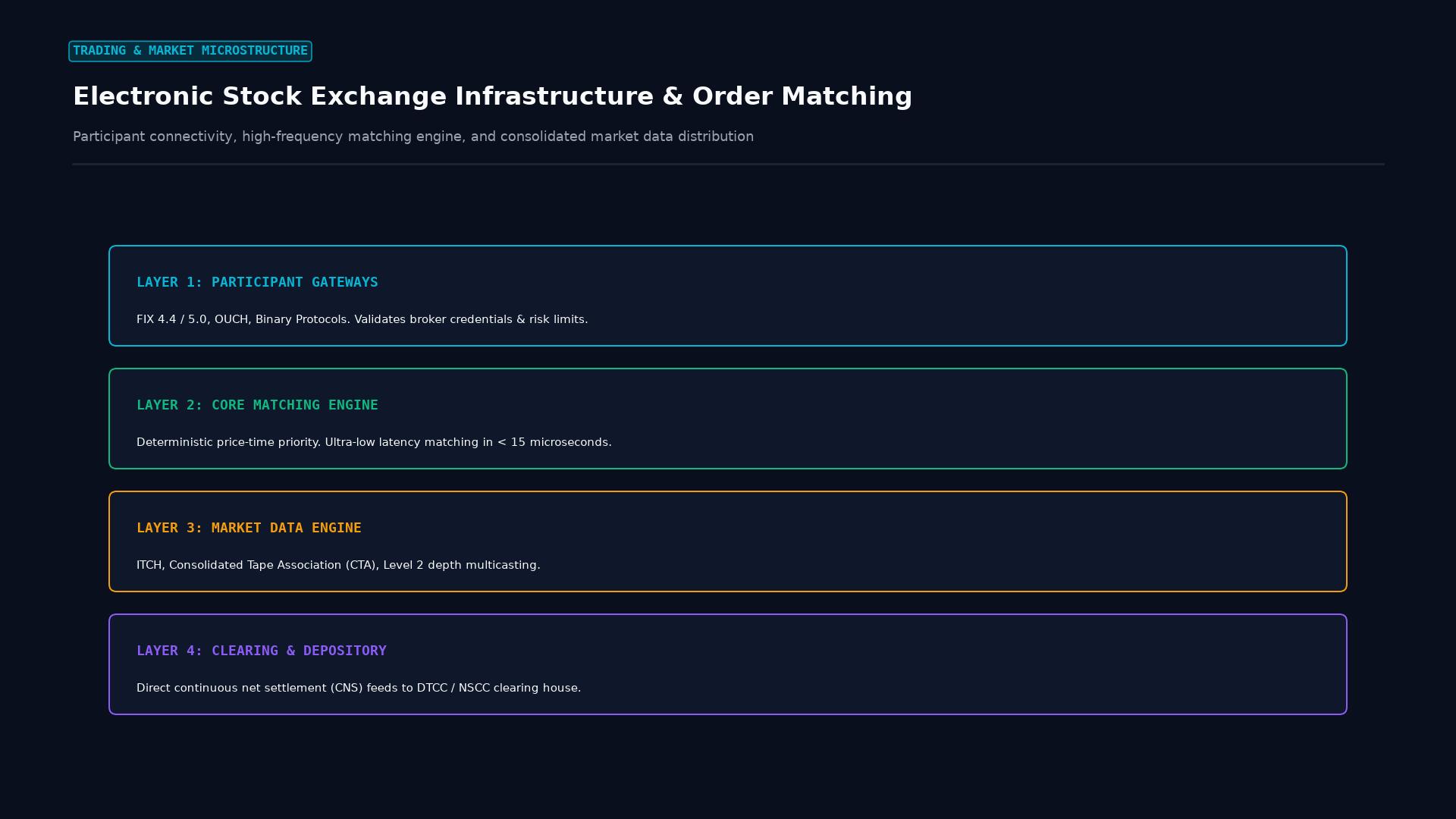 Figure: Regional exchange architecture: BEST electronic trading platform, central securities depository, and multi-tier market listing segments.
Historical Foundation and Market Modernization
The development of the Macedonian capital market accompanied the structural post-socialist privatization process of the 1990s:
1. Foundation and First Trading Session (1995–1996)
The MKSE was incorporated as a joint-stock company on September 13, 1995, founded by leading domestic commercial banks, insurance corporations, and brokerage firms. The historic first trading session occurred on March 28, 1996, trading physical paper shares of newly privatized industrial enterprises.
2. Electronic Trading and the BEST Platform (2001)
In 2001, the MKSE terminated open-outcry floor trading, modernizing into a fully electronic exchange through the adoption of the BEST (Balkan Electronic Securities Trading) software platform, developed in collaboration with international software partners and the Ljubljana Stock Exchange.
3. Regional Balkan Integration and SEE Link (2014–Present)
To resolve the structural liquidity limitations characteristic of small frontier markets, the MKSE joined forces with the Zagreb Stock Exchange (ZSE) and Bulgarian Stock Exchange (BSE) in May 2014 to create SEE Link.
Supported by the European Bank for Reconstruction and Development (EBRD), SEE Link established an integrated regional order-routing infrastructure that enables international institutional brokers to route trades across Southeast European exchanges (including North Macedonia, Croatia, Bulgaria, Serbia, and Slovenia) through a single software connection.
       CHRONOLOGICAL MILESTONES: MKSE EXPANSION

Year        Milestone                      Strategic Impact
----------------------------------------------------------------------------------
1995        Incorporation of MKSE          Creation of organized domestic exchange
1996        First Live Trading Session     Initial trading of privatized enterprises
2001        Electronic Trading via BEST    Abolished manual floor; electronic orders
2005        Launch of MBI10 Index          Created standardized blue-chip benchmark
2014        SEE Link Foundation (EBRD)     Integrated regional order-routing network
2020        Zagreb Stock Exchange Stake    ZSE acquires strategic minority ownership
Market Segments and Listing Requirements
Securities on the MKSE are categorized into two primary market segments governed by transparent financial disclosure thresholds:
1. The Official Market
The premium tier of the exchange, reserved for enterprises that satisfy strict corporate governance, capitalization, and liquidity standards:
- Super Listing: The highest tier, mandating minimum equity capital of 10 million euros, a free-float of at least 20%, an audited operating history of five years, and quarterly financial reporting under International Financial Reporting Standards (IFRS).
- Exchange Listing: Mandates minimum equity capital of 5 million euros, a 15% free float, and a three-year operating record.
- Mandatory Listing: Enforced under Macedonian securities legislation to mandate reporting transparency for major joint-stock companies with more than fifty shareholders and substantial equity capital, even if not actively seeking capital expansion.
2. The Regular (Free) Market
Designed for smaller, unlisted enterprises and secondary trading of privatized shares that do not meet official listing criteria. Disclosure requirements are streamlined, providing investors with secondary liquidity while observing basic audit standards.
       MKSE SEGMENTATION AND LISTING CRITERIA

Tier            Min Equity Capital   Min Free Float   Operating History
----------------------------------------------------------------------------------
Super Listing   10,000,000 EUR       20.0%            5 Years Audited IFRS
Exchange Listing 5,000,000 EUR       15.0%            3 Years Audited IFRS
Mandatory       Statutory Criteria   Varies           Joint-Stock Companies
Free Market     No Minimum           No Minimum       Base Corporate Registration
The Benchmark Index: MBI10
The principal benchmark index of the Macedonian capital market is the MBI10 (Macedonian Blue Chip Index), launched on December 30, 2004, with a base level of 1,000.00.
The MBI10 is a price index weighted by free-float market capitalization, tracking the performance of the ten most liquid, institutional-grade equities traded on the exchange:
$$\text{MBI10}t = \frac{\sum{i=1}^{10} \Big( P_{i,t} \times Q_{i,t} \times \text{FF}{i,t} \times \text{Cap}{i,t} \Big)}{\text{Divisor}_t}$$
Where:
- $P_{i,t}$ is the current transaction price of constituent stock $i$.
- $Q_{i,t}$ is the total number of issued shares of constituent $i$.
- $\text{FF}_{i,t}$ is the free-float weighting factor ($0 < \text{FF} \le 1.0$), ensuring that shares held by sovereign entities, strategic founders, or controlling parent companies are excluded from the index calculation.
- $\text{Cap}_{i,t}$ is a diversification capping factor that restricts the maximum weight of any single corporate constituent to 20.0%, preventing a single large enterprise from dominating index returns.
- $\text{Divisor}_t$ is an index adjustment factor modified to preserve continuity during dividend distributions, share splits, or constituent replacements.
Core MBI10 Constituent Champions
The benchmark index is anchored by dominant national enterprises:
- Alkaloid AD Skopje (ALK): The leading pharmaceutical multinational in North Macedonia, manufacturing generic prescription drugs, herbal remedies, and cosmetics exported to over forty nations.
- Komercijalna Banka AD Skopje (KMB): The largest domestic commercial bank by total assets and deposit volume.
- Makpetrol AD Skopje (MPT): The primary national distributor and retailer of petroleum, natural gas, and biofuels.
- Granit AD Skopje (GRNT): The premier civil engineering and infrastructure construction contractor in the Western Balkans.
- Stopanska Banka AD Skopje (STB): A systemically important commercial bank majority-owned by the National Bank of Greece (NBG).
       MBI10 CONSTITUENT CAPITALIZATION PROFILE

+---------------------------------------------------------------+
| Alkaloid AD Skopje (Pharmaceuticals):      ~20.0% Max Cap     |
+---------------------------------------------------------------+
| Komercijalna Banka AD Skopje (Banking):    ~20.0% Max Cap     |
+---------------------------------------------------------------+
| Stopanska Banka AD Skopje (Banking):       ~15.0% Weight      |
+---------------------------------------------------------------+
| Makpetrol AD Skopje (Energy / Fuel):       ~12.0% Weight      |
+---------------------------------------------------------------+
| Granit AD Skopje (Construction):           ~8.0% Weight       |
+---------------------------------------------------------------+
| Residual Top-10 Constituents:              ~25.0% Aggregate   |
+---------------------------------------------------------------+
Trading Technology, Settlement, and Central Securities Depository
Transactions executed on the MKSE settle under international best practices:
- Trading Mechanism: Trading operates through continuous double auction matching and scheduled pre-close fixing auctions between 10:00 AM and 02:00 PM local time (CET).
- Clearing and Depository: Trade execution is synchronized electronically with the Central Securities Depository (CSD AD Skopje). The CSD maintains the definitive shareholder registry and settles trades on a T+2 rolling settlement cycle on a strict Delivery versus Payment (DvP) basis through the central bank RTGS interbank payment system, eliminating counterparty settlement risk.
- Currency and Peg Stability: While all local equity prices are quoted in Macedonian denars (MKD), international investors benefit from the central bank’s de facto fixed peg of the denar to the euro (~61.50 MKD/EUR), eliminating unhedged currency fluctuation risks for Eurozone asset managers.
Real-World Case Study: International Frontier Yield Investing on MKSE
In 2023, an institutional European frontier market fund, Balkan Alpha Partners, evaluated capital allocation into the banking and pharmaceutical sector of North Macedonia.
+--------------------------------------------------------------------+
|               BALKAN ALPHA PARTNERS MKSE INVESTMENT                |
+--------------------------------------------------------------------+
| 1. Investment Rationale: Blue-chip banking equities on the MKSE    |
|    traded at price-to-earnings (P/E) ratios between 6.5x and 8.0x, |
|    offering annual cash dividend yields exceeding 7.5%.            |
| 2. FX Stability Factor: Unlike other frontier markets where high   |
|    dividend yields are erased by currency depreciation, the MKD    |
|    peg to the euro guaranteed stable euro-denominated returns.     |
| 3. Execution Execution: The fund routed buy orders through a       |
|    regional broker via the SEE Link platform, acquiring a block   |
|    of 15,000 shares in Komercijalna Banka AD Skopje (KMB).         |
| 4. Dividend Settlement: KMB announced an annual cash dividend of   |
|    1,150 MKD per share (approx. 18.70 EUR), yielding 8.2% net.     |
| 5. Depository Processing: The CSD AD Skopje processed dividend     |
|    distributions directly to the foreign custodian's account with  |
|    favorable withholding tax treatment under bilateral tax treaties.|
| 6. Outcome: Over a 12-month horizon, the investment captured an    |
|    8.2% cash yield plus a 14.5% capital appreciation in local MKD, |
|    translating directly into a +22.7% return in euros.             |
+--------------------------------------------------------------------+
Frequently Asked Questions
Can foreign retail investors buy shares listed on the Macedonian Stock Exchange?
Yes. Foreign retail and institutional investors have equal legal rights to acquire listed securities on the MKSE. A foreign investor must open a custodial investment account through an authorized domestic brokerage firm or an international custodian bank affiliated with the Central Securities Depository (CSD AD Skopje). Foreign investors can freely repatriate capital gains and dividend income in foreign currency without legal restrictions.
What is the primary liquidity challenge on the MKSE?
Because North Macedonia is a small developing economy with an annual GDP of approximately $14 billion, the domestic stock exchange exhibits low daily turnover compared to major European bourses. Daily trading volume is heavily concentrated in the top five blue-chip stocks (Alkaloid, Komercijalna Banka, Stopanska Banka, Makpetrol, and Granit). Institutional investors entering or exiting large equity positions must utilize block trading facilities or execute orders gradually over multiple sessions to avoid adverse market price impact.
How are capital gains taxed on the Macedonian Stock Exchange?
Under North Macedonia’s tax legislation, personal income tax rules governing capital gains realized from securities trading have historically included full exemptions or reduced preferential tax rates (such as a 10% flat capital gains tax rate with exemptions for long-term holding periods) to incentivize domestic capital market participation. International investors should review the specific Double Taxation Avoidance Agreement (DTAA) enacted between North Macedonia and their home jurisdiction.
Ready to trade forex?
Open a free demo account with a regulated broker. Practice with virtual funds before risking real money.