MKTG
MKTG is the standard corporate finance, general ledger, and securities ticker abbreviation for Marketing, designating commercial promotion expenditures within corporate income statements.
In corporate accounting, financial statement analysis, enterprise resource planning (ERP) charts of accounts, and financial market nomenclature, the abbreviation MKTG stands for Marketing. Within corporate financial statements, MKTG identifies the ledger accounts and expense line items dedicated to customer acquisition, corporate advertising, digital performance media, public relations, market research, and brand promotion.
On institutional equity research dealing desks and fundamental corporate valuation models, MKTG expenditures are audited as a primary component of Selling, General, and Administrative (SG&A) operating expenses. Because modern technology and consumer-facing enterprises allocate substantial portions of gross revenue to sales and marketing outlays, fundamental analysts evaluate MKTG metrics to determine operating leverage, Customer Acquisition Cost (CAC) payback efficiency, and long-term operating margin scalability.
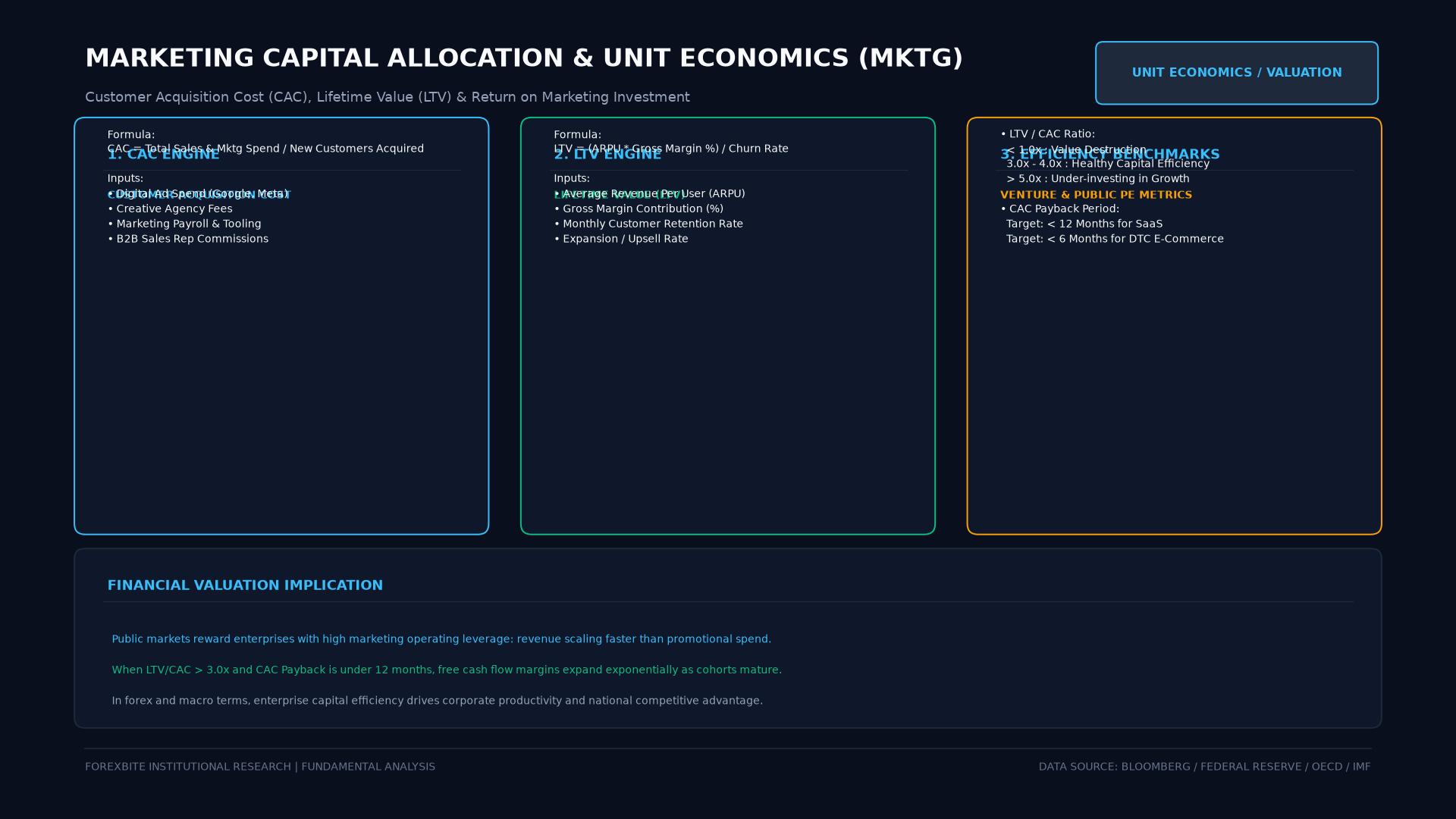 Figure: Enterprise marketing capital allocation framework detailing Customer Acquisition Cost (CAC), Customer Lifetime Value (LTV), Payback Period thresholds, and operating leverage transmission.
Financial Accounting Standards: Expensing vs Capitalization (ASC 720)
Under US Generally Accepted Accounting Principles (US GAAP) and International Financial Reporting Standards (IFRS), the accounting treatment of marketing expenditures is governed by strict conservatism principles:
1. The Immediate Expensing Mandate (ASC 720-35)
Under Financial Accounting Standards Board (FASB) ASC 720-35 (Other Expenses - Advertising Costs), advertising and marketing expenditures must be expensed as incurred:
- The cost of producing advertisements (such as filming television commercials or producing graphic assets) must be expensed the first time the advertising takes place.
- Media placement costs (such as digital pay-per-click bidding, billboard leases, or programmatic display fees) must be expensed in the exact reporting period in which the media is displayed.
Even if an enterprise launches a multi-million-dollar global brand marketing campaign that builds intangible customer loyalty for a decade, GAAP strictly bars the company from capitalizing those marketing expenses as intangible assets on the balance sheet. All MKTG cash outflows must flow directly through the income statement as period operating expenses.
2. The Direct-Response Advertising Exception
Historically, SOP 93-7 (codified within ASC 720-35) permitted a narrow accounting exception for Direct-Response Advertising:
- If an enterprise could prove through historical statistical data that a specific direct-response marketing campaign (such as a direct mail catalogue or direct-response television commercial) resulted in verifiable, future customer purchases, the direct production and distribution costs could be capitalized as an asset and amortized over the estimated realization window.
- In modern financial reporting, this exception is rarely used due to the rigorous evidentiary thresholds required by independent audit firms.
       ACCOUNTING TREATMENT: MKTG VS CAPITAL ASSETS

Expenditure Category    Income Statement Timing Balance Sheet Recognition
----------------------------------------------------------------------------------
Digital Ad Placement    Expensed Immediately   None (Direct Period OPEX)
Brand Sponsorships      Expensed Immediately   None (Direct Period OPEX)
Direct Mail Campaigns   Expensed Immediately   Rare (Restricted Asset)
Physical Machinery      Amortized via MACRS    Capitalized Property, Plant (PP&E)
Internal Software R&D   Amortized over Horizon Capitalized Intangibles (ASC 350)
Quantitative Metrics: Evaluating MKTG Efficiency in Fundamental Analysis
Fundamental equity analysts and corporate treasurers evaluate the economic productivity of MKTG expenses using specific quantitative equations:
1. Marketing Intensity Ratio
Measures the proportion of corporate revenue consumed by marketing and advertising activities:
$$\text{Marketing Intensity %} = \frac{\text{Total MKTG Expense}}{\text{Total Gross Revenue}} \times 100$$
- Mature Industrial / B2B Manufacturing: Typically exhibits low marketing intensity (1% to 4% of revenue).
- Consumer Packaged Goods (CPG): Moderately high intensity (8% to 15% of revenue).
- High-Growth Enterprise SaaS / Direct-to-Consumer: Very high intensity (35% to 60% of revenue during customer land-grab phases).
2. Return on Marketing Investment (ROMI)
Quantifies the net operating profit generated per dollar of marketing capital deployed:
$$\text{ROMI} = \frac{\Delta \text{Revenue Attributable to Marketing} \times \text{Gross Margin %} - \text{MKTG Expense}}{\text{MKTG Expense}} \times 100$$
If a retail consumer enterprise executes a $5,000,000 marketing campaign that generates $18,000,000 in incremental new sales at a 60% gross profit margin:
$$\text{Gross Profit Generated} = $18,000,000 \times 0.60 = $10,800,000$$
$$\text{ROMI} = \frac{$10,800,000 - $5,000,000}{$5,000,000} \times 100 = \frac{$5,800,000}{$5,000,000} \times 100 = 116%$$
The company captured $1.16 in net operating profit above the cost of the campaign for every dollar invested.
3. Customer Acquisition Cost (CAC) and Payback Period
In recurring-revenue subscription businesses (such as SaaS or streaming platforms), analysts evaluate the CAC Payback Period:
$$\text{CAC Payback (Months)} = \frac{\text{CAC}}{\text{ARPU} \times \text{Gross Margin %}}$$
Where:
- $\text{CAC} = \frac{\text{Total Sales & MKTG Outlays in Period } t}{\text{New Customers Acquired in Period } t}$.
- $\text{ARPU}$ is Average Monthly Revenue Per User.
A payback period under 12 months indicates high capital efficiency, while payback horizons extending past 24 months signal that marketing spend is eroding corporate liquidity.
       MKTG UNIT PAYBACK PROFILE

Net Cash Flow
Per Customer
   ^
   |                                 * Cumulative Profit Zone
   |                                /
   |                               /
$0 |------------------------------+--------------------------- Break-Even Horizon
   |                             /   (Payback Month: Month 11)
   |                            /
   |  * Month 0: -$500 CAC     /  Monthly Subscription Cash Flows
   |    Initial MKTG Cash Burn/   (Net of Cost of Service)
   +--------------------------------------------------------->
      0         3          6          9         12        18
                               Month
The SaaS Accounting Distortion: MKTG Expense vs Enterprise Valuation
The GAAP requirement to expense all MKTG outlays immediately creates a well-documented accounting distortion in the financial analysis of high-growth subscription technology companies.
When a traditional manufacturing firm builds a new physical factory, it capitalizes the construction costs on its balance sheet, depreciating the asset over thirty years; current-year operating income is barely impacted.
When a cloud software firm spends $100,000,000 on MKTG to acquire 5,000 enterprise software clients who sign five-year recurring contracts:
- The entire $100,000,000 is expensed immediately in Year 1.
- The company reports massive GAAP operating losses, causing traditional price-to-earnings (P/E) ratios to appear negative or broken.
- However, the acquired customer contracts represent valuable, multi-year recurring cash flow assets that generate high returns in Years 2 through 5 without requiring additional marketing expense.
To account for this structural asymmetry, fundamental growth investors utilize metrics such as The Rule of 40:
$$\text{Rule of 40 Score} = \text{Annual Revenue Growth Rate %} + \text{Free Cash Flow Margin %}$$
A company allocating heavy capital to MKTG that achieves 50% revenue growth alongside a -10% cash flow margin scores a 40%, satisfying institutional investment thresholds despite reporting GAAP accounting losses.
Real-World Case Study: Direct-to-Consumer Brand MKTG Restructuring
In 2023, an e-commerce direct-to-consumer apparel enterprise, Apex Athleisure, audited its income statement following a period of declining operating margins:
+--------------------------------------------------------------------+
|               APEX ATHLEISURE MKTG EXPENDITURE AUDIT               |
+--------------------------------------------------------------------+
| 1. Income Statement Profile (FY 2022):                             |
|    - Gross Net Sales: $80,000,000                                  |
|    - Cost of Goods Sold (COGS @ 40%): -$32,000,000                 |
|    - Gross Profit (60% Margin): $48,000,000                        |
|    - MKTG Line Item (Paid Meta/TikTok Ads): -$36,000,000 (45% rev) |
|    - Other G&A Overhead: -$14,000,000                              |
|    - Reported Operating Income (EBIT): -$2,000,000 (Net Loss)      |
+--------------------------------------------------------------------+
| 2. Forensic Analysis:                                              |
|    - Digital ad privacy changes (Apple iOS App Tracking Transparency|
|      ATT) reduced ad targeting efficiency, pushing Blended CAC from |
|      $42.00 up to $88.00 per customer.                             |
|    - Average Order Value ($AOV) remained flat at $95.00.           |
|    - Unit Margin after COGS and CAC was negative: -$12.00 per unit.|
+--------------------------------------------------------------------+
| 3. Operational Restructuring (FY 2023):                            |
|    - Slashed unhedged paid digital ad spend from $36M down to $18M.|
|    - Reallocated $3M into organic customer referral programs and   |
|      email lifecycle retention marketing.                          |
|    - New MKTG Total: $21,000,000 (28% of revenue).                 |
| 4. Strategic Outcome:                                              |
|    - Revenue declined slightly to $75,000,000, but Gross Profit    |
|      held at $45,000,000.                                          |
|    - Operating Income (EBIT) rebounded from -$2.0M to +$10,000,000.|
+--------------------------------------------------------------------+
By prioritizing MKTG capital efficiency over top-line growth, Apex transformed an unprofitable business into an enterprise generating $10 million in operating profit.
Frequently Asked Questions
Why does GAAP prohibit companies from capitalizing brand marketing expenses?
The Financial Accounting Standards Board prohibits capitalizing marketing expenditures because the future economic benefits of brand awareness are highly subjective, intangible, and impossible to measure reliably. Unlike a physical machine with an observable operational lifespan, a consumer brand campaign may fail completely or dissolve rapidly due to shifting consumer trends or public relations scandals. Immediate expensing prevents management from artificially inflating corporate balance sheets with subjective intangible assets.
How do auditors verify MKTG expenses during corporate audits?
During annual financial audits, independent accounting firms execute substantive testing on the MKTG ledger:
- Invoice Matching: Cross-referencing recorded marketing expenses against contracts, media invoices, and digital ad receipts (Google Ads, Meta, Amazon).
- Cutoff Testing: Verifying that ad campaigns run in December are recorded in that fiscal year rather than deferred to January.
- Classification Audits: Ensuring that customer discounts, rebates, or slotting fees are properly deducted directly from Gross Revenue under ASC 606 rather than misclassified as operating MKTG expenses to inflate gross margins.
What is the difference between direct marketing costs and institutional brand marketing?
Direct marketing costs are transactional outlays engineered to generate an immediate, measurable consumer conversion (such as Google pay-per-click search ads, direct mail catalogues, or affiliate commissions). Institutional brand marketing focuses on long-term corporate reputation and market awareness (such as stadium naming rights, Olympic sponsorships, or corporate goodwill television broadcasts), where individual consumer transactions cannot be traced directly to specific marketing dollars.
Ready to trade forex?
Open a free demo account with a regulated broker. Practice with virtual funds before risking real money.