MM
In institutional finance, banking, and accounting, MM is the standard notation designating one million units ($1,000,000), derived from the Roman numeral M (mille) multiplied by itself. MM also serves as an established acronym for Money Market and Market Maker across trading desks and regulatory frameworks.
In institutional finance, corporate accounting, capital markets syndication, and financial journalism, the abbreviation MM carries three primary meanings depending on operational context:
- Numerical Notation for One Million ($1,000,000)$: Derived from classical Roman numerals where M represents one thousand (mille). In traditional accounting, corporate bond indentures, and commercial energy contracts, $M \times M = 1,000 \times 1,000 = 1,000,000$. Hence, $10MM denotes ten million dollars.
- Money Market: The wholesale global financial market for short-term borrowing and lending with maturities ranging from overnight up to one year. This encompasses Treasury bills, commercial paper, certificates of deposit (CDs), banker’s acceptances, and repurchase agreements (repos).
- Market Maker: An exchange member firm, registered broker-dealer, or algorithmic principal trading firm that continuously quotes two-sided prices (bid and ask) to provide liquidity, absorb temporary inventory imbalances, and capture the bid-ask spread.
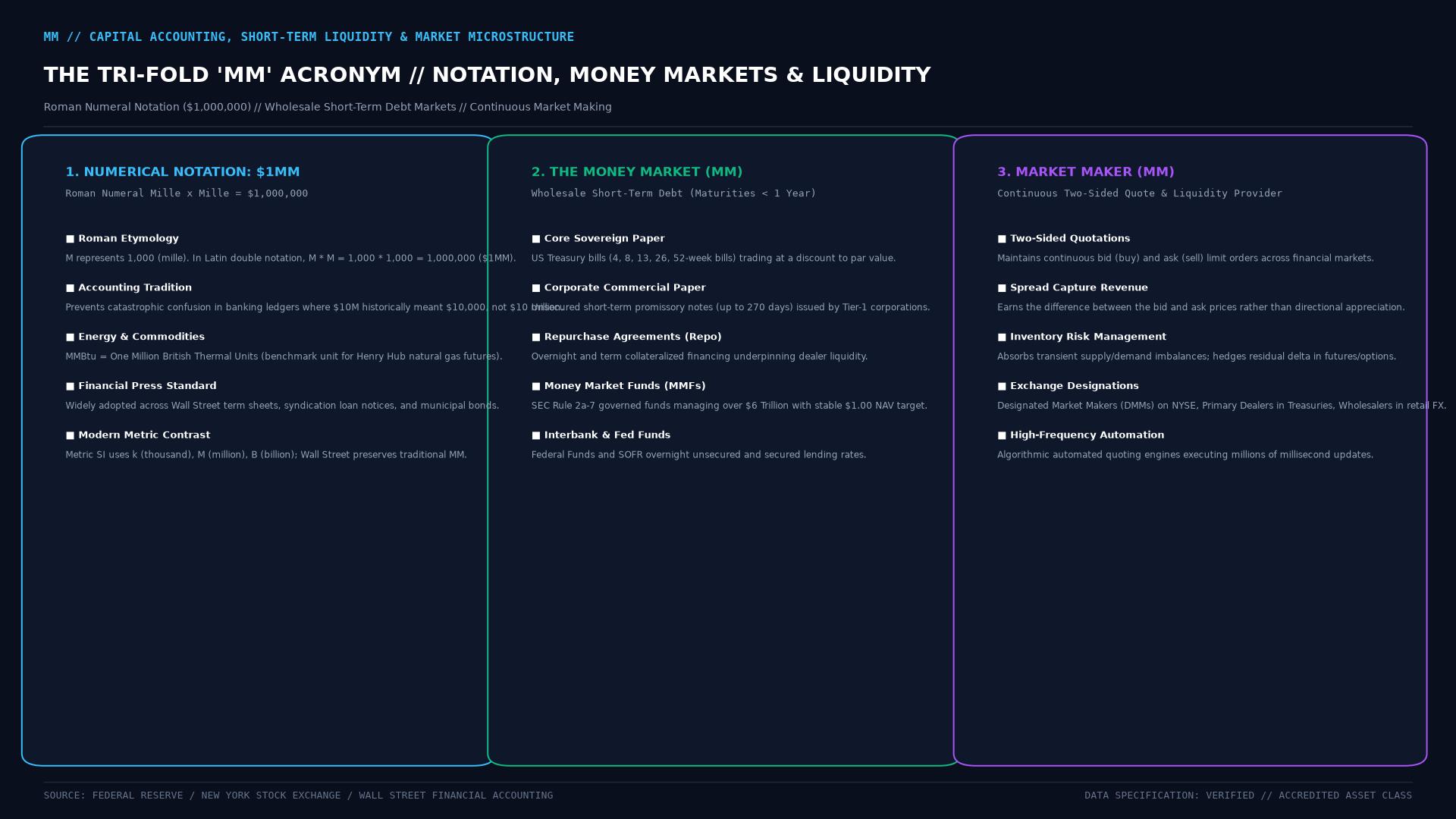 Figure: The tri-fold operational domains of ‘MM’ across global finance: (1) Traditional Roman accounting notation for one million ($1MM), (2) The wholesale Money Market for short-term debt instruments under SEC Rule 2a-7, and (3) Two-sided continuous liquidity provision by Market Makers.
1. MM as Numerical Notation ($1,000,000)
The Linguistic and Mathematical Origin
In contemporary metric notation (the International System of Units, SI), the prefix k (kilo) designates thousands ($10^3$), M (mega) designates millions ($10^6$), and B or G (giga) designates billions ($10^9$). However, Anglo-American banking and financial accounting predated metric standards by centuries, relying on Latin accounting traditions.
In Latin:
- M = mille (one thousand, 1,000).
- MM = mille mille (one thousand thousands, $1,000 \times 1,000 = 1,000,000$).
Under classical financial ledger standards:
- $1M = One thousand dollars ($1,000).
- $1MM = One million dollars ($1,000,000).
- $1B or $1BN = One billion dollars ($1,000,000,000).
+------------------+------------------------+-------------------------------+
| Quantity         | Traditional Accounting | Metric / Modern Casual        |
+------------------+------------------------+-------------------------------+
| One Thousand     | $1M                    | $1k or $1K                    |
| One Million      | $1MM                   | $1M                           |
| One Billion      | $1B or $1BN            | $1B or $1G                    |
| One Trillion     | $1T or $1TN            | $1T                           |
+------------------+------------------------+-------------------------------+
Industry Persistence: Energy and Syndicated Lending
While casual business writing and consumer media frequently use a single “M” to represent million (e.g., “$5M seed round”), traditional financial institutions deliberately preserve the “MM” convention to prevent catastrophic ambiguity:
- Syndicated Lending and Debt Indentures: Credit agreements drafted by Wall Street law firms consistently define loan tranches using MM (e.g., “$250,000,000 (Two Hundred Fifty Million Dollars, or $250MM)”). A junior analyst misinterpreting $50M as fifty million instead of fifty thousand in a classical legal draft could introduce severe drafting errors.
- Energy and Commodities Trading: Natural gas futures on the New York Mercantile Exchange (NYMEX) are priced per MMBtu (One Million British Thermal Units). Here, MBtu strictly represents one thousand Btu, and MMBtu denotes one million Btu. Modifying this notation would disrupt physical pipeline delivery contracts and pricing models globally.
- Oil and Gas Extraction Accounting: In upstream petroleum reporting, reserve estimates use Mcf for one thousand cubic feet of natural gas and MMcf for one million cubic feet. Crude oil barrels are denoted as Mbbl (one thousand barrels) and MMbbl (one million barrels).
2. MM as Money Market
Institutional Structure of the Money Market
The Money Market (MM) is the foundational plumbing of global liquidity. While capital markets (equity and long-term bond markets) finance multi-year capital expenditures, the money market facilitates short-term working capital, central bank monetary policy transmission, and corporate treasury cash management.
Maturities in the money market range from overnight to 397 days (the statutory limit for money market fund eligible securities under US SEC Rule 2a-7).
                     MONEY MARKET CAPITAL FLOW PIPELINE

  Cash Providers                             Intermediaries          Borrowers
  +-------------------+                      +------------+          +-------------------+
  | - Corporations    |                      | Dealers /  |          | - US Treasury     |
  | - Sovereign Funds | === Cash (Repos) ==> | Repo Desks | =======> | - Primary Dealers |
  | - Wealthy Family  | <== Collateral (UST) | & Clearing | <======= | - Financial Corps |
  |   Offices         |                      +------------+          | - Non-Fin Corps   |
  +-------------------+                                              +-------------------+
Key Instruments in the Money Market
- Treasury Bills (T-Bills): Short-term sovereign obligations issued by governments (such as the US Department of the Treasury) at a discount to face value with maturities of 4, 8, 13, 17, 26, or 52 weeks. They carry zero credit risk and serve as the global risk-free rate benchmark.
- Repurchase Agreements (Repos) and Reverse Repos: Bilateral contracts where one party sells securities (typically government bonds) to another with a simultaneous agreement to buy them back at a slightly higher price on a specified future date (often overnight). The price differential reflects the repo interest rate ($SOFR$ in the US): $$\text{Repo Interest} = \text{Principal} \times \text{Repo Rate} \times \frac{\text{Tenor in Days}}{360}$$
- Commercial Paper (CP): Unsecured promissory notes issued by highly rated corporations and financial institutions to fund short-term liabilities (payroll, inventory). Maximum maturity without SEC registration under Section 3(a)(3) of the Securities Act of 1933 is 270 days.
- Certificates of Deposit (CDs) and Commercial Paper Eurobonds (Euro-CP): Negotiable interest-bearing time deposits issued by commercial banks, traded actively among institutional investors.
- Banker’s Acceptances (BAs): Time drafts drawn on and accepted by a commercial bank, primarily facilitating cross-border trade transactions.
Money Market Funds (MMFs) and Regulatory Architecture
Money Market Funds are collective investment schemes that pool capital from retail and institutional investors to purchase high-grade, short-term money market instruments.
- Stable Net Asset Value (NAV): Traditionally, retail and government money market funds maintain a fixed Net Asset Value of $1.00 per share. Income earned is credited to shareholders as additional fractional shares.
- Breaking the Buck: If a fund’s portfolio asset value drops below $0.995 per share, it must mark down its NAV below $1.00. This rare event occurred famously on September 16, 2008, when the Reserve Primary Fund suffered catastrophic losses on its $785MM exposure to Lehman Brothers commercial paper, plunging its NAV to $0.97 and triggering a worldwide run on the shadow banking system.
- SEC Rule 2a-7 Reforms (2010, 2014, and 2023): To eliminate structural run risks, regulators mandated:
- Institutional prime and tax-exempt MMFs must trade with a floating NAV rounded to four decimal places (e.g., $1.0000).
- Mandatory minimum liquidity requirements: at least 25% in daily liquid assets and 50% in weekly liquid assets (raised in 2023).
- Removal of redemption gates and implementation of mandatory liquidity fees during periods of rapid redemptions.
3. MM as Market Maker
The Role of Market Makers in Trading Microstructure
A Market Maker (MM) is a financial institution, exchange specialist, or proprietary algorithmic trading firm ready to buy or sell financial assets on a continuous, transparent basis at quoted prices. Without market makers, continuous order books would suffer severe liquidity gaps, causing excessive price volatility and prohibitive transaction costs for retail and institutional traders alike.
Market makers operate across all asset classes:
- Foreign Exchange (FX): Tier-1 investment banks (such as JPMorgan, Citi, UBS, Deutsche Bank) act as non-clearing principal market makers, quoting bid/ask prices on bilateral Electronic Broking Services (EBS), Refinitiv Matching, and proprietary single-dealer platforms (SDPs).
- Equities: Designated Market Makers (DMMs) on the New York Stock Exchange and registered Market Makers on Nasdaq maintain fair and orderly markets. High-frequency algorithmic firms (such as Citadel Securities, Virtu Financial, Jane Street) internalize order flow and quote across multiple alternative trading systems (ATS).
- Options and Derivatives: Specialized electronic options market makers provide continuous quoting across thousands of strikes and expiry dates, utilizing automated Greeks hedging models.
                    MARKET MAKER BID-ASK EQUILIBRIUM

          Bid Price ($99.98)                  Ask Price ($100.02)
   [Market Maker Buys From Seller]     [Market Maker Sells To Buyer]
                 |                                   |
                 +-------------- Spread = $0.04 -----+
                                    |
                           Midpoint = $100.00

   Market Maker Profit = Spread Capture - Adverse Selection - Inventory Cost
The Market Maker’s Economic Function and Profit Model
A market maker does not generate primary profits by taking directional directional bets on market movement. Rather, its revenue model relies on three variables:
- Spread Capture (Gross Revenue): The difference between the price at which the firm sells (ask) and buys (bid): $$\text{Gross Spread P&L} = \sum (\text{Ask Price} - \text{Bid Price}) \times \text{Volume Executed}$$
- Adverse Selection Loss (Information Cost): The loss incurred when quoting against informed counterparties (institutional funds or algorithmic traders with superior alpha models or speed). If an informed buyer lifts all market maker offers right before a positive news release, the market maker is left with a losing short position.
- Inventory Holding Cost: The capital cost and market risk of holding long or short positions in fluctuating securities until an offsetting counterparty enters the market. Market makers utilize the Ho-Stoll Model and Avellaneda-Stoikov Model to dynamically adjust their reservation prices:
$$r(s, q, t) = s - q \gamma \sigma^2 (T - t)$$
Where:
- $s$ = current mid-price.
- $q$ = current inventory position (positive if long, negative if short).
- $\gamma$ = risk aversion coefficient.
- $\sigma^2$ = asset price volatility.
- $T - t$ = remaining time horizon.
If a market maker accumulates an excess long position ($q > 0$), it automatically lowers its reservation price, dropping both its bid and ask to deter incoming sellers and attract aggressive buyers to balance its book.
Comparative Matrix: The Three Meanings of MM
+------------------+-----------------------------+-----------------------------+-----------------------------+
| Dimension        | Numerical Notation ($1MM)   | Money Market (MM)           | Market Maker (MM)           |
+------------------+-----------------------------+-----------------------------+-----------------------------+
| Primary Domain   | Accounting, Legal, Energy   | Banking, Fixed Income, Cash | Trading, Exchanges, Market  |
|                  | Contracts, Loan Syndication | Management, Central Banks   | Microstructure, Algorithms  |
+------------------+-----------------------------+-----------------------------+-----------------------------+
| Primary Objective| Eliminating scale ambiguity | Short-term liquidity and    | Continuous two-sided        |
|                  | in corporate finance        | cash capital preservation   | liquidity and price discovery|
+------------------+-----------------------------+-----------------------------+-----------------------------+
| Core Mechanisms  | Latin mille multiplication: | T-Bills, Commercial Paper,  | Bid-Ask spread capture,     |
|                  | M ($10^3$) x M ($10^3$)     | Repos, SEC Rule 2a-7 MMFs   | inventory skewing, hedging  |
+------------------+-----------------------------+-----------------------------+-----------------------------+
| Governing Body / | GAAP, IFRS, ISDA Master     | Federal Reserve, SEC, BIS,  | SEC, FINRA, CFTC, ESMA,     |
| Legal Standard   | Agreements, NYMEX Indentures| European Central Bank       | Exchange Rulebooks (MiFID II)|
+------------------+-----------------------------+-----------------------------+-----------------------------+
| Typical Users    | CFOs, Credit Analysts,      | Corporate Treasurers, Asset | HFT Firms, Designated DMMs, |
|                  | Syndicate Desks, Attorneys  | Managers, Custodian Banks   | Bank FX Spot Trading Desks  |
+------------------+-----------------------------+-----------------------------+-----------------------------+
Best Practices for Navigating “MM” in Professional Contexts
- Avoid Single-Letter Ambiguity in Legal Documents: When drafting term sheets or investor presentations, explicitly state whether $M refers to thousands or millions. Utilizing standard institutional notation ($k for thousands, $MM for millions, $B for billions) prevents contract disputes.
- Recognize Cross-Border Conventions: While US energy and finance professionals routinely write $100MM, many European institutions and modern software platforms adopt the metric standard ($100M for million, $100k for thousand). Always confirm the accounting policies defined in a document’s preliminary notes.
- Assess Counterparty Risk in Money Market Operations: Even ultra-short debt instruments carry counterparty and systemic liquidity risks. Corporate treasurers must monitor credit ratings, collateral quality in tri-party repos, and changes in SEC Rule 2a-7 redemption fee mechanisms.
- Account for Market Maker Inventory Skew: When trading large blocks in foreign exchange or illiquid equities, observe whether market maker bid/ask quotes are asymmetrically shifted away from the mid-price. An asymmetric quote indicates the market maker is managing inventory distress and adjusting prices to shed risk.
Frequently Asked Questions (FAQ)
Why do banks and accountants write $MM instead of $M for millions?
In classical Roman numerals, M represents the number 1,000 (from the Latin mille). When early accounting and banking systems developed, writing $1M indicated one thousand dollars. To express one million (a thousand thousands, or $1,000 \times 1,000$), accountants doubled the letter to MM. Although casual business communication frequently uses $M for million following the metric prefix mega-, Wall Street banks, syndicated loan desks, and energy commodity markets retain $MM to avoid multi-million-dollar contractual misunderstandings.
How does a Money Market Fund differ from a traditional bank savings account?
A traditional bank savings account is a direct deposit liability of a regulated commercial bank, insured by government deposit insurance schemes (such as the FDIC in the United States up to $250,000 per depositor per institution). In contrast, a Money Market Fund is an investment security holding a diversified portfolio of short-term debt instruments (Treasury bills, repos, commercial paper). Money Market Funds are not government-insured and carry market risk, although government-backed MMFs invest exclusively in sovereign debt to achieve negligible default probability.
Can a Market Maker lose money during periods of extreme market volatility?
Yes. Market makers face two primary risks that can generate substantial trading losses during extreme volatility: inventory risk and adverse selection. If asset prices gap down violently before the firm can offset its accumulated long inventory, it must mark down that inventory at a loss. During fast-moving market breakdowns, order flow often becomes one-sided as informed institutional algorithms aggressively sell into the market maker’s bids. Under such conditions, market makers frequently widen their bid-ask spreads or temporarily withdraw quote depth to limit balance sheet exposure.
Ready to trade forex?
Open a free demo account with a regulated broker. Practice with virtual funds before risking real money.