MNT
MNT is the ISO 4217 currency code for the Mongolian Tögrög (also spelled Tugrik; currency symbol ₮), the official legal tender of Mongolia issued and regulated by the Bank of Mongolia (Mongolbank).
The MNT (Mongolian Tögrög or Tugrik, graphical symbol ₮) is the official national currency of Mongolia. Under the Law on the Central Bank of Mongolia (enacted in 1996 and subsequently modernized), the Bank of Mongolia (Mongolbank) exercises exclusive statutory authority over the issuance, circulation, and monetary governance of the currency.
The name tögrög translates etymologically to “round,” “circle,” or “circular disc” in classical Mongolian, echoing the historical design of silver coins introduced during the nation’s transition from traditional barter and Chinese trade ingots. The tögrög is nominally subdivided into 100 möngö (мөнгө), although persistent inflation throughout the post-Soviet transition phase effectively eliminated möngö coins from daily retail circulation, establishing the 10, 20, 50, 100, 500, 1,000, 5,000, 10,000, and 20,000 tögrög banknotes as the practical media of exchange.
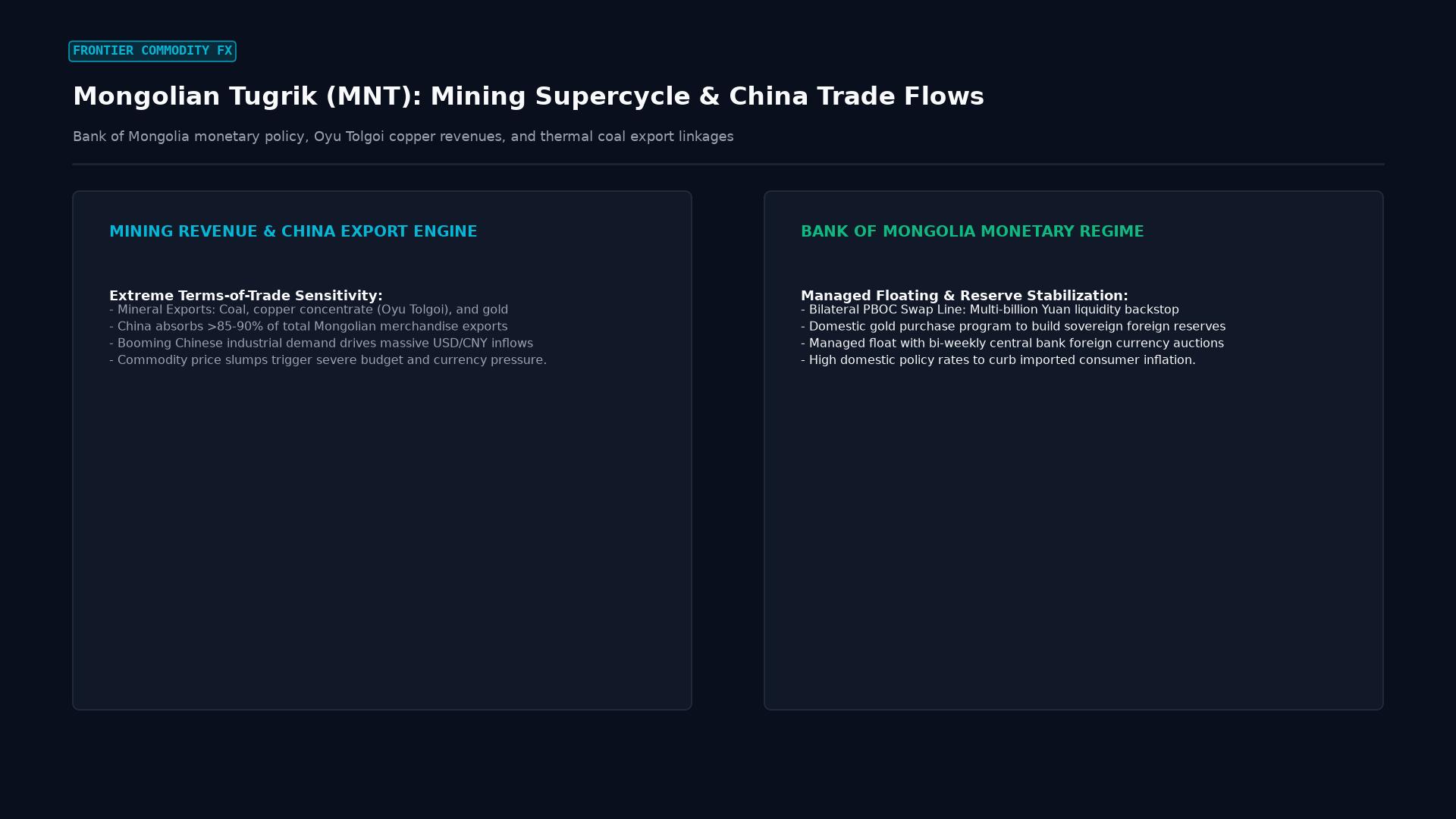 Figure: Bank of Mongolia monetary policy, Oyu Tolgoi copper revenues, and thermal coal export linkages
Historical Evolution and Currency Redenominations
The Soviet Era and the First Tögrög (1925)
Prior to the establishment of the modern central bank, Mongolia operated under a fragmented currency ecosystem dominated by Mexican silver trade dollars, Chinese silver ingots (sycees), Russian imperial rubles, and barter commodities such as sheep, fur pelts, and bricks of compressed tea.
On December 9, 1925, following the establishment of the Mongolian-Russian Trade and Industry Bank (predecessor to Mongolbank), the nation issued the first silver tögrög. The original coin contained 18 grams of pure silver (0.900 fineness), pegged directly to the Soviet silver ruble at parity ($1 \text{ MNT} = 1 \text{ Soviet Ruble}$). Throughout the socialist era (1924–1990), Mongolia maintained a tightly controlled, centrally planned mono-bank financial system. Prices and cross-border exchange transactions were determined by state fiat, insulating the domestic currency from international market forces.
The Democratic Transition and Shock Therapy (1990s)
Following the collapse of the Council for Mutual Economic Assistance (Comecon) and the transition to a market economy in 1990, Mongolbank abandoned fixed socialist price controls. The sudden termination of Soviet budget subsidies (which previously funded approximately one-third of Mongolia’s annual GDP) triggered hyperinflation.
Annual consumer price inflation exceeded 320% in 1992 and 180% in 1993. The official exchange rate of the tögrög plunged from roughly 4 MNT per US Dollar in 1990 to over 400 MNT per USD by 1994, and surpassed 1,000 MNT per USD by the early 2000s. To restore macroeconomic stability, the government enacted comprehensive financial reforms, establishing a two-tiered commercial banking system, floating the exchange rate, and liberalizing cross-border capital accounts.
Macroeconomic Fundamentals and the Commodity Supercycle
The Mongolian Tögrög is an archetype of a frontier commodity currency. Because Mongolia possesses immense mineral wealth alongside a relatively small domestic population and industrial base, the external purchasing power of the MNT is driven by global raw material demand and extractive infrastructure development.
                 MNT MACROECONOMIC VALUE TRANSMISSION CHAIN

  Global Commodity Prices (Copper, Coking Coal, Gold, Iron Ore)
                           |
                           v
  Chinese Heavy Industrial Demand & Steel Manufacturing Output
                           |
                           v
  Mongolian Mining Extraction Volumes (Oyu Tolgoi, Tavan Tolgoi)
                           |
                           v
  Trade Balance Surplus / Deficit & Commercial Bank Hard Currency Deposits
                           |
                           v
  Mongolbank Foreign Exchange Reserves & USD Liquidity Auctions
                           |
                           v
  MNT Exchange Rate Stability vs. Currency Depreciation Pressure
1. Extractive Industry Concentration
Mining accounts for approximately 25% of Mongolia’s Gross Domestic Product, 80% to 90% of total outbound merchandise export earnings, and over 70% of foreign direct investment (FDI) inflows. Key geological assets include:
- Oyu Tolgoi (OT): One of the largest known copper-gold porphyry deposits on earth, operated by Rio Tinto in partnership with state enterprise Erdenes Oyu Tolgoi. The commencement of underground production in 2023 unlocked high-grade ores expected to transform the nation’s balance of payments over a thirty-year operating horizon.
- Tavan Tolgoi (TT): One of the world’s largest unmined metallurgical (coking) coal deposits, located in the South Gobi desert, supplying blast furnaces across northern China.
When global commodity prices surge, massive inflows of US Dollars for project financing and export settlements create strong appreciation pressure on the MNT. Conversely, downswings in Chinese industrial manufacturing rapidly compress mining export receipts, depleting domestic foreign exchange liquidity and triggering sharp tögrög sell-offs.
2. Bilateral Trade Concentration with China
Mongolia shares a 4,677-kilometer land border with the People’s Republic of China, which absorbs over 80% of Mongolia’s merchandise exports and supplies more than 35% of its industrial machinery, consumer goods, and refined fuel products. Consequently, the MNT displays high empirical correlation with the Chinese Yuan (CNY). Bilateral border trade bottlenecks, customs clearances at major border crossings (such as Gashuunsukhait-Ganqimaodu and Zamiin-Uud-Erenhot), and shifts in Chinese infrastructure policy directly dictate daily demand for MNT conversion.
To mitigate foreign exchange strain during commodity downturns, Mongolbank maintains a bilateral local currency swap agreement (BLCSA) with the People’s Bank of China (PBOC) valued at 15 billion RMB (approximately $2.1 billion USD). This facility provides critical backstop liquidity for import financing and reserve management.
Monetary Policy Framework of the Bank of Mongolia
The Managed Floating Exchange Rate Regime
Mongolbank officially classifies the tögrög under an independent managed floating exchange rate regime. In theory, market supply and demand dictate the clearing price of the MNT against the US Dollar and other major currencies. In operational practice, Mongolbank actively intervenes in the domestic foreign exchange market through bi-weekly electronic FX auctions held on the Thomson Reuters / Refinitiv and Bloomberg interbank platforms.
The primary goals of central bank interventions are:
- Smoothing Excess Volatility: Curbing speculative currency runs and preventing disorderly price swings driven by lump-sum export payments or seasonal dividend repatriations.
- Preserving Minimum Foreign Exchange Reserves: Maintaining international reserves above the prudential benchmark of at least three to four months of prospective merchandise imports.
- Controlling Import-Pass-Through Inflation: Because Mongolia imports virtually all of its refined petroleum products (primarily from the Russian Federation via Rosneft), vehicles, pharmaceuticals, and industrial technology, domestic consumer price inflation exhibits an exceptionally high pass-through elasticity to MNT/USD depreciation: $$\Delta \text{CPI}t \approx \alpha + \sum{k=0}^{n} \beta_k \Delta (\text{MNT/USD}){t-k} + \gamma \Delta P{t}^{\text{global commodity}}$$
The Policy Rate and Macroprudential Instruments
Mongolbank utilizes several primary tools to manage domestic liquidity and protect the tögrög:
- The Central Bank Policy Rate: The benchmark interest rate on 7-day Central Bank Bills (CBBs), used to drain or inject commercial bank excess liquidity and adjust the carrying return of holding domestic tögrög deposits versus foreign currency assets.
- Reserve Requirements Ratio (RRR): Mongolbank imposes differentiated reserve requirement ratios on commercial banks, enforcing higher cash reserve mandates on foreign currency liabilities (e.g., USD deposits) compared to domestic MNT liabilities to counter domestic financial dollarization.
- Consumer Debt-to-Income (DTI) and Loan-to-Value (LTV) Caps: Enacted to prevent runaway household credit growth from feeding into speculative foreign goods consumption.
Foreign Exchange Microstructure and Trading Dynamics
Unlike G10 currencies that trade continuously across 24-hour decentralized interbank platforms, the market for the Mongolian Tögrög possesses specific structural characteristics:
+------------------------+--------------------------------------------------+
| Feature                | MNT Market Characteristic                        |
+------------------------+--------------------------------------------------+
| Trading Venue          | Domestic Interbank FX Auction & Bank Desks       |
| Primary Quote Pair     | USD/MNT (Direct quote: Tögrög per 1 US Dollar)  |
| Secondary Pairs        | CNY/MNT, EUR/MNT, RUB/MNT                        |
| Offshore Hedging       | Non-Deliverable Forwards (NDF, limited liquidity)|
| Settlement Convention  | T+2 for standard spot, T+0/T+1 for domestic cash |
| Convertibility         | Article VIII IMF Status (Current Account Free;   |
|                        | Capital Account Subject to Macroprudential Rules)|
+------------------------+--------------------------------------------------+
1. Quotation Mechanics (USD/MNT)
In foreign exchange markets, the tögrög is quoted in direct terms against the US Dollar (USD/MNT). For example, a quote of USD/MNT = 3,450.00 indicates that 3,450 Mongolian tögrög are required to purchase one US Dollar.
- A rise in the exchange rate to
3,550.00reflects tögrög depreciation (or US Dollar strengthening). - A decline in the exchange rate to
3,350.00reflects tögrög appreciation.
2. Onshore vs. Offshore Liquidity
International institutional investors, multilateral lenders, and global mining contractors managing MNT exposure face a segmented liquidity landscape:
- Onshore Market: Dominated by the “Big Five” commercial domestic banks (Khan Bank, Trade and Development Bank of Mongolia, Golomt Bank, XacBank, and State Bank). Liquidity is highest during Ulaanbaatar banking hours (09:00 to 17:00 UTC+8).
- Offshore NDF Market: Due to capital account restrictions and the absence of a global continuous clearing hub for physical tögrög settlement, offshore cross-border hedging is conducted via USD-settled Non-Deliverable Forwards (NDFs). NDF contracts fix a contractual forward exchange rate, with the counterparty paying or receiving the net differential in US Dollars upon maturity against the official Mongolbank reference fix.
Sovereign Debt, External Vulnerabilities, and Sovereign Ratings
Mongolia’s reliance on external financing to fund infrastructure has created an ongoing dynamic between sovereign debt management and MNT stability.
The “Bonds Landscape”
To fund railways connecting southern coal deposits directly to the Chinese border and modernize urban infrastructure, the Government of Mongolia and the Development Bank of Mongolia (DBM) have issued a succession of benchmark US-dollar sovereign Eurobonds:
- Chinggis Bonds (2012): The landmark $1.5 billion inaugural sovereign issuance that introduced Mongolia to international debt capital markets.
- Khuraldai, Mazaalai, Nomad, and Century Bonds: Successive liability management exercises executed to refinance maturing debt tranches, extend average maturity profiles, and lower sovereign yield spreads.
Debt Sustainability and the IMF Safety Net
When global mineral downturns coincide with debt maturities, foreign debt servicing exerts direct downward pressure on the tögrög. In 2017, facing severe fiscal stress and reserve depletion, Mongolia entered into an Extended Fund Facility (EFF) program with the International Monetary Fund (IMF) and partner institutions (including Japan, South Korea, the World Bank, and the Asian Development Bank) totaling $5.5 billion. The program enforced fiscal consolidation, banking sector stress testing, and governance reforms that replenished Mongolbank’s gross foreign reserves and restored market confidence in the MNT.
Best Practices for Trading and Hedging MNT Exposure
- Track High-Frequency Mining Data: Macro investors and corporate treasurers must treat commodity indicators (LME copper prices, Coking Coal futures on the Dalian Commodity Exchange, and weekly coal truck crossings at the Ganqimaodu border checkpoint) as leading indicators for MNT directional momentum.
- Monitor Mongolbank FX Auction Results: Mongolbank regularly publishes auction results disclosing both the total volume of USD demanded by domestic commercial banks and the volume satisfied by the central bank. Persistent unfulfilled USD demand signals brewing domestic liquidity shortages and impending tögrög pressure.
- Factor in Sovereign Bond Refinancing Windows: Large sovereign bond amortizations can require the central bank and state-owned enterprises to accumulate dollars, temporarily withdrawing FX liquidity from the domestic interbank market.
- Account for High Domestic Interest Rate Differentials: Because Mongolian inflation and nominal central bank policy rates are historically higher than those of the Federal Reserve or the European Central Bank, shorting USD/MNT onshore yields substantial positive interest rate carry, but exposes the trader to sudden tail-risk devaluations during global risk-off commodity shocks.
Frequently Asked Questions (FAQ)
What is the official currency symbol and ISO code for the Mongolian Tögrög?
The ISO 4217 three-letter currency code is MNT (numeric code 496). The graphical currency symbol is ₮, written as a capital letter T crossed by two diagonal slanting parallel bars. In domestic Mongolian Cyrillic, the currency is written as төгрөг and abbreviated as төг.
Why is the value of the Mongolian Tögrög closely linked to the Chinese economy?
Over 80% of Mongolia’s total merchandise exports consist of minerals and raw materials (coking coal, copper concentrate, iron ore, and crude oil) sold directly to Chinese industrial manufacturers. When Chinese economic activity expands and blast furnace utilization rates rise, demand for Mongolian raw materials increases, generating substantial hard-currency inflows that support the MNT. Conversely, a slowdown in Chinese manufacturing or real estate construction diminishes coal and copper demand, directly deteriorating Mongolia’s current account balance and weakening the tögrög.
How does Mongolbank intervene to stabilize the MNT exchange rate?
Mongolbank operates a managed floating regime and intervenes primarily through bi-weekly electronic foreign exchange auctions conducted with licensed domestic commercial banks. During periods of currency weakness, the central bank sells US Dollars from its official foreign exchange reserves to absorb excess tögrög liquidity and satisfy commercial import demand. The central bank also utilizes monetary policy rate adjustments, macroprudential reserve requirements on foreign currency deposits, and bilateral currency swap agreements (such as its facility with the People’s Bank of China) to maintain systemic liquidity.
Ready to trade forex?
Open a free demo account with a regulated broker. Practice with virtual funds before risking real money.