Money Manager
A money manager is an institutional professional or registered entity authorized to direct, allocate, and execute investment or trading strategies on behalf of clients, bound by fiduciary duty and compensated via management and performance fees.
What Is a Money Manager?
A money manager (often referred to as an investment manager, portfolio manager, or asset manager) is an individual, investment firm, or registered corporate entity entrusted with the legal and operational authority to manage a portfolio of securities, derivatives, or currencies on behalf of individual, high-net-worth, or institutional clients.
Operating under a discretionary management agreement or formal Limited Power of Attorney (LPOA), a money manager conducts market analysis, formulates risk-adjusted asset allocation models, and executes trades according to a mutually agreed Investment Policy Statement (IPS). Unlike standard retail brokers—who merely provide execution infrastructure and market access—a money manager assumes active fiduciary responsibility for safeguarding and growing client wealth.
In the foreign exchange (Forex) and alternative investment industries, professional money managers operate primarily as Commodity Trading Advisors (CTAs), global macro hedge funds, private wealth offices, or retail account managers utilizing PAMM (Percent Allocation Management Module) and MAM (Multi-Account Manager) technological software.
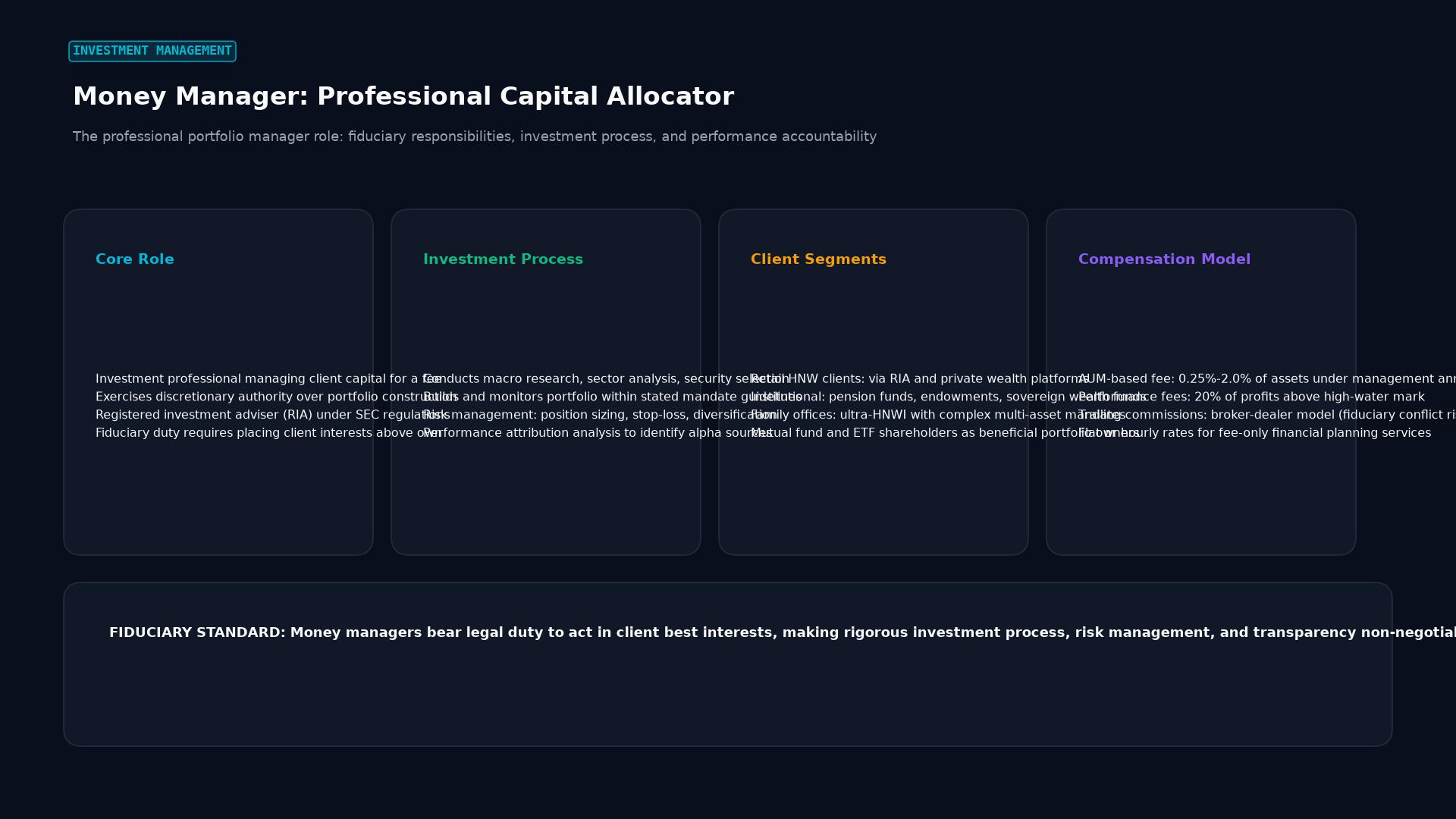 Figure: The professional portfolio manager role: fiduciary responsibilities, investment process, and performance accountability
Key Takeaways
- Fiduciary Responsibility: Licensed money managers are legally bound by fiduciary duty, requiring them to place their clients’ financial interests above their own and eliminate hidden conflicts of interest.
- The “2 and 20” Fee Architecture: Institutional managers traditionally charge an annual Management Fee (e.g., 1% to 2% of Assets Under Management [AUM]) plus an incentive-driven Performance Fee (e.g., 10% to 20% of net profits).
- The High-Water Mark (HWM): A standard contractual investor protection clause stipulating that a money manager cannot collect performance incentive fees until historical portfolio peak equity is fully recovered after a drawdown.
- PAMM / MAM Technology: In retail forex, brokers utilize Percent Allocation Management Modules (PAMM) and Multi-Account Managers (MAM) to enable a single manager to execute trades across hundreds of segregated sub-accounts simultaneously.
- Regulatory Oversight: Legitimate money managers must hold official regulatory licenses—such as Registered Investment Advisor (RIA) or CTA status with the CFTC/NFA in the U.S., or SMCR authorization with the FCA in the UK.
Comparative Taxonomy: Financial Professionals
| Role | Fiduciary Duty? | Discretionary Execution? | Primary Revenue Model | Core Objective |
|---|---|---|---|---|
| Money Manager | Yes (Strict) | Yes (Direct trading) | AUM fee + Performance fee | Maximize risk-adjusted net portfolio return |
| Financial Advisor | Yes / Suitability | No (Advisory recommendations) | Flat fee, hourly, or % AUM | Holistic financial planning, tax, retirement |
| Forex Broker | No (Counterparty) | No (Client clicks orders) | Bid-ask spreads & commissions | Provide execution connectivity & leverage |
| Proprietary Trader | No (Trades firm funds) | Yes (Proprietary capital) | % Split of proprietary P&L | Extract market alpha for firm balance sheet |
The Mathematics of the High-Water Mark and Hurdle Rate
To prevent managers from being rewarded for recovering from volatile drawdowns, professional institutional contracts incorporate a High-Water Mark (HWM) and an optional Hurdle Rate:
$$\text{Eligible Performance Profit} = \max\left( \text{Ending Equity} - \max(\text{Historical Peak Equity}, ; \text{Hurdle Baseline}), ; 0 \right)$$
$$\text{Performance Fee Payable} = \text{Eligible Profit} \times \text{Incentive Fee Rate (% prob)}$$
Numerical Example:
A client invests $1,000,000 with a foreign exchange CTA charging a 20% performance fee with a strict High-Water Mark:
- Year 1: Portfolio gains 20%, rising to $1,200,000.
- Net Profit = $$200,000$.
- Performance Fee (20%) = $40,000.
- New High-Water Mark established: $1,160,000 (Net of fee).
- Year 2: A macro trend reversal triggers a drawdown; portfolio equity drops to $950,000.
- Performance Fee = $0.00. (Manager collects only standard management fee).
- Year 3: Strategy rebounds strongly, rising to $1,250,000.
- Total Gross Gain in Year 3 = $$300,000$.
- However, the manager is only compensated on profits above the $1,160,000 High-Water Mark:
- Eligible Profit = $$1,250,000 - $1,160,000 = $90,000$.
- Performance Fee Payable = $$90,000 \times 20% = \mathbf{$18,000}$.
- The client is protected from paying fees on the $210,000 recovery portion.
Real-World Case Study: The Institutional CTA Trend-Following Mandate
Commodity Trading Advisors (CTAs) managing global macro and foreign exchange portfolios are among the largest institutional money managers in the world.
- The Mandate: An institutional pension fund allocates $50,000,000 to a registered currency money manager specializing in systematic medium-term trend following across G10 and emerging market pairs.
- Execution via Custodian: The pension fund does not wire capital directly to the money manager; the funds remain held at an independent custodian bank (State Street). The manager receives algorithmic trading access via FIX API under a limited power of attorney.
- Execution during Crisis: During the 2022 global dollar surge, the manager’s models captured multi-month trends across Long USD/JPY and Short EUR/USD, generating a net return of +18.4% while global equity and bond markets crashed by 15% to 20%.
- Outcome: The money manager delivered true non-correlated portfolio diversification, proving the institutional value of professional alternative asset management.
Strategic Risks and Investor Pitfalls
- The Asymmetric Incentive Hazard: Performance fees can create moral hazard. Because managers share in upside profits but do not reimburse investors for realized principal losses, unethical managers may take excessive, reckless leverage to generate short-term gains.
- Unregulated Offshore PAMM Scams: In the retail forex space, fraudulent actors frequently establish offshore PAMM accounts, using fake historical screenshots or dangerous martingale/grid algorithms that inevitably blow up investor capital.
- Style Drift: A money manager hired for disciplined, low-volatility carry-trade strategies who suddenly pivots into aggressive intraday crypto scalping represents dangerous operational style drift.
Frequently Asked Questions (FAQ)
Can a money manager withdraw client funds?
No. Under a legitimate Limited Power of Attorney (LPOA) or PAMM structure, the money manager is granted trading authorization only. All depositing, withdrawing, and banking functions remain under the exclusive control of the client.
What is the difference between a PAMM and a MAM account?
In a PAMM (Percent Allocation Management Module) account, all investor funds are pooled into a single master account, and trades are allocated proportionally based on each investor’s percentage of total equity. In a MAM (Multi-Account Manager) account, the manager can customize allocation rules on an individual sub-account basis (e.g., allocating higher risk to specific aggressive accounts).
How do I verify if a forex money manager is legitimate?
Always check their registration credentials with statutory financial regulators. In the United States, verify their NFA ID on the NFA BASIC database; in the UK, search the FCA Financial Services Register; and ensure that client funds are held in segregated accounts at regulated Tier-1 banks.
Ready to trade forex?
Open a free demo account with a regulated broker. Practice with virtual funds before risking real money.