Most Favored Nation
Most-Favored-Nation (MFN) status is a foundational principle of international trade law requiring a sovereign nation to extend any trade concession, privilege, or tariff reduction granted to one country equally and unconditionally to all other trading partners.
What Is Most-Favored-Nation (MFN) Status?
Most-Favored-Nation (MFN) status is the cornerstone legal principle of modern international economic diplomacy and global trade architecture. Codified in Article I of the General Agreement on Tariffs and Trade (GATT 1994) under the World Trade Organization (WTO), MFN mandates that member states must treat all trading partners equally: if a nation grants a trade benefit—such as lowering an import tariff, reducing a quota, or easing customs clearance procedures—to any single country, it must immediately and unconditionally extend that identical benefit to all other WTO member nations.
Despite its somewhat misleading name, MFN status does not grant a country special or exclusive privileges above others; rather, it guarantees non-discrimination. It ensures that no single country is treated worse than the most favored trading partner.
In the United States, MFN status was formally renamed Permanent Normal Trade Relations (PNTR) in 1998 to eliminate domestic political misconceptions regarding the term. In global foreign exchange and macroeconomics, the granting, threatening, or revoking of MFN status represents a potent geopolitical catalyst that can dramatically alter bilateral trade balances, corporate supply chains, and sovereign currency valuations.
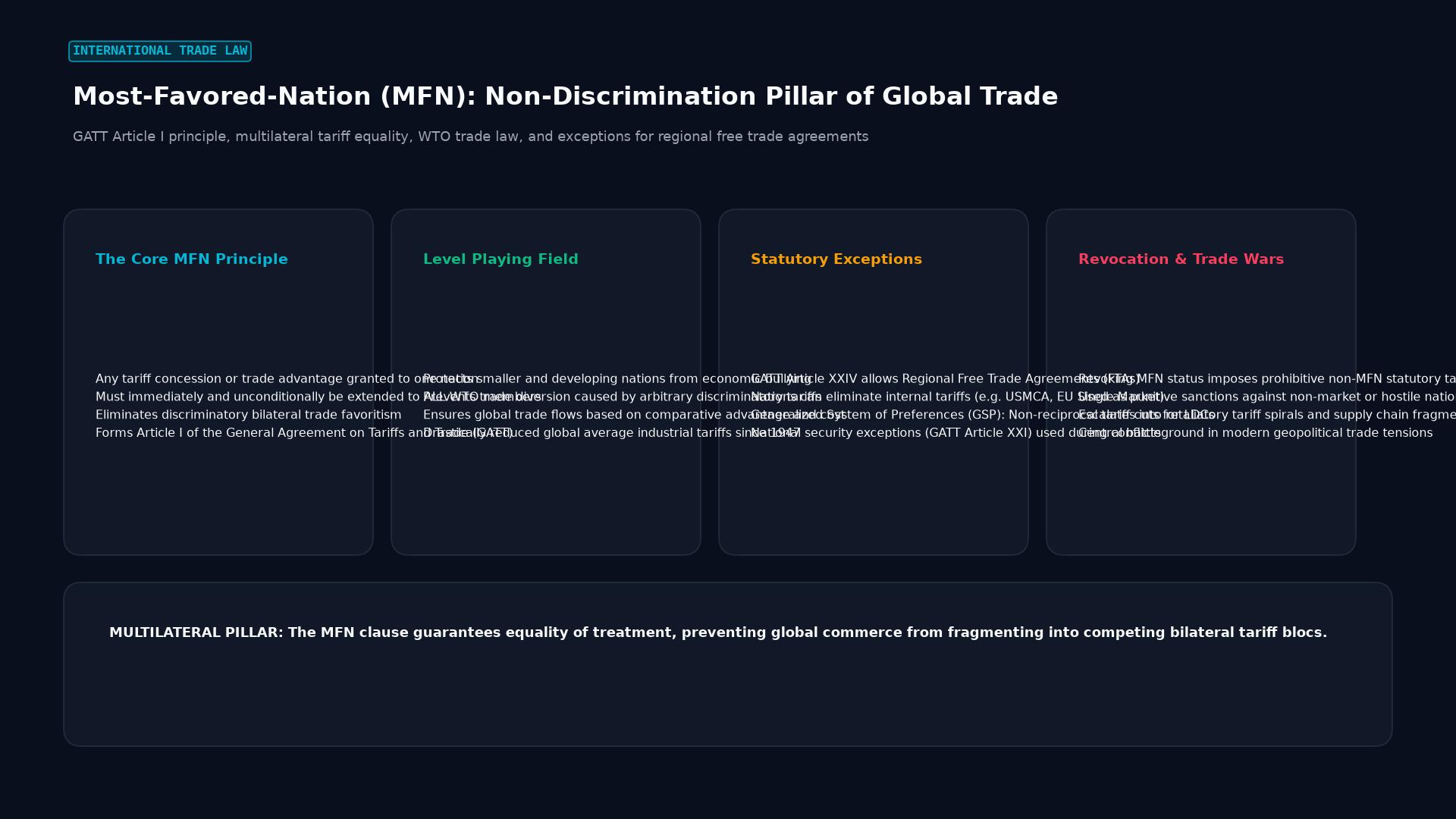 Figure: GATT Article I principle, multilateral tariff equality, WTO trade law, and exceptions for regional free trade agreements
Key Takeaways
- The Pillar of the WTO: MFN non-discrimination is the fundamental rule governing the 164 member economies of the World Trade Organization, ensuring a level playing field in global commerce.
- The Core GATT Exceptions: The WTO permits two major legal exceptions to MFN: Free Trade Agreements / Customs Unions (GATT Article XXIV, such as the USMCA or EU) and preferential market access for developing nations (Generalized System of Preferences [GSP]).
- Tariff Equalization: Guarantees that exporters from different countries face the identical baseline import tariff schedule when shipping goods into a destination market.
- Foreign Exchange Transmission: Revoking MFN status immediately subjects a targeted nation to punitive, high-tier statutory tariffs, devastating export revenues, draining foreign exchange reserves, and triggering severe currency devaluation.
- From Trade to Geopolitics: MFN status is increasingly utilized as a powerful geoeconomic sanction tool in response to international conflicts and trade disputes.
Comparative Taxonomy: International Trade Regimes
| Trade Classification | Legal Basis | Tariff Treatment | Scope | Real-World Example |
|---|---|---|---|---|
| Most-Favored-Nation (MFN / PNTR) | GATT Article I | Standard baseline non-discriminatory tariffs | All WTO members | Standard trade between US, Japan, EU, UK |
| Free Trade Agreement (FTA) | GATT Article XXIV | 0% or near-zero preferential tariffs | Signatory members only | USMCA (US/Mexico/Canada), CPTPP |
| Customs Union | GATT Article XXIV | Zero internal tariffs + Common external tariff | Member states | European Union (EU) Single Market |
| Generalized System of Preferences | WTO Enabling Clause | Unilateral tariff reductions for poor economies | Developing / LDCs | EU “Everything But Arms” for Africa |
| Non-MFN / Sanctioned Status | National Decree / Security | Punitive, extreme statutory tariffs (Smoot-Hawley tier) | Specific targeted nations | North Korea, Cuba, Russia, Belarus |
Real-World Case Study: China’s 2001 WTO Accession and PNTR
The economic history of the 21st century was profoundly reshaped by the granting of MFN / PNTR status to the People’s Republic of China:
- The Annual Uncertainty (1980–2000): Prior to 2000, China held only temporary MFN status with the United States, requiring a contentious, highly politicized annual vote by the U.S. Congress to renew. U.S. multinationals were hesitant to build multi-billion-dollar supply chains in China due to the constant threat that MFN status would be revoked.
- The PNTR Accord: In October 2000, President Bill Clinton signed the U.S.-China Relations Act, granting China Permanent Normal Trade Relations (PNTR), paving the way for China’s official entry into the WTO in December 2001.
- The Economic Explosion: Guaranteeing low, permanent MFN tariffs on Chinese manufactured exports sparked a colossal flood of foreign direct investment (FDI). Over the subsequent two decades:
- China’s share of global merchandise exports surged from 4% to over 15%.
- China accumulated over $3.2 trillion in foreign exchange reserves (mostly in U.S. Treasuries), becoming the world’s manufacturing powerhouse.
- The global foreign exchange market was transformed as the Chinese Renminbi emerged as an international economic force.
The Consequences of Revoking MFN Status: The 2022 Russian Precedent
Following the escalation of conflict in Ukraine in early 2022, the United States, the European Union, Canada, Japan, and the G7 took the historic step of formally revoking Russia’s Most-Favored-Nation status:
- The Tariff Shock: Without MFN protection, Russian export commodities were immediately subjected to high statutory tariffs (often jumping from 3% to 35%–50% overnight).
- Supply Chain Dislocation: Major Western corporations immediately severed Russian commercial contracts to avoid punitive duties, shifting procurement to alternate emerging markets.
- Currency Turmoil: The combination of MFN revocation, trade embargoes, and central bank reserve freezes caused the Russian Ruble (RUB) to experience historic volatility, initially collapsing past 135 RUB/USD before extreme domestic capital controls were imposed.
Strategic Risks for Global Currency Markets
- The Threat of Tariff Escalation: When a superpower threatens to strip a trading partner of MFN status, the immediate threat of trade collapse triggers aggressive capital flight, putting immediate speculative downward pressure on the targeted nation’s currency.
- Retaliatory Cycles: Stripping MFN status rarely occurs in isolation; it inevitably triggers tit-for-tat retaliatory export bans, critical mineral restrictions, and reciprocal tariffs that disrupt global economic growth and fuel worldwide inflation.
Frequently Asked Questions (FAQ)
Does MFN mean a country gets the best trade terms in the world?
No. Despite the word “favored,” MFN does not mean preferential or superior treatment. It is a baseline guarantee of equal, non-discriminatory treatment among all WTO member states. A country with an active Free Trade Agreement (FTA) typically receives far better terms (often 0% tariffs) than standard MFN terms.
Who can revoke MFN status?
MFN status is granted through international treaties and domestic legislation. In the United States, only the U.S. Congress has the constitutional authority to revoke Permanent Normal Trade Relations (PNTR) with a foreign nation, typically via formal legislative action signed by the President.
How does MFN affect forex traders?
Geopolitical debates surrounding MFN renewals or revocations generate substantial volatility in currency pairs. An unexpected revocation can devastate an export economy’s current account balance, weakening its domestic currency against reserve currencies like the USD and EUR.
Ready to trade forex?
Open a free demo account with a regulated broker. Practice with virtual funds before risking real money.