Balance of Trade
The balance of trade (trade balance) is the difference between a country's total value of exports and its total value of imports over a specific period. A positive balance (trade surplus) means the country exports more than it imports. A negative balance (trade deficit) means it imports more than it exports. It is the largest component of the current account and a key indicator in forex fundamental analysis.
Trade Balance and Its Currency Impact
Every time a company in Japan exports a car to the United States, the American buyer pays in dollars, but the Japanese manufacturer needs yen to pay Japanese workers and suppliers. Those dollars must be converted to yen — creating demand for yen and supply of dollars. Scale this to an entire country’s exports, and you understand why trade surpluses create structural demand for the exporting nation’s currency.
The reverse: a country that imports far more than it exports (a persistent trade deficit) is continuously supplying its own currency to buy foreign currencies for those imports — creating structural selling pressure on the domestic currency.
This is the fundamental mechanism linking trade balance to forex markets. The connection is real but operates over months and years, not days and hours.
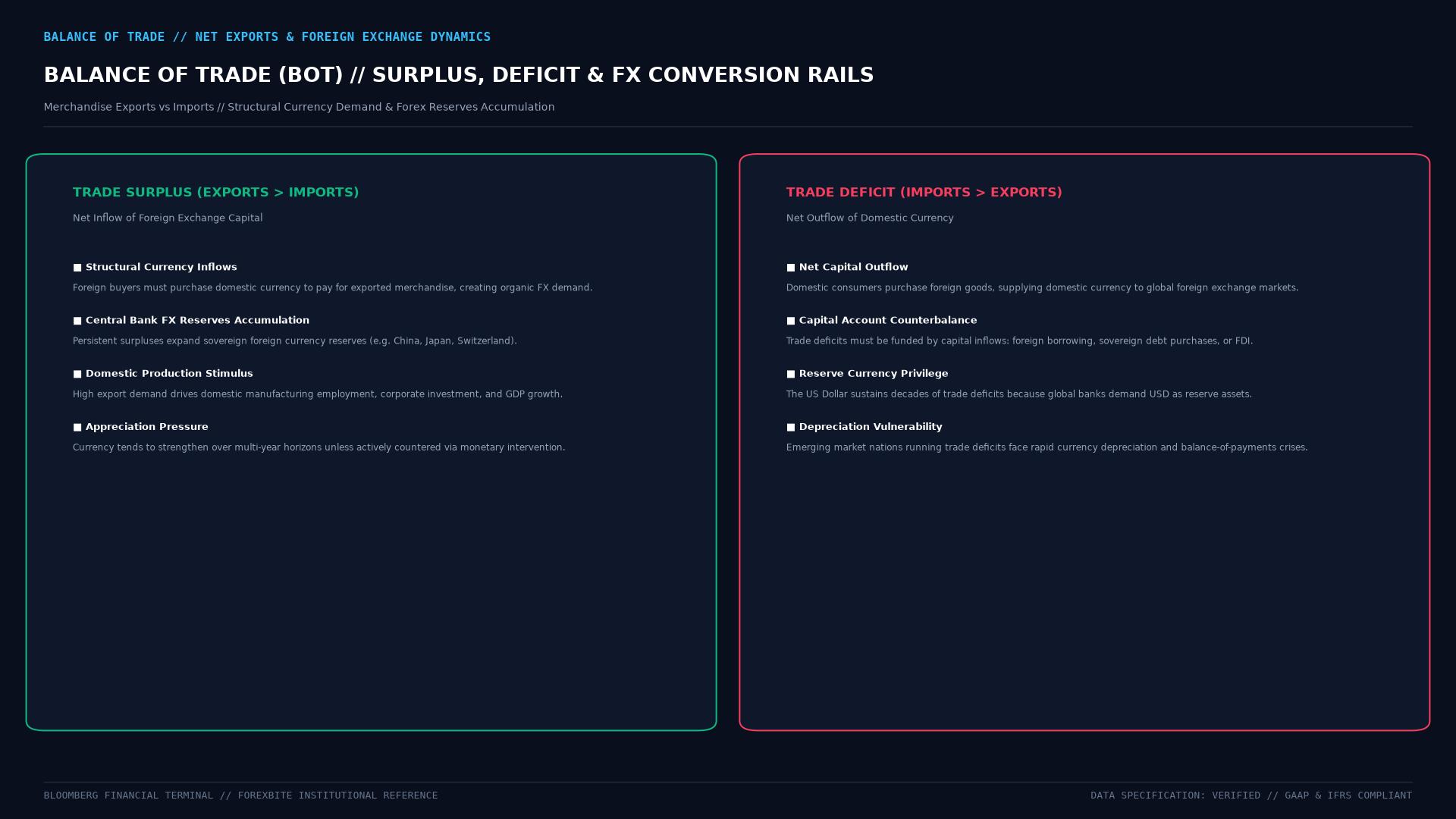 Figure: Balance of trade dynamics ($Exports - Imports$), depicting trade surpluses vs deficits, macroeconomic driver variables, and the structural transmission mechanism to foreign exchange supply-demand balance.
What the Trade Balance Report Includes
Goods trade (merchandise trade):
- Manufactured goods (automobiles, electronics, machinery)
- Commodities (oil, agricultural products, metals)
- Consumer products (clothing, food)
Services trade: Increasingly significant for developed economies. Financial services, tourism, software licensing, education, healthcare. The UK’s goods deficit is partially offset by its services surplus. The US runs a goods deficit but a services surplus.
Most monthly trade balance reports focus primarily on goods trade — services data is typically available with longer lags. When media reports say “the trade deficit narrowed this month,” they’re almost always referring to the goods trade balance.
The US-China Trade Dynamic: A Case Study
The US runs a persistent and large trade deficit with China (approximately $279 billion in goods in 2023, per US Census Bureau data). This deficit has been a fixture of US economic discussion for decades.
From a pure forex perspective, the deficit means the US continuously sends dollars to China in exchange for goods. China’s central bank (PBOC) manages yuan appreciation by reinvesting those dollars into US Treasury bonds rather than converting them all to yuan — which explains how China has accumulated over $3 trillion in US Treasury holdings. This artificial recycling of trade deficit dollars back into US assets prevents the dollar from weakening as much as a naive interpretation of the trade deficit would suggest.
Reading Trade Balance Data for Forex
The key question when trade data releases is: did the actual number beat or miss consensus expectations?
Better-than-expected trade surplus (or smaller-than-expected deficit): Suggests stronger export demand and/or weaker import demand. Generally bullish for the currency.
Worse-than-expected trade deficit (or smaller-than-expected surplus): Suggests weakening exports or strong import growth. Mildly bearish for the currency.
However, trade balance is a second-tier indicator compared to NFP, CPI, or central bank decisions. It rarely causes dramatic single-day moves in major pairs. Its significance is more as a:
- Contributing factor to the broader current account picture
- Long-run structural force on currency valuation
- Input into GDP calculations (net exports is a GDP component)
Trade Balance by Country: Who to Watch
Germany: The Eurozone’s dominant exporter. Germany’s trade surplus is the largest in the world by some measures — persistently a force in EUR strength.
Japan: Another major exporter. Japan’s trade balance is heavily influenced by energy imports (Japan has little domestic energy) and global demand for electronics and automobiles. When oil prices surge, Japan’s trade balance deteriorates — historically a yen-negative factor.
Australia: Commodity exports (iron ore, coal, gold, agricultural products) dominate. A strong trade surplus typically accompanies high commodity prices and supports AUD.
US: Structural goods trade deficit, partially offset by services surplus. The headline goods trade deficit is reported monthly and watched as a secondary indicator.
Key Takeaways
- Trade surplus (exports > imports) creates structural demand for the domestic currency; trade deficit creates supply pressure
- Goods trade data is available monthly; services trade with longer lags
- Trade balance is a second-tier indicator — rarely a major market mover in isolation
- Country-specific factors matter: energy import dependency (Japan), commodity export concentration (Australia), services offset (US, UK)
- The connection between trade balance and currency operates over months to years, not days
FAQ
If the US has a persistent trade deficit, why is the dollar so strong? Several factors offset the currency-weakening effect of the trade deficit: (1) the dollar is the global reserve currency, creating ongoing foreign demand for dollar assets; (2) the US financial account shows massive capital inflows (foreign investment into US stocks, bonds, real estate); (3) US technology companies generate enormous service export earnings. The trade deficit is just one component of the broader balance of payments.
Does a trade surplus always strengthen a currency? Generally yes over the long run, but the effect can be muted or offset. Japan’s trade surplus was often overwhelmed by carry trade unwinding and risk-off flows. China’s large surplus is partially sterilized by PBOC recycling. The trade balance is a factor, not the sole determinant.
Ready to trade forex?
Open a free demo account with a regulated broker. Practice with virtual funds before risking real money.