MTL
MTL is the historical ISO 4217 currency code for the Maltese Lira (currency symbol: Lm or ₤M), the official legal tender of the Republic of Malta from 1972 until January 1, 2008, when Malta adopted the Euro at the fixed conversion rate of 1 EUR = 0.429300 MTL.
The MTL (Maltese Lira, symbol Lm, Maltese: Lira Maltija) was the sovereign national currency of Malta from 1972 until its formal replacement by the Euro (EUR) on January 1, 2008. Administered by the Central Bank of Malta (Bank Ċentrali ta’ Malta), the lira was internationally renowned for its exceptionally high nominal unit value, consistently ranking as the second-most valuable currency unit in the world behind only the Kuwaiti Dinar (KWD).
The lira was formally subdivided into 100 cents, with each cent originally divided into 10 mils until the mil was formally demonetized in 1994. Across its thirty-five-year existence, the Maltese Lira served as a bedrock of macroeconomic stability for the archipelago, managed via a sophisticated trade-weighted currency basket peg before entering the European Union’s Exchange Rate Mechanism II (ERM II) and completing final Eurozone integration.
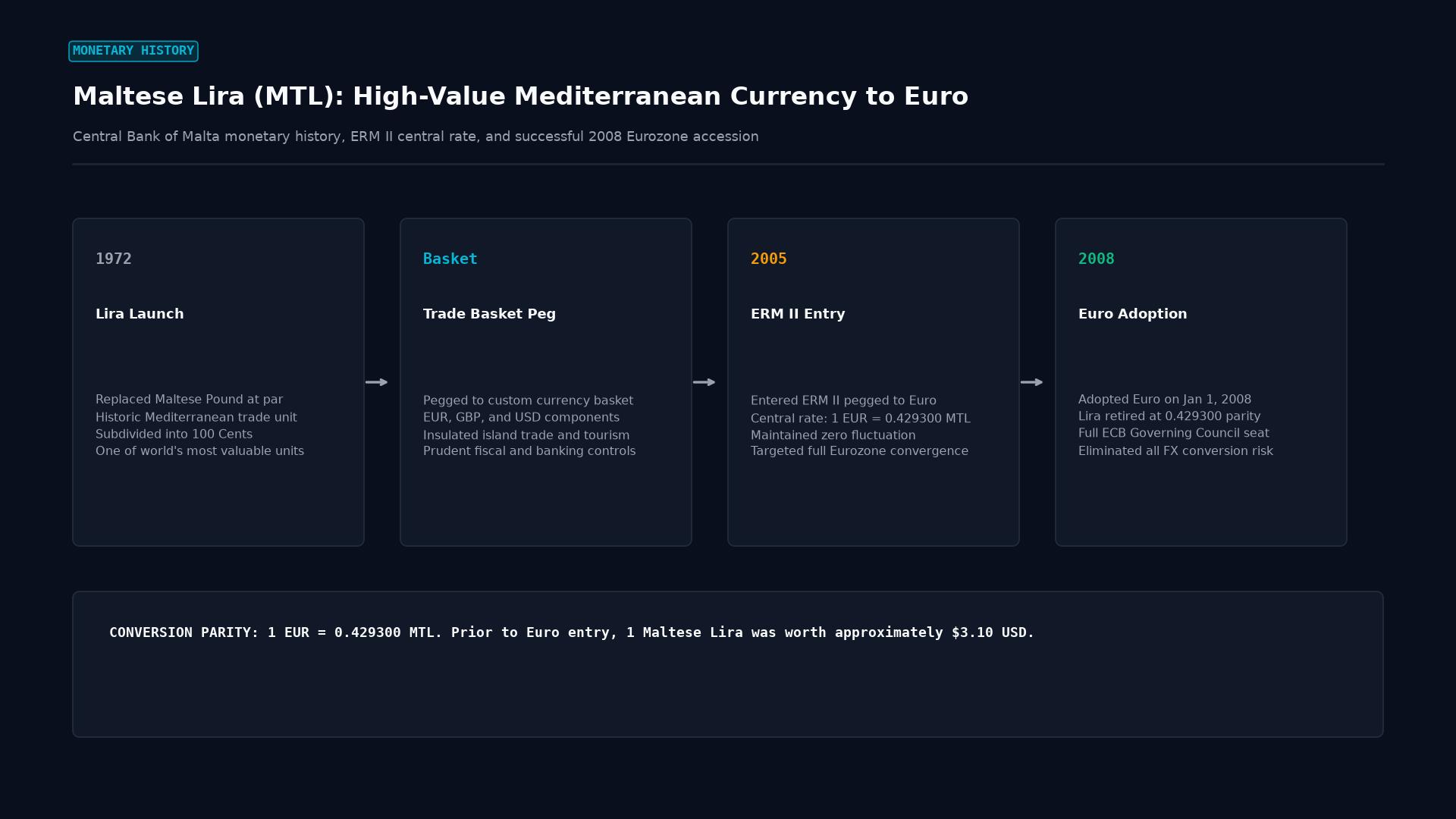 Figure: Central Bank of Malta monetary history, ERM II central rate, and successful 2008 Eurozone accession
Historical Origins and Currency Evolution
The Colonial Era and the Maltese Pound
Following the Treaty of Paris in 1814, Malta became a British Crown Colony and a vital naval garrison in the central Mediterranean. British silver and gold coinage circulated alongside local and Sicilian coins. In 1855, the British sovereign was declared the sole legal tender, and the Maltese Pound was established at parity ($1:1$) with the British Pound Sterling (GBP).
During this era, paper currency issuance was handled directly by the colonial government and private commercial institutions (such as the Anglo-Maltese Bank and the Banco di Malta). Even after Malta gained political independence in 1964, the currency remained pegged one-to-one with the British Pound.
Birth of the Modern Lira (1972)
In 1968, the newly established Central Bank of Malta assumed statutory monopoly over banknote issuance. On May 16, 1972, Malta officially decimalized its currency, replacing the colonial pounds, shillings, and pence system with a decimalized Maltese Pound (divided into 100 cents and 1,000 mils).
Simultaneously, the Maltese government enacted a decisive policy shift:
- Delinking from Sterling: Breaking the historic 1:1 parity with the British Pound to shield the domestic economy from the UK’s balance of payments crises and Sterling devaluations.
- Adoption of the Name “Lira”: In 1983, the currency was officially renamed the Lira Maltija (Maltese Lira), adopting the symbol Lm, ending dual-language references to the “pound” on domestic banknotes.
                    MALTESE MONETARY EVOLUTION TIMELINE

  1855 - 1972             1972 - 2005             2005 - 2007        2008+
  +-------------+         +-------------+         +-------------+    +-------------+
  | Maltese     | ======> | Maltese Lira| ======> | ERM II Peg  | => | Euro (EUR)  |
  | Pound (GBP) |         | (Basket Peg)|         | (Central    |    | (Full Member|
  | 1:1 Parity  |         | High Value  |         |  Parity)    |    |  Eurosystem)|
  +-------------+         +-------------+         +-------------+    +-------------+
The Currency Basket Peg Architecture
Because Malta is a small, open island economy that imports nearly 100% of its food, fuels, and industrial machinery, domestic consumer price inflation is exceptionally sensitive to exchange rate fluctuations. To anchor domestic inflation expectations, the Central Bank of Malta managed the lira through a trade-weighted currency basket peg from 1972 until 2005.
1. Composition and Weighting Formulas
The basket weights were periodically revised to reflect shifts in Malta’s foreign trade flows and tourism receipts. The basket was composed primarily of the Euro (and previously its constituent currencies like the Deutsche Mark, French Franc, and Italian Lira), the British Pound (GBP), and the US Dollar (USD).
$$\text{Value of 1 MTL} = w_{\text{EUR}} \cdot P_{\text{EUR}} + w_{\text{GBP}} \cdot P_{\text{GBP}} + w_{\text{USD}} \cdot P_{\text{USD}}$$
+------------------+-----------------------------+-----------------------------+
| Era / Revision   | Primary Currencies in Basket| Economic Rationale          |
+------------------+-----------------------------+-----------------------------+
| 1970s - 1980s    | GBP, DEM, USD, FRF, ITL     | Balanced British tourism and|
|                  |                             | Continental trade           |
+------------------+-----------------------------+-----------------------------+
| 1990s            | ECU/EUR (~60%), GBP (~25%), | Expanding European Single   |
|                  | USD (~15%)                  | Market integration          |
+------------------+-----------------------------+-----------------------------+
| 2002 - 2005      | EUR (70%), GBP (20%),       | Final preparation for EU    |
| (Pre-ERM II)     | USD (10%)                   | accession and ERM II        |
+------------------+-----------------------------+-----------------------------+
2. High Nominal Valuation Mechanics
A distinctive feature of the Maltese Lira was its high nominal value. At the time of its euro adoption in 2008, 1 MTL was worth approximately $3.10 USD and 2.33 EUR.
This high valuation was not a sign of speculative overvaluation, but rather an artifact of historical decimalization arithmetic:
- When Malta decimalized in 1972, it preserved the British Pound’s high base value ($1 \text{ MTL} = 1 \text{ GBP}$).
- Over the subsequent thirty years, the Central Bank of Malta maintained tight monetary policy, fiscal conservatism, and steady balance of payments surpluses from tourism and maritime ship repair, preventing the secular currency debasement experienced by southern European neighbors.
The Eurozone Convergence Pathway
Malta formally joined the European Union on May 1, 2004. As an EU member state without an opt-out clause, Malta was legally committed to adopting the single European currency upon fulfilling the Maastricht Convergence Criteria.
                   MALTA'S MAASTRICHT CONVERGENCE SCORECARD

  Convergence Pillar            Maastricht Ceiling        Malta Performance (2007)
  ------------------            ------------------        ------------------------
  1. Price Stability (CPI)      ≤ 2.8% (Reference)        2.2% (Passed)
  2. Fiscal Deficit / GDP       ≤ 3.0%                    2.6% (Passed)
  3. Sovereign Debt / GDP       ≤ 60.0% (or declining)    63.7% (Declining, Passed)
  4. Long-Term Interest Rates   ≤ 6.4%                    4.3% (Passed)
  5. ERM II Exchange Stability  Min 2 years without strain 0% deviation (Passed)
1. ERM II Participation (2005–2007)
On May 2, 2005, the Maltese Lira was formally integrated into the EU’s Exchange Rate Mechanism II (ERM II) at the central parity rate of: $$1 \text{ EUR} = 0.429300 \text{ MTL}$$
Although ERM II rules allow a standard fluctuation margin of $\pm 15%$, the Maltese authorities announced a unilateral commitment to zero fluctuation:
- The Central Bank of Malta locked its domestic policy rates directly to the European Central Bank’s refinancing rate.
- The Central Bank intervened in the foreign exchange market whenever private flows diverged from the central parity, maintaining an ironclad peg for over thirty consecutive months without experiencing speculative attacks.
2. Final Adoption and Cash Changeover (2008)
On July 10, 2007, the EU Council of Finance Ministers (ECOFIN) approved Malta’s Eurozone entry, confirming the irrevocable conversion rate: $$1.00 \text{ EUR} = 0.429300 \text{ MTL}$$ $$\text{Reciprocal Rate: } 1.00 \text{ MTL} \approx 2.32937 \text{ EUR}$$
- January 1, 2008: The Euro became legal tender, and the Maltese Lira entered the dual-circulation phase.
- January 31, 2008: Dual circulation ended; the Euro became the exclusive cash legal tender across Malta and Gozo.
- Redemption Horizon: Maltese commercial banks exchanged coins for free until 2010, while the Central Bank of Malta continued redeeming fourth- and fifth-series Maltese Lira banknotes until January 31, 2018, at which point all remaining unredeemed lira balances expired and were transferred to the government treasury.
Macroeconomic Transformation Post-Euro Adoption
The transition from the Maltese Lira to the Euro eliminated foreign exchange conversion costs and currency risk, accelerating the structural transformation of the Maltese economy:
+------------------------+--------------------------------------------------+
| Economic Engine        | Impact of Euro Adoption                          |
+------------------------+--------------------------------------------------+
| iGaming & Technology   | Malta established itself as Europe's leading     |
|                        | remote gaming hub (MGA licensing), benefiting    |
|                        | from frictionless multi-currency euro clearing.  |
+------------------------+--------------------------------------------------+
| International Banking  | Expansion of international commercial banks and  |
| & Fund Administration  | UCITS fund managers under MFSA oversight.        |
+------------------------+--------------------------------------------------+
| Maritime & Freeport    | Expansion of Marsaxlokk Freeport as a transship- |
|                        | ment container hub, denominated in hard euros.   |
+------------------------+--------------------------------------------------+
| Tourism & Hospitality  | Boost in UK and EU visitors, completely removing |
|                        | tourist exchange rate spreads across the EU.     |
+------------------------+--------------------------------------------------+
Historical Trading and Legacy Financial Analysis
For macroeconomic historians, quantitative currency analysts, and legal researchers handling legacy contracts, several principles apply:
- Fixed Conversion Invariance: Under Council Regulation (EC) No 1131/2007, all historical contracts, legal obligations, and sovereign debt instruments denominated in Maltese Liri must be converted using the official six-significant-figure conversion factor: $$\text{EUR Amount} = \frac{\text{MTL Amount}}{0.429300}$$ Rounding to the nearest cent must follow standard Eurosystem rules (if the third decimal is 5 or higher, round up; otherwise, round down).
- Absence of Monetary Autonomy: The elimination of the Maltese Lira transferred sovereign monetary policy from Floriana (Central Bank of Malta) to Frankfurt (ECB Governing Council). The Governor of the Central Bank of Malta holds a permanent seat and voting rights on the ECB Governing Council.
- Sovereign Rating Trajectory: Post-euro adoption, Malta’s sovereign credit ratings (rated by S&P, Moody’s, and Fitch) reflected institutional integration into the Eurozone, allowing the Maltese Treasury to issue benchmark government bonds (Malta Government Stocks, MGS) at low sovereign yield spreads over German Bunds.
Frequently Asked Questions (FAQ)
What was the final conversion rate between the Maltese Lira and the Euro?
The irrevocable official conversion rate established by the European Union Council on July 10, 2007, was 1 EUR = 0.429300 MTL. To convert Maltese Liri into Euros, divide the amount by 0.429300 (or multiply by approximately 2.329373).
Why was the Maltese Lira worth more than the US Dollar and the British Pound?
The high nominal unit value of the Maltese Lira originated from its historical 1:1 parity with the British Pound prior to 1972. When Malta decimalized, it retained this high base value rather than redenominating into smaller units. Over the next three decades, disciplined monetary management by the Central Bank of Malta, steady tourism receipts, and minimal foreign debt prevented the sharp currency devaluations seen in other Mediterranean countries, preserving the lira’s high purchasing power.
Can old Maltese Lira coins and banknotes still be exchanged for Euros?
No. The redemption window has closed. Maltese commercial banks ceased exchanging coins in 2010. The Central Bank of Malta redeemed fifth-series banknotes for a statutory period of ten years following euro adoption, with the final deadline expiring on January 31, 2018. Any remaining Maltese Lira notes are now historical collector items with numismatic value only.
Ready to trade forex?
Open a free demo account with a regulated broker. Practice with virtual funds before risking real money.