MUR
MUR is the ISO 4217 currency code for the Mauritian Rupee (currency symbol: ₨), the official legal tender of the Republic of Mauritius, issued and administered by the Bank of Mauritius (BoM).
The MUR (Mauritian Rupee, symbol ₨, code MUR) is the sovereign currency of the Republic of Mauritius, an island nation situated in the southwest Indian Ocean. The currency is issued and regulated by the Bank of Mauritius (Banque de Maurice, established under the Bank of Mauritius Act of 1966), which functions as the nation’s autonomous central bank.
The rupee is formally subdivided into 100 cents. While 1, 5, 10, 20, and 50 cent coins were historically minted, inflation has made the 1, 5, 10, and 20 rupee coins and the 25, 50, 100, 200, 500, 1,000, and 2,000 rupee banknotes the functional circulating media of exchange. As an open, upper-middle-income island economy with a major cross-border financial services sector, the value and liquidity of the MUR reflect Mauritius’ position as a conduit for foreign direct investment into Africa and India.
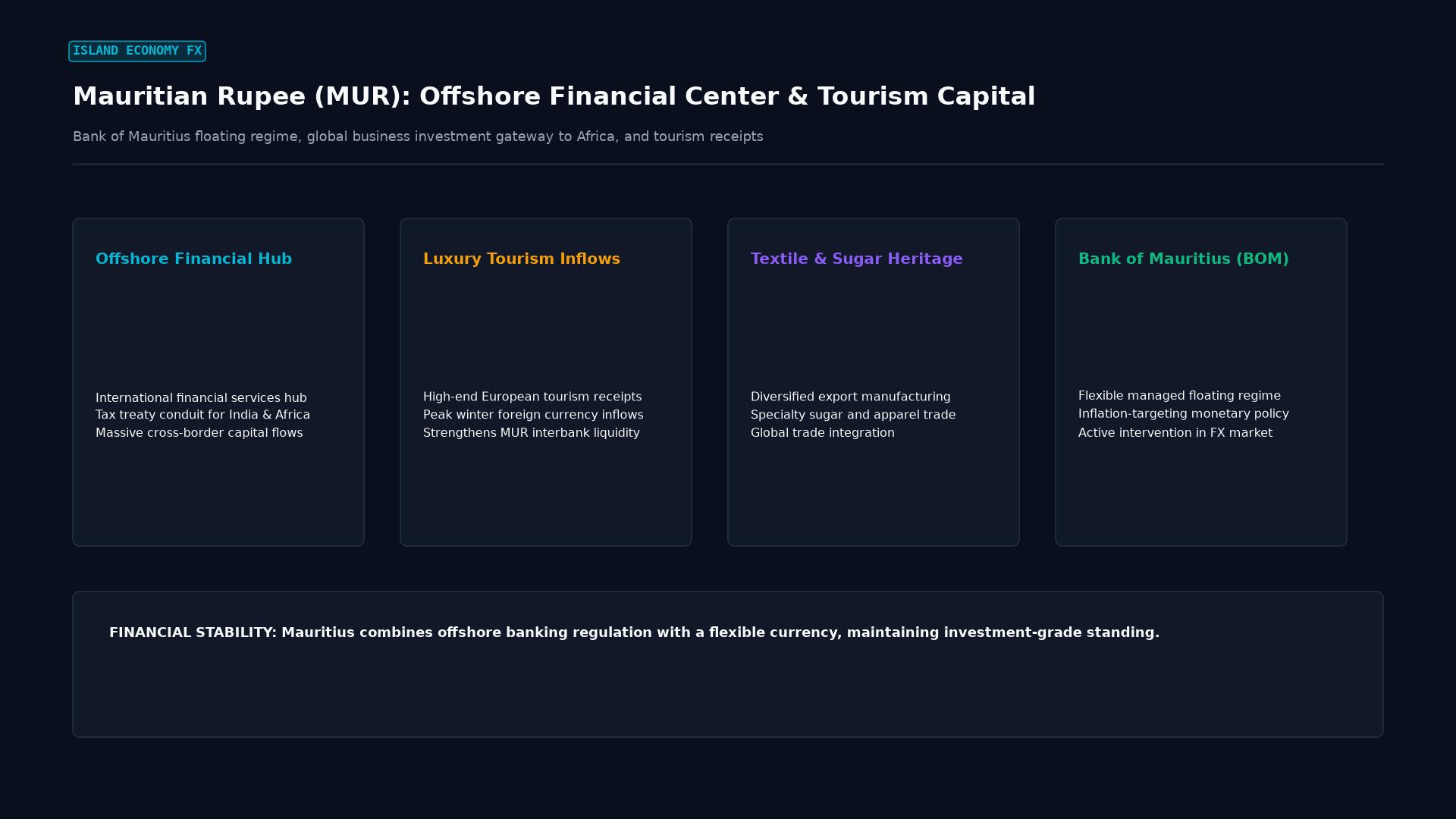 Figure: Bank of Mauritius floating regime, global business investment gateway to Africa, and tourism receipts
Historical Origins and Currency Development
Colonial Transition and the 1877 Currency Reform
Mauritius passed through Dutch, French, and British colonial rule. Under French governance (1715–1810), transactions relied on the French livre and colonial piastres. Following the British capture of the island in 1810, colonial authorities introduced the British Pound and Indian Rupee.
During the nineteenth century, the expansion of the sugarcane plantation industry triggered massive indentured labor migration from the Indian subcontinent. Indian laborers and merchants brought large volumes of Indian silver rupees into circulation, making the Indian Rupee the de facto currency of commercial exchange.
In 1876, colonial authorities formalized this monetary reality by passing the Currency Note Act:
- The Mauritian Rupee was officially introduced in 1877 as the legal tender of Mauritius, Rodrigues, and the Seychelles (which later created its own rupee).
- It was originally established at 1:1 parity with the Indian Rupee (INR) and tied to the British Pound at a fixed rate of 10 rupees per pound sterling.
Post-Independence Modernization (1966–1983)
Following the establishment of the Bank of Mauritius in 1966 and full national independence in 1968, the central bank took over currency issuance from the Board of Commissioners of Currency.
In the 1970s, as the Bretton Woods system collapsed, the Bank of Mauritius broke its direct link with Sterling. Between 1979 and 1983, facing oil shocks and cyclically collapsing sugar prices, the government negotiated standby programs with the International Monetary Fund (IMF), implementing two devaluations and adopting a trade-weighted currency basket peg before transitioning to a market-determined managed float.
The “Mauritian Miracle” and Macroeconomic Structure
In the 1960s, British Nobel laureate economist James Meade famously predicted that Mauritius was destined for catastrophic economic collapse due to rapid population growth, high ethnic diversity, and extreme reliance on a single agricultural crop (sugarcane). Defying these predictions, Mauritius engineered one of Africa’s most successful developmental transformations, known internationally as the Mauritian Miracle.
                   THE STRUCTURAL EVOLUTION OF THE MUR ECONOMY

  1970s: Agrarian Monocrop          1980s-1990s: Industrial Export    2000s+: Financial Hub & Tech
  +-----------------------+         +----------------------------+    +--------------------------+
  | - Raw Cane Sugar      | ======> | - Export Processing Zones  | => | - Cross-Border IFC Funds |
  | - Monocrop Exposure   |         | - Textile Manufacturing    |    | - Luxury Island Tourism  |
  | - High Vulnerability  |         | - Early Beach Tourism      |    | - ICT-BPO & Fintech Hub  |
  +-----------------------+         +----------------------------+    +--------------------------+
1. The Mauritius International Financial Centre (IFC)
Mauritius developed a world-class financial services and offshore corporate structuring hub, contributing over 12% to national GDP:
- Tax Treaty Network: Mauritius established comprehensive Double Taxation Avoidance Agreements (DTAAs) and Investment Promotion and Protection Agreements (IPPAs), historically serving as the primary conduit for international institutional capital investing into India (due to favorable capital gains tax provisions in the historic India-Mauritius tax treaty).
- The Gateway to Africa: Mauritius functions as a primary domiciliation hub for private equity, venture debt, and development finance institutions targeting sub-Saharan Africa. The offshore Global Business Companies (GBC) sector generates significant foreign currency liquidity (primarily USD and EUR) within the domestic banking system.
2. High-End Tourism and Hospitality
Tourism generates approximately 8% to 10% of direct GDP and substantial hard-currency export earnings. Concentrated heavily on high-net-worth European travelers (principally from France, the United Kingdom, and Germany), tourism receipts provide steady EUR inflows that offset the country’s structural merchandise trade deficit.
3. Textiles, Value-Added Sugar, and Blue Economy
While the relative share of raw agriculture has shrunk, Mauritius pivoted to refined specialty sugars, high-end textile apparel for global luxury fashion brands, and deep-sea maritime processing (canned tuna exports from the Port Louis hub).
Monetary Policy Framework of the Bank of Mauritius
1. Modern Flexible Inflation Targeting
In 2023, the Bank of Mauritius modernized its monetary policy framework, transitioning formally to a Flexible Inflation Targeting regime designed to enhance policy predictability and anchor domestic inflation expectations.
- Key Repo Rate / Policy Rate: The central bank’s Monetary Policy Committee (MPC) sets the headline Key Rate to steer the overnight interbank money market rate.
- Target Inflation Band: The central bank targets a medium-term headline inflation corridor of 2.0% to 5.0%, with an explicit midpoint target of 3.5%.
               BANK OF MAURITIUS MONETARY TRANSMISSION

  Monetary Policy Committee (MPC)
                 |
                 v
  Bank of Mauritius Key Policy Rate (Sets Interbank Repo Cost)
                 |
                 v
  Commercial Bank Lending & Deposit Rates (MCB, SBM, Absa)
                 |
                 v
  Domestic Credit Growth & Inward Investment Inflows
                 |
                 v
  FX Interbank Auction Market (Smoothing Volatility in USD/MUR)
                 |
                 v
  Import Price Deflator & Headline CPI Inflation Stability
2. The Managed Floating Exchange Rate Regime
Under the IMF classification, the Mauritian Rupee operates under a managed float with no predetermined path.
Because Mauritius is an import-dependent island nation importing refined petroleum, vehicles, wheat, and raw industrial inputs, depreciation of the MUR immediately feeds into domestic consumer price inflation through the import-cost push mechanism: $$\Delta \text{CPI}_t = f(\Delta \text{USD/MUR}_t, \Delta \text{EUR/MUR}t, \Delta P{\text{energy}}^{\text{global}})$$
To prevent disorderly exchange rate depreciation and speculative hoarding of foreign currency, the Bank of Mauritius regularly intervenes in the domestic foreign exchange market, selling US Dollars from its official foreign reserves directly to commercial banks to satisfy corporate energy and import requirements.
Foreign Exchange Microstructure and Market Mechanics
Foreign exchange dealing in Mauritius is centered in the capital, Port Louis, and exhibits well-defined seasonal and structural patterns:
+------------------------+--------------------------------------------------+
| Market Parameter       | Operational Characteristic                       |
+------------------------+--------------------------------------------------+
| Major Currency Pairs   | USD/MUR (Corporate/Trade), EUR/MUR (Tourism)     |
| Secondary Pairs        | GBP/MUR, ZAR/MUR, INR/MUR                        |
| Interbank Market Core  | The Mauritius Commercial Bank (MCB), State Bank  |
|                        | of Mauritius (SBM), Absa Bank Mauritius, HSBC    |
| FX Trading Windows     | 09:00 to 16:00 Local Time (UTC+4)                |
| Settlement Standards   | Spot T+2 (Standard interbank), Spot T+0 (Cash)   |
| Regulatory Oversight   | Bank of Mauritius & Financial Services Commission|
+------------------------+--------------------------------------------------+
1. Seasonal Liquidity Dynamics
The supply of foreign currency to the Mauritian interbank market follows a pronounced seasonal rhythm:
- November to February (High Liquidity): Peak European tourist season and corporate end-of-year bonuses create a massive surge in Euro and British Pound conversions into MUR, providing strong seasonal appreciation support to the rupee.
- May to August (Tighter Liquidity): Low tourist season combined with major corporate dividend repatriations and annual import inventory restocking typically tightens foreign exchange liquidity, requiring central bank interventions to smooth the exchange rate.
2. The Offshore vs. Onshore Segmentation
A defining structural element of the Mauritian banking sector is the existence of two distinct capital segments:
- Segment A (Domestic): Servicing domestic residents, local companies, and retail banking, denominated primarily in Mauritian Rupees.
- Segment B (Offshore / Global Business): Servicing international offshore corporate entities, private equity funds, and non-resident trusts, conducted almost exclusively in foreign currencies (USD, EUR, GBP, ZAR).
The massive foreign currency deposits held by Segment B entities provide domestic banks with substantial liquidity, though regulations strictly limit the extent to which offshore foreign deposits can be converted into unhedged domestic rupee credit.
Regulatory Resilience: The FATF Grey List Exit (2021)
In February 2020, the Financial Action Task Force (FATF) placed Mauritius on its “Grey List” (jurisdictions under increased monitoring) due to perceived strategic deficiencies in its Anti-Money Laundering and Combating the Financing of Terrorism (AML/CFT) framework. The European Union subsequently placed Mauritius on its high-risk third-country list.
This regulatory action posed an existential threat to the Mauritian Rupee:
- International banks scrutinized cross-border wire transfers originating from Port Louis.
- Global institutional funds considered redomiciling to rival jurisdictions (such as Singapore, Luxembourg, or Dubai).
In response, the Mauritian government and the Bank of Mauritius executed an aggressive, high-speed legislative overhaul:
- Enacted the Anti-Money Laundering and Combatting the Financing of Terrorism (Miscellaneous Provisions) Act.
- Implemented mandatory ultimate beneficial ownership (UBO) registries across the corporate registry.
- Enhanced risk-based supervisory audits across offshore management companies and domestic banks.
In October 2021 (in record time of under two years), the FATF officially commended Mauritius and removed it completely from the Grey List, followed by removal from the UK and EU lists. This restored institutional confidence, reversing capital flight and stabilizing foreign exchange inflows into the MUR banking system.
Best Practices for Trading and Managing MUR Exposure
- Monitor Tourism Arrival Statistics and Hotel Occupancy: Because tourism constitutes the primary source of organic foreign exchange earnings, monthly tourist arrivals published by Statistics Mauritius serve as a leading indicator for seasonal rupee demand.
- Track Bank of Mauritius FX Intervention Bulletins: The central bank routinely publishes the exact amounts, exchange rates, and dates of its US Dollar sales to domestic commercial banks. Accelerating intervention volumes indicate structural liquidity pressures in the local interbank market.
- Account for Interest Rate Parity Differentials: When placing deposits in Mauritian commercial banks, compare the local rupee interest yield against prevailing US Dollar SOFR or Euro short-term rates. During periods of elevated global interest rates, holding MUR assets requires an adequate risk premium to offset chronic inflation differentials.
- Hedge via Forward Contracts with Tier-1 Banks: International corporations with ongoing operational expenses in Mauritius should lock in forward exchange contracts with major local banks (MCB, SBM) during the high-liquidity tourist season (December–January) when foreign exchange supply is abundant and forward points are favorable.
Frequently Asked Questions (FAQ)
What is the relationship between the Mauritian Rupee (MUR) and the Indian Rupee (INR)?
The Mauritian Rupee originated from the Indian Rupee in 1877, introduced due to large inflows of Indian silver coinage accompanying indentured agricultural labor. Although both share the name “rupee” and the symbol ₨, they are completely independent sovereign fiat currencies. The Mauritian Rupee is issued by the Bank of Mauritius, while the Indian Rupee is issued by the Reserve Bank of India, and there is no peg between them.
What exchange rate regime does Mauritius use for the MUR?
Mauritius operates a managed floating exchange rate regime. Under this system, the value of the Mauritian Rupee is primarily determined by private foreign exchange supply and demand in the interbank market. However, the Bank of Mauritius actively intervenes by buying or selling US Dollars and other foreign currencies to curb excessive exchange rate volatility and protect the domestic economy from imported inflationary shocks.
How does the offshore financial sector affect the Mauritian Rupee?
Mauritius hosts an extensive International Financial Centre (IFC) that administers thousands of offshore funds and global business companies. While the majority of these offshore transactions are conducted in US Dollars and Euros, the presence of this sector brings substantial foreign exchange earnings, fund administration revenues, and legal fees into the country. These inflows generate continuous hard currency reserves that support the liquidity of the domestic banking system and provide stability to the MUR.
Ready to trade forex?
Open a free demo account with a regulated broker. Practice with virtual funds before risking real money.