MWK
MWK is the ISO 4217 currency code for the Malawian Kwacha (currency symbol: MK), the official legal tender of the Republic of Malawi, administered and issued by the Reserve Bank of Malawi (RBM).
The MWK (Malawian Kwacha, symbol MK, ISO code MWK) is the sovereign currency of the Republic of Malawi, a landlocked nation located in southeastern Africa. Governed under the statutory authority of the Reserve Bank of Malawi (RBM), established pursuant to the Reserve Bank of Malawi Act of 1964, the currency represents the monetary anchor of an agrarian developing economy.
The word kwacha translates to “it has dawned” in the native Chichewa language, symbolizing national awakening and political liberation following the dissolution of the colonial Federation of Rhodesia and Nyasaland. The kwacha is nominally subdivided into 100 tambala (translating to “rooster,” the traditional herald of dawn). Persistent structural inflation has rendered all tambala coins obsolete, leaving paper banknotes spanning denominations of 20, 50, 100, 200, 500, 1,000, 2,000, and 5,000 kwacha as the sole circulating instruments of domestic commerce.
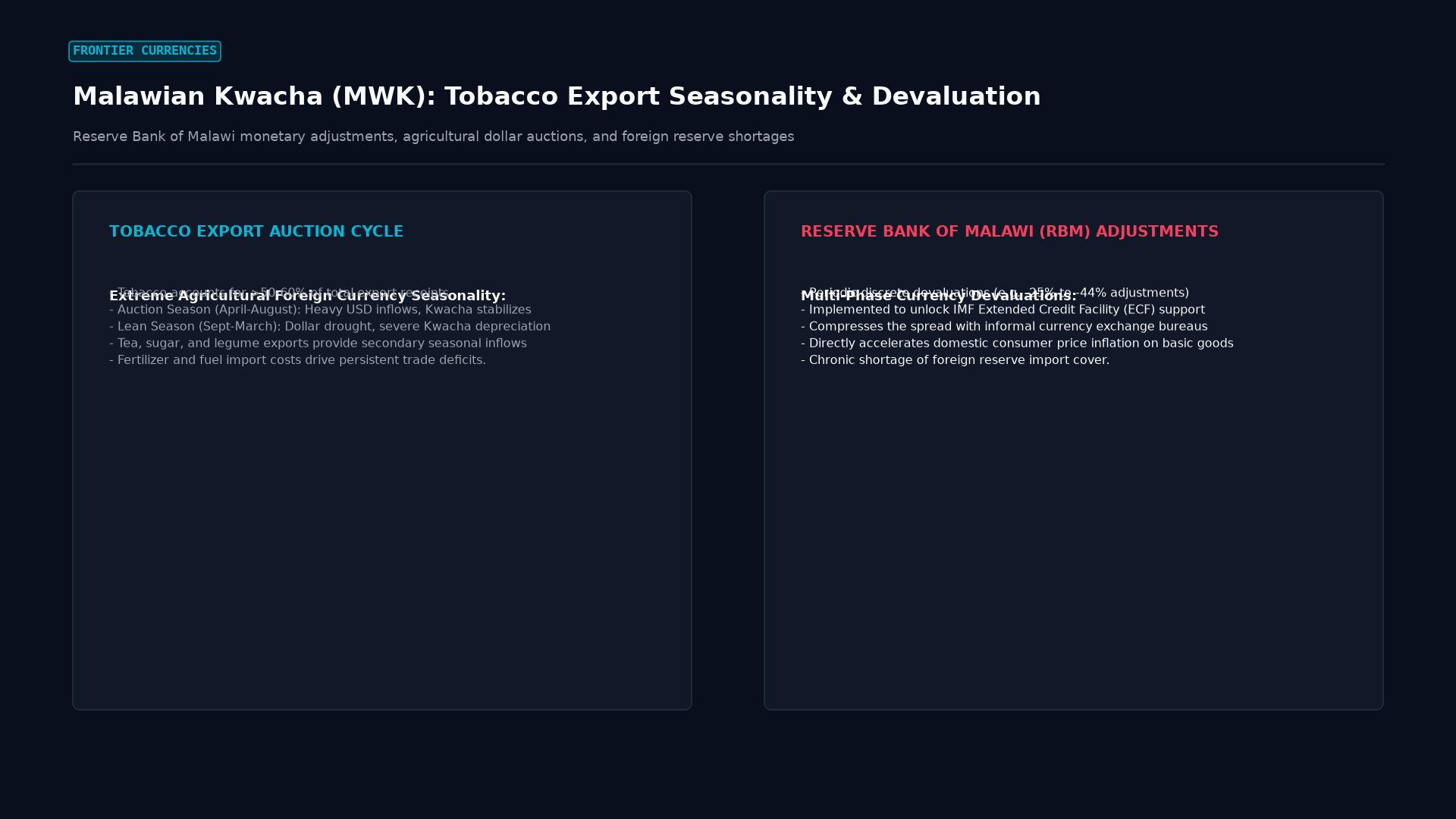 Figure: Reserve Bank of Malawi monetary adjustments, agricultural dollar auctions, and foreign reserve shortages
Historical Evolution and Currency Redenominations
The Colonial Era and Decimals (1964–1971)
Prior to national independence in 1964, the territory (then the British protectorate of Nyasaland) utilized the British Pound and later the currency of the Federation of Rhodesia and Nyasaland. Following independence, the newly sovereign state issued the Malawian Pound, maintaining 1:1 parity with the British Pound Sterling (divided into 20 shillings and 240 pence).
In 1971, Malawi executed a comprehensive decimalization program, replacing the pound with the Malawian Kwacha: $$1 \text{ Malawian Pound} = 2 \text{ Malawian Kwacha (MWK)}$$ $$1 \text{ MWK} = 10 \text{ Shillings} = 100 \text{ Tambala}$$
The Era of Pegged Systems and Structural Readjustment
For its initial two decades, the Reserve Bank of Malawi maintained a rigid peg to a trade-weighted basket composed primarily of the British Pound, the US Dollar, and the South African Rand. However, recurrent terms-of-trade shocks, droughts in the Shire river basin, and civil conflict in neighboring Mozambique (severing Malawi’s primary rail conduits to the Indian Ocean ports of Beira and Nacala) generated chronic balance of payments deficits.
In 1994, under pressure from the International Monetary Fund (IMF) and the World Bank, the RBM abandoned its administrative peg and floated the kwacha. The currency immediately dropped from roughly 4.5 MWK per USD to over 15 MWK per USD, commencing a thirty-year trend of periodic currency crises and structural devaluations.
Macroeconomic Fundamentals: The Agrarian Tobacco Engine
The fundamental external value of the Malawian Kwacha is inextricably linked to the seasonal harvest and international export of raw leaf tobacco, widely termed the nation’s “Green Gold.”
                 THE SEASONAL TOBACCO LIQUIDITY CYCLE

  April to September: The Tobacco Auction Season (Inflow Phase)
  +-------------------------------------------------------------------------+
  | - Tobacco Auction Floors open in Lilongwe, Limbe, and Chinkhoma         |
  | - Multinational leaf merchants (Universal, Alliance One) inject USD     |
  | - Commercial banks convert USD to MWK to pay local farmers              |
  | - Foreign exchange reserves surge at the RBM; MWK stabilizes or gains   |
  +-------------------------------------------------------------------------+
                                     |
                                     v
  October to March: The Lean Rainy Season (Outflow Phase)
  +-------------------------------------------------------------------------+
  | - Auction floors close; agricultural export earnings drop to zero       |
  | - Massive commercial import demand for chemical fertilizers and fuel    |
  | - Commercial banks face severe USD shortages; RBM reserves decline      |
  | - Parallel market spreads widen; severe downward pressure on the MWK    |
  +-------------------------------------------------------------------------+
1. Tobacco Concentration Risk
Tobacco accounts for approximately 50% to 60% of Malawi’s total merchandise export receipts and employs a vast portion of the rural labor force. Because leaf prices are determined on physical auction floors in US Dollars, the opening of the Tobacco Marketing Season between April and September provides the central bank with its primary annual foreign exchange injection.
During the lean season (October to March), tobacco inflows cease, but the nation must import massive quantities of refined fuel, chemical fertilizers under the Affordable Inputs Programme (AIP), and pharmaceutical supplies. This structural calendar mismatch exposes the MWK to violent seasonal depreciation unless backstopped by international donor disbursements.
2. High Import Cost-Push Inflation
Because Malawi is landlocked and lacks domestic crude petroleum refining or industrial chemical capacity, every critical consumer and capital good must be transported thousands of kilometers by road from the ports of Beira (Mozambique) or Dar es Salaam (Tanzania). Consequently, any depreciation of the MWK rapidly feeds into domestic consumer price inflation: $$\text{Domestic Inflation} = \alpha + \beta_1 (\Delta \text{USD/MWK}) + \beta_2 (\Delta P_{\text{transport}}^{\text{global}}) + \beta_3 (\text{Food Supply Shocks})$$
When cyclones (such as Cyclone Freddy in 2023) devastate southern agricultural districts, food scarcity combines with currency weakness to generate consumer inflation spikes exceeding 30% to 35% annually.
Anatomy of Structural Devaluations and the IMF Anchor
Unlike floating currencies where exchange rate adjustments occur continuously in basis-point increments, the Reserve Bank of Malawi has historically defended an administrative rate for extended periods before being forced into sudden, large discrete devaluations.
+------------------------+-------------------+------------------------------+
| Devaluation Date       | Percentage Shift  | Macroeconomic Catalyst       |
+------------------------+-------------------+------------------------------+
| May 2012               | -49.0%            | Restoration of IMF Extended  |
|                        | (168 to 250 MWK)  | Credit Facility after freeze |
+------------------------+-------------------+------------------------------+
| May 2022               | -25.0%            | Post-COVID terms of trade and|
|                        | (825 to 1,026 MWK)| Ukraine fertilizer surge     |
+------------------------+-------------------+------------------------------+
| November 2023          | -44.0%            | Mandatory prior action for   |
|                        | (1,180 to 1,700)  | a new $178M IMF ECF program  |
+------------------------+-------------------+------------------------------+
1. The May 2012 Landmark Devaluation
Under President Bingu wa Mutharika, the RBM pegged the kwacha at 168 MWK per USD despite runaway domestic inflation. Major international bilateral donors suspended direct budget support, cutting off roughly 40% of the national budget. The formal banking system ran completely dry of dollars, resulting in nationwide fuel queues spanning miles.
Upon assuming the presidency following Mutharika’s death in April 2012, President Joyce Banda immediately devalued the kwacha by 49% to 250 MWK per USD and normalized relations with the IMF, replenishing commercial fuel supplies but triggering a doubling of urban transport and food costs.
2. The November 2023 44% Devaluation
By mid-2023, the official exchange rate was administratively held near 1,180 MWK per USD, while the unregulated parallel market rate had soared above 1,800 MWK per USD. Commercial banks could not process import letters of credit, leading to acute nationwide shortages of diesel and pharmaceutical goods.
On November 8, 2023, RBM Governor Wilson Banda announced an immediate 44% devaluation of the kwacha, aligning the official rate to 1,700 MWK per 1 USD. This action satisfied a mandatory prior condition for the IMF Executive Board to approve a new 48-month, $178 million Extended Credit Facility (ECF) arrangement, unlocking vital balance-of-payments financing and multilateral debt relief.
Foreign Exchange Microstructure and the Parallel Market
The foreign exchange market in Malawi is structured around two coexisting tiers:
                    THE SPLIT FOREIGN EXCHANGE MARKET

  Official Banking Channel (RBM / Commercial Banks)
  +-------------------------------------------------------------------------+
  | - Quoted around official reference rate (e.g., 1,700 - 1,750 MWK/USD)   |
  | - High compliance, mandatory priority import queues                     |
  | - Severe chronic volume shortages; months-long payment backlogs         |
  +-------------------------------------------------------------------------+
                                     ^
                                     | Spread generates arbitrage incentive
                                     v
  Parallel Street Market (Informal FX Bureaus / Border Towns)
  +-------------------------------------------------------------------------+
  | - Premium pricing (typically 15% to 30% above official rate)            |
  | - Immediate physical cash execution without bureaucratic paperwork      |
  | - Sourced from cross-border traders, diaspora remittances, cash hoarding|
  +-------------------------------------------------------------------------+
1. Priority Allocation and Mandatory Export Surrender
Under RBM Foreign Exchange Directives:
- Mandatory Surrender Requirement: Exporters (including tobacco leaf houses, sugar refiners, and tea estates) must surrender a statutory percentage (historically between 20% and 30%) of their gross foreign exchange export proceeds directly to the Reserve Bank of Malawi at the official rate. The remaining balance must be held in domestic Foreign Currency Accounts (FCAs) or converted within strict timeframes.
- Priority List for Importers: Commercial banks are legally mandated to allocate their scarce foreign currency according to strict national priorities:
- Strategic petroleum and diesel products.
- Agricultural inputs (fertilizers, seeds).
- Essential pharmaceuticals and medical equipment.
- Sovereign and multilateral debt service.
Non-essential consumer goods, electronics, and luxury vehicles are systematically denied official dollar allocations, forcing importers into the informal parallel market.
Best Practices for Managing MWK Currency Risk
- Incorporate Parallel Premium Differentials into Cost Modeling: Multilateral contractors and foreign investors must avoid evaluating operational budgets based solely on the official RBM exchange rate. When the official-to-parallel spread exceeds 15%, local supply chains automatically price goods using parallel replacement costs.
- Align Liquidity Commitments with the Tobacco Season: Corporations operating in Malawi should execute major local currency conversions or debt settlements during the peak tobacco marketing months (May through July), when interbank US Dollar liquidity is at its annual high and transaction slippage is lowest.
- Utilize Authorized Foreign Currency Accounts (FCAs): International entities and NGOs must maintain dedicated US Dollar offshore or authorized onshore FCAs. Retaining foreign currency balances prevents exposure to unexpected overnight discrete devaluations.
- Monitor IMF Review Tranches: Because the stability of the kwacha depends on external budget support, track IMF staff-level agreements and board review schedules. Any delay in program disbursements typically triggers immediate parallel market dollar hoarding and renewed pressure on the kwacha.
Frequently Asked Questions (FAQ)
What is the origin and meaning of the name “Kwacha”?
The word kwacha is derived from the Chichewa language, meaning “it has dawned.” It was adopted in 1971 to symbolize the dawn of freedom, political independence, and economic self-determination following the end of British colonial rule. The subunit tambala means “rooster” in Chichewa, named after the bird that crows at the break of dawn.
Why does the Malawian Kwacha experience frequent large devaluations?
The Malawian Kwacha suffers from chronic balance of payments deficits because the country imports substantially more goods (fuel, fertilizers, machinery, medicines) than it exports. Because the Reserve Bank of Malawi often attempts to fix or manage the exchange rate to prevent consumer price inflation, the official rate becomes overvalued while foreign exchange reserves deplete. When foreign currency reserves run out and the informal parallel market spread becomes unsustainable, the central bank is forced to devalue the official rate to realign it with economic fundamentals and satisfy conditions for IMF financial assistance.
How does the tobacco auction season impact the value of the MWK?
Tobacco accounts for over half of Malawi’s total merchandise export earnings. When the tobacco auction floors open in April, international leaf-buying corporations bring hundreds of millions of US Dollars into the country, converting them into kwacha to pay farmers and local handlers. This influx of foreign currency replenishes the central bank’s foreign reserves and stabilizes the kwacha. Conversely, when the auction floors close in September, foreign currency inflows dry up, causing severe dollar shortages and seasonal depreciation of the kwacha through the remainder of the year.
Ready to trade forex?
Open a free demo account with a regulated broker. Practice with virtual funds before risking real money.