Nostro Account
A Nostro account is a foreign currency account held by a domestic bank at a foreign correspondent bank in the currency of that foreign country, facilitating cross-border trade settlements, foreign exchange clearing, and SWIFT wire transfers.
What Is a Nostro Account?
A Nostro account (originating from the Latin word nostro, meaning “ours”) is a foreign currency bank account maintained by a domestic financial institution at a foreign correspondent bank, denominated in the local currency of the jurisdiction where the correspondent bank is located. For example, when a commercial bank headquartered in London holds a U.S. Dollar account at JPMorgan Chase in New York, the London bank refers to that account as its USD Nostro Account—literally meaning “our account on your books.”
Nostro accounts, alongside their symmetrical counterpart—Vostro accounts (“your account on our books”)—constitute the fundamental architectural plumbing of the global correspondent banking system. International cross-border payments and multi-billion-dollar foreign exchange spot trades do not involve physical airplanes flying pallets of cash across oceans; instead, international value is transferred by debiting and crediting these interconnected Nostro and Vostro ledgers coordinated through secure interbank messaging networks like SWIFT and the ISO 20022 protocol.
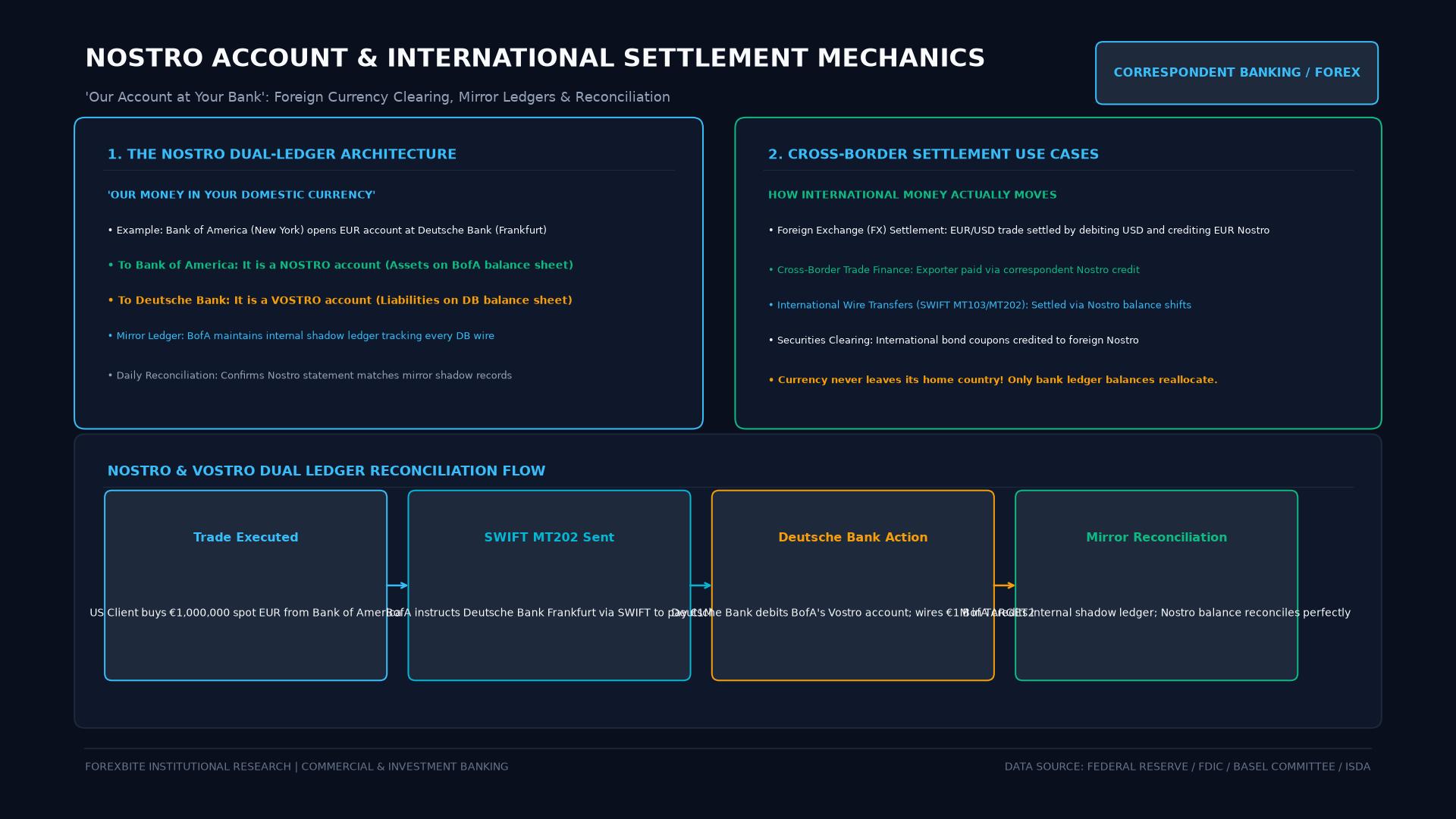 Figure: International correspondent banking ledger: domestic bank asset tracking in foreign currency at foreign correspondent banks via SWIFT MT950 statements.
Key Takeaways
- The Linguistic Symmetry: The identical bank account is simultaneously a Nostro account to the bank that owns the funds and a Vostro account to the custodian bank holding the funds.
- Cross-Border Settlement Plumbing: Virtually every international wire transfer, import/export letter of credit, and foreign exchange spot transaction clears through Nostro account adjustments.
- Elimination of Cross-Border Physical Transit: Value is transferred electronically: when a German bank pays a Japanese exporter in Yen, the German bank’s JPY Nostro account in Tokyo is debited, and the Japanese exporter’s bank is credited.
- Basel III Liquidity Traps: Under Basel III banking regulations, commercial banks must hold high-quality liquid assets (HQLA) against Nostro account balances to satisfy the Liquidity Coverage Ratio (LCR), making idle foreign Nostro balances expensive to maintain.
- De-Risking Concerns: Stricter international Anti-Money Laundering (AML) and sanctions rules have caused Tier-1 Western banks to sever correspondent Nostro relationships with banks in developing and emerging markets, a trend known as de-risking.
Comparative Taxonomy: Nostro, Vostro, and Loro Accounts
The international banking community categorizes correspondent accounts through standardized Latin terminology to avoid jurisdictional confusion.
| Account Classification | Latin Meaning | Conceptual Definition | Who Holds the Money? | Practical Example |
|---|---|---|---|---|
| Nostro Account | “Ours” | Our account on your books | Foreign correspondent bank | Deutsche Bank holds USD at Citi New York |
| Vostro Account | “Yours” | Your account on our books | Domestic bank for foreign client | Citi New York manages account for Deutsche Bank |
| Loro Account | “Theirs” | Their account on their books | Third-party bank reference | Bank of America referencing Deutsche’s account at Citi |
| Central Bank Reserve | Sovereign | Direct digital reserves at national central bank | Domestic Central Bank (Fed, ECB) | JPMorgan’s master account at the NY Fed |
Mechanics: Cross-Border Foreign Exchange Settlement
When an institutional foreign exchange trade is executed between two global banks, Nostro accounts execute the physical delivery of the two currency legs:
$$\text{Trade: Bank A (Frankfurt) BUYS $100,000,000 USD from Bank B (Tokyo) for €92,000,000 EUR}$$
Settlement takes place on value date $T+2$ through simultaneous, coordinated ledger entries:
- The Euro Leg (Frankfurt / TARGET2):
- Bank A instructs the European Central Bank’s TARGET2 payment system to debit its account €92,000,000.
- Bank B’s EUR Nostro Account in Frankfurt is credited €92,000,000.
- The Dollar Leg (New York / Fedwire):
- Bank B instructs its correspondent bank in New York to debit its USD Nostro Account $100,000,000.
- Bank A’s USD Nostro Account at its New York correspondent bank is credited $100,000,000.
- The Result: Both currency legs settle with finality in their respective domestic clearing systems without capital ever crossing physical national boundaries.
Real-World Case Study: The 1974 Herstatt Bank Failure and Settlement Risk
The systemic danger of uncoordinated Nostro account settlement was etched into global financial history on June 26, 1974, by the failure of Bankhaus Herstatt in Germany:
- The Time-Zone Trap: Several international banks sold Deutsche Marks (DEM) to Herstatt Bank in exchange for U.S. Dollars.
- The German Leg Settled: During European business hours, the counterparty banks paid Deutsche Marks directly into Herstatt’s Frankfurt accounts via local Nostro transfers.
- The Collapse: At 3:30 PM Frankfurt time, German banking regulators abruptly revoked Herstatt’s banking license and froze all its assets due to catastrophic foreign exchange losses.
- The Unfunded Leg: Because New York was only beginning its business day (10:30 AM EST), Herstatt’s New York correspondent bank halted all outgoing payments. The counterparty banks had surrendered their Marks, but Herstatt never credited their USD Nostro accounts in New York.
- The Legacy: This catastrophe—known permanently as Herstatt Risk (Cross-Currency Settlement Risk)—led directly to the creation of the Basel Committee on Banking Supervision and the eventual formation of Continuous Linked Settlement (CLS Bank).
Operational Challenges and Treasury Management
- Overnight Overdraft Charges: If an incoming foreign payment is delayed while an outgoing wire is processed, a bank’s Nostro account can enter an intraday or overnight overdraft, incurring punitive borrowing penalty rates from the foreign correspondent bank.
- Trapped Liquidity: Global banks must maintain excess capital buffers in dozens of foreign Nostro accounts across Tokyo, London, Zurich, and Singapore. Because this capital is geographically dispersed, it cannot be easily deployed for profitable domestic lending.
Frequently Asked Questions (FAQ)
Can an individual retail trader open a Nostro account?
No. Nostro and Vostro accounts are strictly interbank facilities maintained between licensed financial institutions. Retail traders hold standard multi-currency accounts with retail brokers or commercial banks, which in turn use their own institutional Nostro networks to settle trades behind the scenes.
What is the role of SWIFT in Nostro account reconciliation?
SWIFT does not hold money; it transmits encrypted, standardized financial messages. A SWIFT MT950 (Statement Message) is sent daily by the correspondent bank to the domestic bank, providing a comprehensive electronic statement of all transactions on the Nostro account for automated ledger reconciliation.
Why is an account called both Nostro and Vostro?
It is entirely a matter of accounting perspective. If Bank A deposits money into Bank B, Bank A records the asset on its ledger as a Nostro Account (“our money at their bank”), while Bank B records the liability on its ledger as a Vostro Account (“their money at our bank”).
Ready to trade forex?
Open a free demo account with a regulated broker. Practice with virtual funds before risking real money.