Vostro Account
A Vostro account ('your account with us') is a bank account held by a domestic correspondent bank on behalf of a foreign financial institution, denominated in the domestic currency to facilitate cross-border trade, clearing, and foreign exchange settlement.
What Is a Vostro Account?
In global banking and foreign exchange operations, a Vostro account (derived from the Latin vostro, meaning “yours”) is an account maintained by a domestic financial institution on behalf of a foreign correspondent bank. It is denominated in the domestic currency of the host bank where the funds are physically held.
Because most banks cannot maintain physical branch networks and central bank reserve accounts in every sovereign jurisdiction, international finance relies on the correspondent banking network. A single ledger entry represents two sides of the same relationship:
- To the foreign bank that deposited the capital abroad, the facility is designated as a Nostro account (“our account with you”).
- To the domestic custodian bank that holds and administers the funds, the identical facility is designated as a Vostro account (“your account with us”).
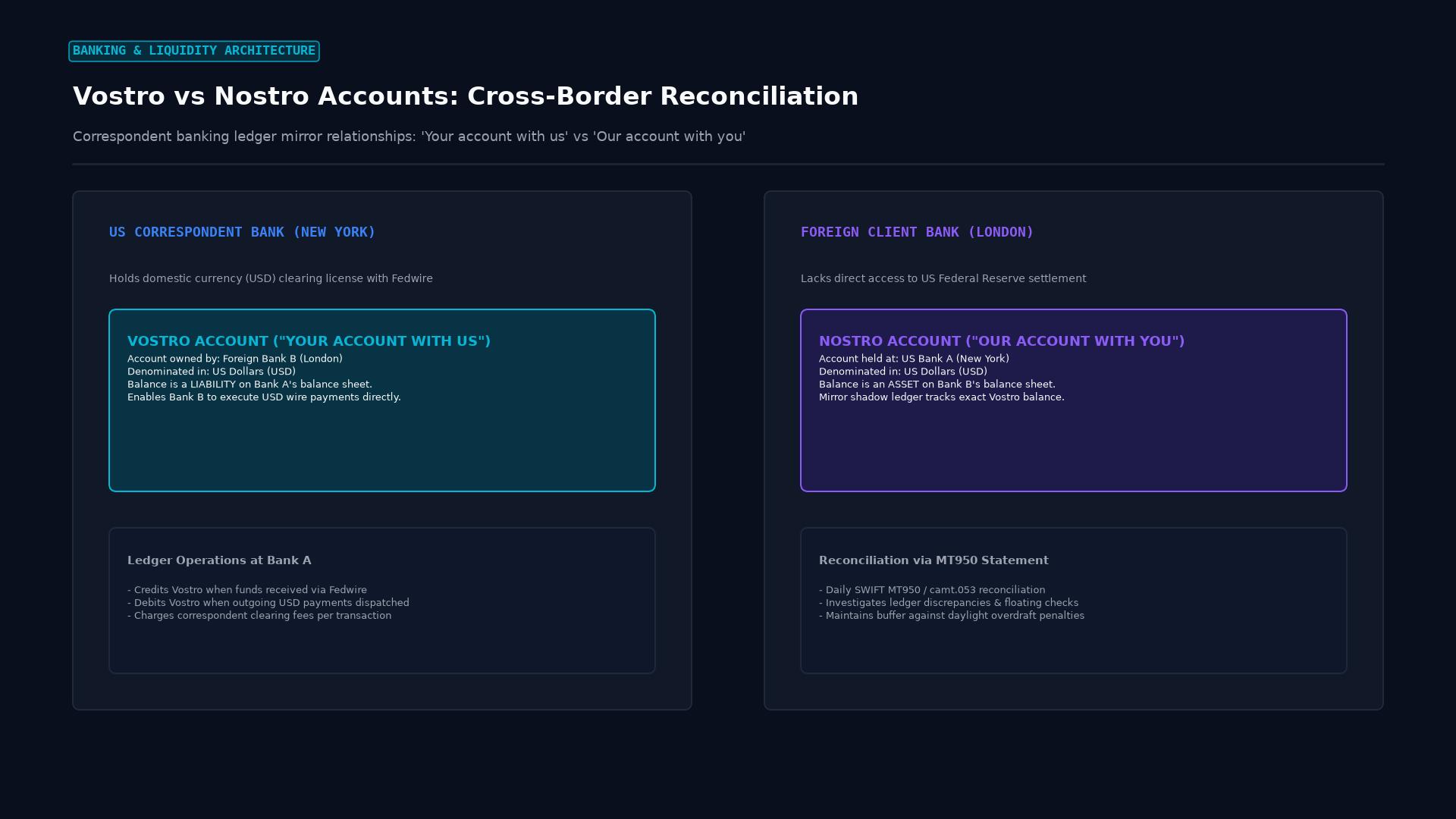 Figure: Bilateral correspondent banking ledger mirror: Vostro account (‘Your account with us’ in domestic currency) balanced against Nostro account (‘Our account with you’).
Technical Mechanics & SWIFT Settlement Standards
Cross-border payments and forex conversions flowing through Vostro accounts depend on standardized messaging protocols established by the Society for Worldwide Interbank Financial Telecommunication (SWIFT):
- SWIFT MT103 (Single Customer Credit Transfer): Instructs the host bank to debit the foreign institution’s Vostro balance and credit a domestic commercial beneficiary.
- SWIFT MT202 / MT202COV (Financial Institution Transfer): Executes interbank liquidity movements, covering FX spot contracts and money market sweeps. The
COVextension provides complete underlying customer disclosure to ensure compliance with anti-money laundering (AML) and Office of Foreign Assets Control (OFAC) screening standards. - SWIFT MT950 (Statement Message): Generated at the close of every business day by the custodian bank, detailing opening balances, debit/credit postings, and closing balances for automated reconciliation against the foreign bank’s internal Nostro ledger.
Balance Management & Intraday Liquidity
Vostro accounts are subject to real-time liquidity parameters:
$$\text{Available Intraday Liquidity} = \text{Ledger Balance} + \text{Uncommitted Daylight Overdraft Limit} - \text{Earmarked Settlement Holds}$$
If a foreign bank initiates transaction volumes exceeding its funded Vostro balance, the correspondent bank may extend an uncommitted intraday credit line (daylight overdraft), charging liquidity fees or requiring sovereign bond collateralization.
Account Classification Matrix
| Account Type | Literal Meaning | Perspective | Typical Currency Denomination | Primary Function |
|---|---|---|---|---|
| Vostro Account | “Yours” | Domestic custodian bank | Domestic currency of the custodian bank (e.g., USD in New York) | Processing incoming client payments, clearing domestic checks, local RTGS access |
| Nostro Account | “Ours” | Foreign depositing bank | Foreign currency relative to the depositor (e.g., USD held by a Japanese bank) | Maintaining offshore currency liquidity, settling FX conversions |
| Loro Account | “Theirs” | Third-party observer bank | Third-party reporting currency | Referencing an account held by one institution with another institution |
Real-World Case Study: The RBI Special Rupee Vostro Accounts (2022–2023)
Following the imposition of comprehensive Western financial sanctions and the disconnection of major Russian commercial banks from the SWIFT network in March 2022, traditional dollar-clearing channels for bilateral trade between India and Russia were obstructed.
SRVA Mechanism (July 2022 - 2023):
1. Reserve Bank of India (RBI) authorized the creation of Special Rupee Vostro Accounts (SRVA).
2. Russian banks (including Sberbank and VTB) opened INR-denominated Vostro accounts with Indian custodians (e.g., UCO Bank, IndusInd Bank).
3. Indian refiners paid Indian Rupees (INR) directly into the Russian banks' Vostro accounts to purchase discounted crude oil.
4. Accumulated Rupee balances inside the Vostro accounts were subsequently deployed to purchase Indian goods (pharmaceuticals, agriculture) and invested in Indian Government Treasury Bills.
By late 2023, over 20 Russian financial institutions operated active SRVAs in India. This institutional arrangement demonstrated how sovereign Vostro account architecture can bypass Western correspondent clearing hubs (CHIPS and Fedwire) during major geopolitical realignments.
Frequently Asked Questions (FAQ)
What is the difference between a Nostro and a Vostro account?
There is no physical difference in the account itself; the difference is purely one of accounting perspective. A bank in London holding US dollars with a correspondent bank in New York refers to that deposit as its Nostro account (an asset on the London bank’s balance sheet). The New York custodian holding the dollars refers to that exact same ledger account as a Vostro account (a deposit liability on the New York bank’s balance sheet).
What primary risks do banks encounter when administering Vostro accounts?
Host banks face three major risk vectors: credit/liquidity risk (if the foreign bank defaults while utilizing daylight overdraft credit facilities), operational/settlement risk (time-zone mismatches and failed ledger reconciliation between CLS cutoffs), and financial crime compliance risk (sanctions evasion, terrorist financing, and illicit capital flows routed through nested correspondent relationships).
What happens when an institution has an unreconciled discrepancy between its Nostro and Vostro balances?
Discrepancies—frequently caused by delayed settlement notifications, unrecognized wire fees, or divergent value dates—are categorized as “nostro breaks.” Banks utilize automated exception-handling software to flag unmatched debit and credit entries. If a nostro break remains unresolved over multiple reporting cycles, the bank must set aside regulatory capital reserves against potential operational write-offs in accordance with Basel III operational risk standards.
Ready to trade forex?
Open a free demo account with a regulated broker. Practice with virtual funds before risking real money.