Correspondent Bank
A correspondent bank is a financial institution that provides cross-border wire clearing, currency exchange, trade finance, and custody services to another domestic or foreign bank that lacks a physical presence or direct clearing license in that jurisdiction.
What Is a Correspondent Bank?
A correspondent bank is a licensed financial institution that provides banking services, local currency clearing, settlement, and trade finance to another financial institution (known as the respondent bank). Correspondent banking relationships form the structural backbone of global cross-border finance, enabling local and regional commercial banks to conduct international transactions for their clients without having to establish costly physical branches, legal subsidiaries, or direct central bank clearing accounts in every foreign nation.
When a corporate client or retail trader initiates an international wire transfer—such as sending U.S. Dollars from an account in Kenya to a forex brokerage account in London—the funds typically travel through a network of correspondent banks. These tier-one global institutions hold accounts on behalf of the originating and receiving institutions, settling balances through bilateral ledger accounting and messaging networks like SWIFT.
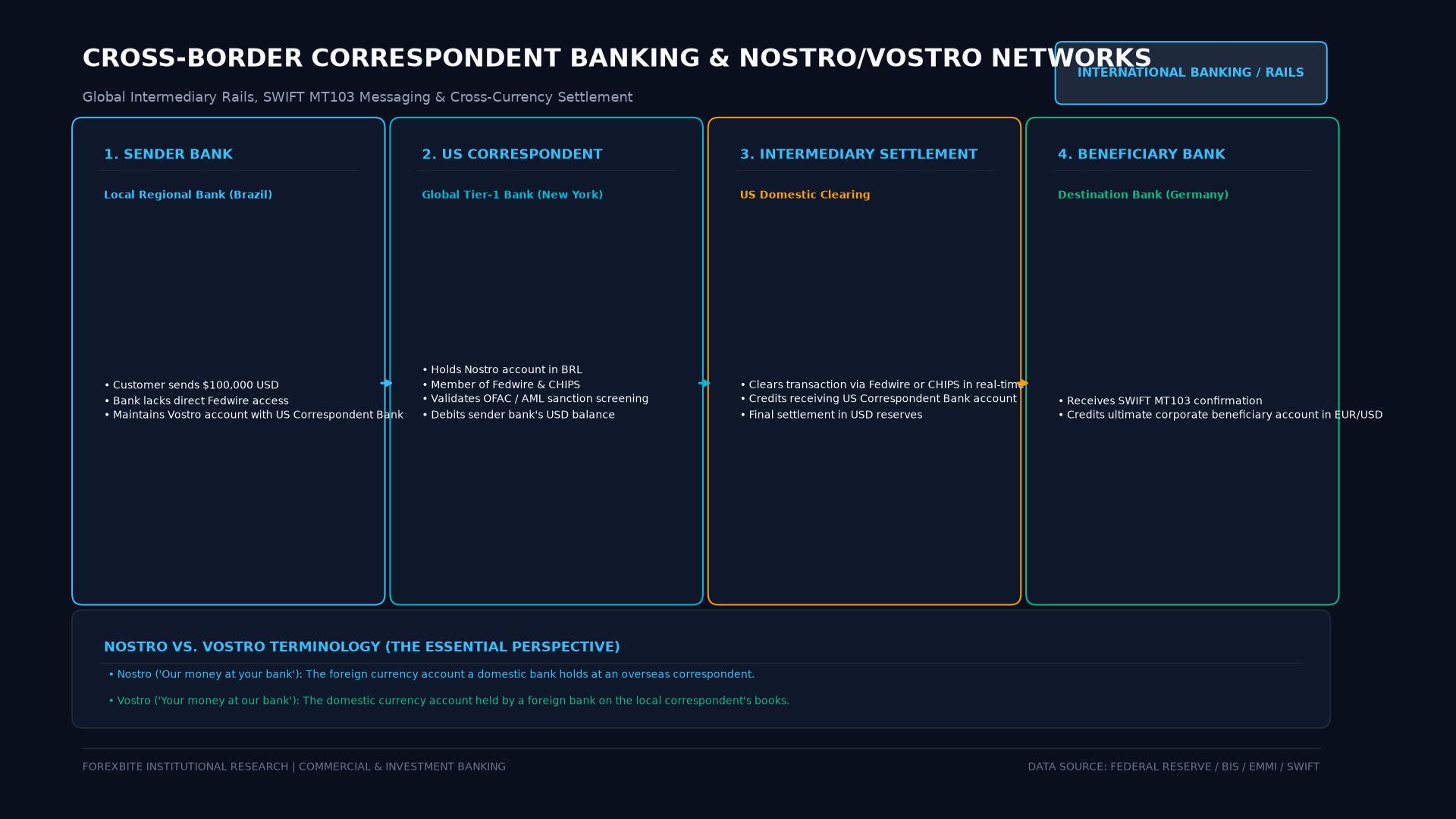 Figure: Cross-border payments infrastructure: nested Nostro/Vostro account ledgers, SWIFT MT103 instructions, and intermediary currency clearing.
Key Takeaways
- Global Trade Enabler: Correspondent banking enables domestic financial institutions to execute foreign currency wire transfers, letter-of-credit trade financing, and foreign exchange conversions internationally.
- The Nostro / Vostro Ledger System: Correspondent relationships operate via reciprocal accounts: a Nostro account (“our account at your bank”) and a Vostro account (“your account at our bank”).
- Currency Clearing Hubs: To settle transactions denominated in U.S. Dollars or Euros, a bank must ultimately route payments through a correspondent bank that holds a direct account at the U.S. Federal Reserve (via Fedwire/CHIPS) or European Central Bank (via TARGET2).
- De-Risking Pressures: Stricter Anti-Money Laundering (AML) and Counter-Terrorism Financing (CTF) mandates post-2008 have caused major global banks to terminate correspondent lines with smaller banks in emerging markets—a phenomenon known as de-risking.
The Nostro and Vostro Account Architecture
At the heart of every correspondent banking arrangement is the dual accounting ledger convention:
| Accounting Term | Latin / Italian Meaning | Institutional Perspective | Real-World Application |
|---|---|---|---|
| Nostro Account | “Ours” | An account that a domestic bank holds in foreign currency at a foreign correspondent bank | Bank of Tokyo-Mitsubishi holds a U.S. Dollar account at JPMorgan Chase in New York |
| Vostro Account | “Yours” | An account that a foreign correspondent bank maintains on its books for a foreign customer bank | JPMorgan Chase maintains a ledger account for Bank of Tokyo-Mitsubishi |
| Loro Account | “Theirs” | A third party referring to a correspondent account held by two other institutions | A French bank referring to Bank of Tokyo’s account at JPMorgan |
$$\text{Nostro (Bank A’s View)} \equiv \text{Vostro (Bank B’s Ledger)}$$
When Bank A wants to pay $10,000,000 to an entity in the United States, it sends a SWIFT MT103/pacs.008 message instructing Bank B to debit Bank A’s Vostro account and credit the beneficiary’s domestic account over Fedwire.
Services Provided by Correspondent Banks
Beyond basic retail wire transfers, correspondent banks perform a broad spectrum of critical institutional functions:
- Foreign Exchange Execution: Providing liquidity and conversion facilities for exotic and non-deliverable currencies that lack deep domestic markets.
- Trade Finance & Letters of Credit: Confirming and underwriting documentary letters of credit and performance bonds for multinational import-export shipping.
- Cash Management & Liquidity Pooling: Enabling corporate treasuries to sweep cash balances across multiple international subsidiaries into centralized interest-bearing accounts.
- Securities Custody & Clearing: Acting as local sub-custodians to hold foreign government bonds, corporate equities, and sovereign debt for overseas pension funds.
Real-World Case Study: An International Wire Routing Failure
A trader based in Singapore deposits $50,000 USD to fund their account with an ASIC-regulated forex broker in Sydney, Australia.
The Wire Routing Pipeline:
- Originating Bank: Local Singapore Bank (holds no direct Fedwire license in New York).
- Intermediary Correspondent Bank: Bank of New York Mellon (BNY Mellon) in New York.
- Broker’s Receiving Bank: Commonwealth Bank of Australia (CBA) in Sydney.
Routing Sequence:
Singapore Bank ──► SWIFT MT103 ──► BNY Mellon (NY) ──► Fedwire Cleared ──► CBA (Sydney)
The Settlement Breakdown:
- The trader enters the broker’s Australian account details but fails to specify the broker’s intermediary Correspondent Bank BIC/SWIFT code in New York.
- Because the transaction involves U.S. Dollars, Australian banks cannot clear the funds directly within Australia; the dollars must legally be cleared on U.S. soil through a U.S. clearinghouse (CHIPS or Fedwire).
- The payment is routed into an unallocated suspense account at an intermediary bank, triggering a 7-day compliance hold and incurring $75 in “intermediary tracing and repair fees.”
- Once the broker’s finance department submits a formal SWIFT amendment clarifying the intermediary correspondent instructions, BNY Mellon debits the Singapore bank’s Vostro ledger and credits CBA’s New York account, finally releasing the funds to the broker.
The “De-Risking” Phenomenon in Global Banking
Over the past decade, international regulatory authorities (including the Financial Action Task Force - FATF and U.S. FinCEN) have levied billions of dollars in fines on tier-one banks for AML deficiencies. Consequently, major correspondent institutions conducted widespread de-risking:
- Exit from High-Risk Jurisdictions: Global banks severed correspondent links with hundreds of smaller local banks across the Caribbean, Eastern Europe, Central Africa, and the South Pacific.
- Impact on Forex Brokers: Retail forex brokers operating under offshore licenses (e.g., Vanuatu, Seychelles, Belize) have experienced immense difficulty maintaining reliable USD and EUR banking rails, forcing many to migrate toward cryptocurrency deposits (USDT/USDC) or alternative payment processors.
- Rise of Cross-Border Fintech: The retreat of traditional correspondent banking spurred the growth of specialized non-bank cross-border payment networks (such as Wise, Airwallex, and RippleNet) that utilize local multi-currency accounts and distributed ledgers to bypass traditional correspondent friction.
Frequently Asked Questions
Why do international wire transfers incur “intermediary bank fees”?
When a cross-border wire passes through one or more correspondent banks to reach its destination, each intermediary bank deducts a processing fee (typically between $15 and $40 USD) from the principal wire amount to cover their operational and compliance costs.
What is the difference between a correspondent bank and an intermediary bank?
In practice, the terms are often used interchangeably. However, an intermediary bank is specifically any third-party bank that acts as a conduit between the originating bank and the receiving bank when no direct bilateral relationship exists, whereas a correspondent bank refers broadly to any bank that provides ongoing agency and account services to another.
How does SWIFT relate to correspondent banking?
SWIFT does not hold funds, transfer money, or clear accounts; it is purely a secure financial messaging network. The actual movement of money occurs when correspondent banks adjust their internal balance sheets (Nostro/Vostro accounts) based on the instructions received via SWIFT messages.
Ready to trade forex?
Open a free demo account with a regulated broker. Practice with virtual funds before risking real money.