NPR
NPR is the ISO 4217 currency code for the Nepalese Rupee (currency symbol: ₨ or रु), the official legal tender of the Federal Democratic Republic of Nepal, issued and regulated by the Nepal Rastra Bank under a permanent conventional peg to the Indian Rupee.
The NPR (Nepalese Rupee, graphical symbol ₨ or Devanagari रु) is the sovereign currency of the Federal Democratic Republic of Nepal, a landlocked Himalayan nation bordered by India and the People’s Republic of China. Under the Nepal Rastra Bank Act of 2002 (superseding the foundational 1955 statute), the Nepal Rastra Bank (NRB) operates as the nation’s autonomous central bank, exercising exclusive authority over currency issuance, foreign exchange administration, and banking supervision.
The rupee is subdivided into 100 paisa (पैसा). While historical paisa coins remain statutory legal tender, persistent inflation has rendered all coin denominations functionally obsolete in daily commerce, making paper banknotes in denominations of 5, 10, 20, 50, 100, 500, and 1,000 rupees the practical medium of exchange. A defining structural characteristic of the Nepalese Rupee is its conventional fixed peg to the Indian Rupee (INR) at the statutory rate of $1.60 \text{ NPR} = 1.00 \text{ INR}$, anchored by deep cross-border labor mobility, geographic integration, and a massive remittance-driven balance of payments model.
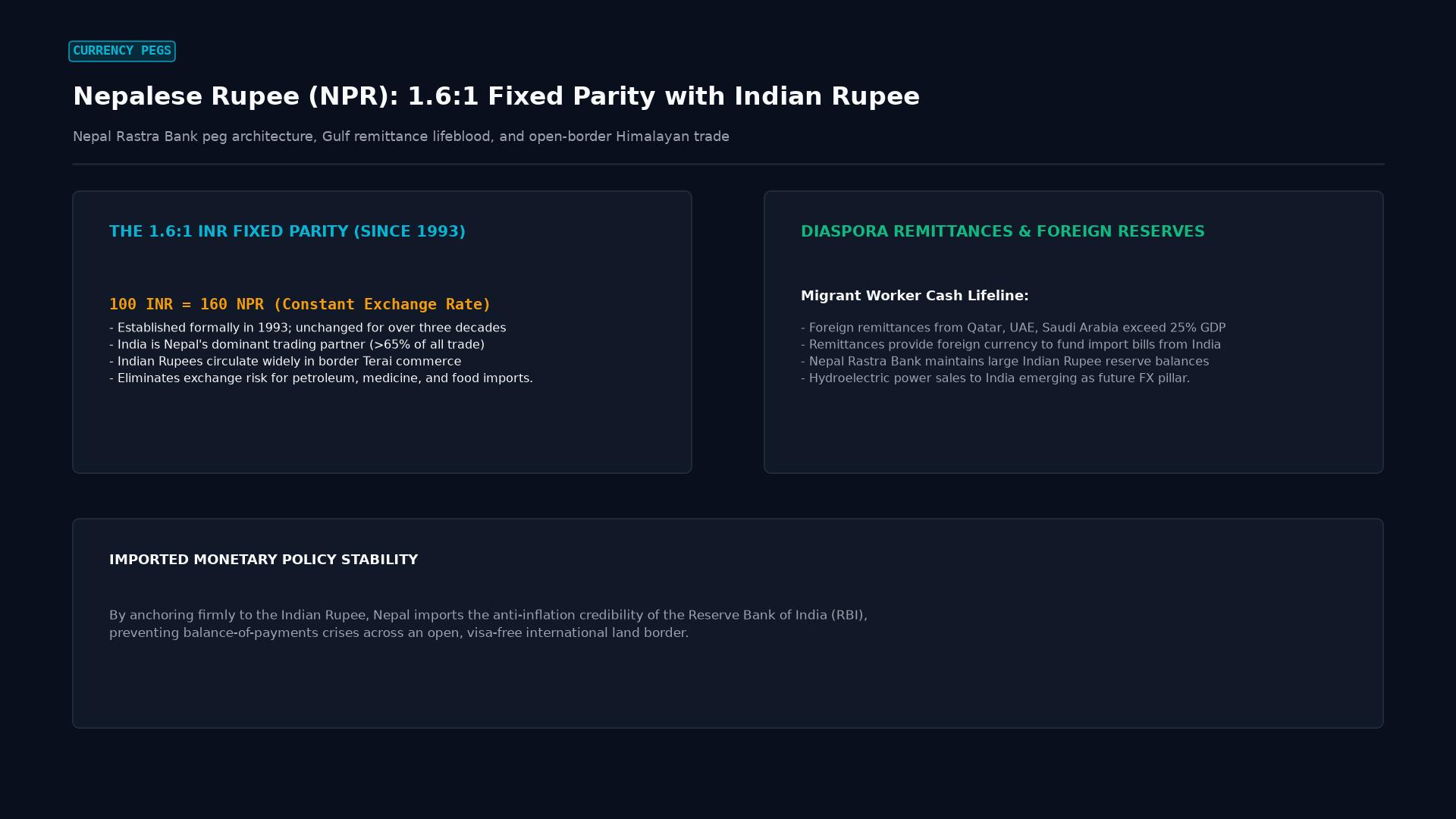 Figure: Nepal Rastra Bank peg architecture, Gulf remittance lifeblood, and open-border Himalayan trade
Historical Origins and the Evolution of the Dual Currency System
Ancient Himalayan Coinage and the Silver Mohar
Prior to the mid-twentieth century, Nepal operated under a silver standard dominated by the Mohar (first minted during the medieval Malla kingdoms of the Kathmandu Valley). Because Nepalese silver mohars were renowned for high purity, they circulated widely beyond Nepal’s borders, functioning as the primary medium of exchange across Tibet until the late eighteenth century.
In 1932, under the Rana dynasty, the currency was standardized, and paper banknotes were first introduced in 1945, initially known as the Mohru or Nepalese Rupee.
The Indian Rupee Co-Circulation and Central Bank Foundation (1956)
For the first half of the twentieth century, Nepal functioned under an informal dual-currency system:
- In the mountainous interior and Kathmandu Valley, Nepalese mohars and paper notes circulated.
- In the fertile southern plains (the Terai), which share a completely open, 1,750-kilometer land border with India, the Indian Rupee (INR) circulated as the dominant medium of exchange.
When the Nepal Rastra Bank (NRB) commenced operations in April 1956, its primary strategic mandate was the eradication of this dual-currency regime. Through the Foreign Exchange Regulation Act of 1960 and the gradual expansion of central bank branches across the Terai, the NRB made the Nepalese Rupee the exclusive legal tender for tax payments, commercial contracts, and domestic bank deposits.
                    NEPALESE MONETARY INTEGRATION TIMELINE

  1932 - 1956                  1960 - 1993                1993 - Present
  +-----------------------+    +--------------------+    +-----------------------+
  | Silver Mohar Era      | => | Dual Currency Phase| => | Fixed 1.60 Peg to INR |
  | Indian Rupee dominates|    | NRB enforces NPR as|    | Over 30 years unbroken|
  | the southern Terai    |    | exclusive legal ten|    | macroeconomic anchor  |
  +-----------------------+    +--------------------+    +-----------------------+
The Architecture of the Indian Rupee (INR) Peg
The defining pillar of Nepal’s monetary framework is its statutory peg to the Indian Rupee.
1. The 1.60 Conversion Mechanism
On February 12, 1993, the Nepal Rastra Bank and the Government of Nepal established the current official exchange rate parity: $$100.00 \text{ INR} = 160.00 \text{ NPR}$$ $$\text{Reciprocal Rate: } 1.00 \text{ NPR} = 0.6250 \text{ INR}$$
This rate has remained unbroken for over three decades, surviving multiple regional economic crises, political transitions from monarchy to republic, the catastrophic 2015 Gorkha earthquake, and global financial shocks.
                     TRIANGULAR EXCHANGE RATE CONVERSION

  +-------------------------------------------------------------------------+
  |                        Global US Dollar (USD)                           |
  +-------------------------------------------------------------------------+
        ^                                                               ^
        | USD/INR Market Rate                                           | Indirect
        | Determined on Indian Interbank                                | Conversion
        v                                                               v
  +-----------------------------------------------------------------+   |
  |                     Indian Rupee (INR)                          |   |
  +-----------------------------------------------------------------+   |
        ^                                                               |
        | Fixed Statutory Peg (1.00 INR = 1.60 NPR)                     |
        v                                                               v
  +-----------------------------------------------------------------------+
  |                     Nepalese Rupee (NPR)                              |
  +-----------------------------------------------------------------------+
2. Triangular Quotation Mechanics (USD/NPR)
Because the NPR is tied to the INR, its value against all third-party global currencies (US Dollar, Euro, British Pound, Japanese Yen) is mathematically derived from the daily exchange rate of the Indian Rupee: $$\text{USD/NPR} = \text{USD/INR} \times 1.60$$
For example, if the Reserve Bank of India market fixing establishes USD/INR = 83.50:
$$\text{USD/NPR} = 83.50 \times 1.60 = 133.60 \text{ NPR}$$
If the Indian Rupee depreciates against the US Dollar in Mumbai, the Nepalese Rupee automatically depreciates against the US Dollar in Kathmandu by the exact same percentage, preserving purchasing power parity across the open border.
3. Economic Rationale for the Peg
- Porous Border and Trade Dominance: India accounts for approximately two-thirds of Nepal’s total merchandise trade and supplies 100% of its refined petroleum products (via the Indian Oil Corporation pipeline network). An independent floating exchange rate would expose cross-border commerce to continuous currency risk and create severe smuggling and currency arbitrage incentives.
- Importing Monetary Credibility: By anchoring the NPR to the Indian Rupee, Nepal directly imports the monetary credibility and inflation-targeting anchor of the Reserve Bank of India (RBI), preventing domestic fiscal deficits from triggering runaway hyperinflation.
Macroeconomic Reality: The Remittance Lifeline and Trade Imbalance
The domestic economy of Nepal is defined by an extreme external structural asymmetry:
+------------------------+--------------------------------------------------+
| Dimension              | Macroeconomic Reality in Nepal                   |
+------------------------+--------------------------------------------------+
| Merchandise Trade      | Massive structural deficit; exports cover less   |
| Deficit                | than 10% to 15% of total merchandise imports.    |
+------------------------+--------------------------------------------------+
| Migrant Remittance     | Inflows of $8B to $10B+ annually, accounting for |
| Inflows                | 25% to 30% of national GDP (Top 5 globally).     |
+------------------------+--------------------------------------------------+
| Primary Labor Destin.  | Gulf Cooperation Council (Qatar, UAE, Saudi)     |
|                        | and Southeast Asia (Malaysia, South Korea).      |
+------------------------+--------------------------------------------------+
| Emerging Growth Pillar | Cross-border Himalayan run-of-the-river clean    |
|                        | hydroelectric power transmission to India.       |
+------------------------+--------------------------------------------------+
1. The Remittance Transmission Loop
Every year, hundreds of thousands of young Nepali workers migrate overseas to work in construction, logistics, and hospitality across the Gulf states and East Asia. The hard-currency earnings (primarily US Dollars, UAE Dirhams, Qatari Riyals, and Saudi Riyals) sent home via formal banking channels and formal remittance platforms (such as IME and Prabhu Money Transfer) provide the vital foreign exchange liquidity required to:
- Fund national consumption and household food imports.
- Maintain NRB gross foreign exchange reserves above the statutory threshold of at least seven months of merchandise imports.
- Enable the NRB to continuously purchase Indian Rupees from the Reserve Bank of India to settle bilateral trade deficits with New Delhi.
                 THE NEPALESE MACRO LIQUIDITY CYCLE

  Nepali Migrant Workers in GCC & Malaysia (Earn USD / Arab Currencies)
                                 |
                                 v
  Cross-Border Remittances Transferred to Nepalese Commercial Banks
                                 |
                                 v
  NRB Converts Hard Currencies to USD / INR Foreign Reserves
                                 |
                                 v
  NRB Settles Massive Import Bills with India (Petroleum, Steel, Food)
                                 |
                                 v
  Fixed Peg Stability Maintained at 1 INR = 1.60 NPR
2. Himalayan Hydroelectric Energy Export
Nepal possesses an estimated 40,000 megawatts of commercially viable run-of-the-river hydroelectric potential fed by glacial Himalayan meltwater. The operationalization of major power projects (such as the Upper Tamakoshi Hydroelectric Project) has shifted Nepal from a seasonal electricity importer to a net exporter during the summer monsoon months:
- Under the landmark India-Nepal Long-Term Power Trade Agreement, Nepal aims to export up to 10,000 MW of clean electricity to India over a ten-year horizon.
- Hydroelectric exports generate steady Indian Rupee revenues directly, reducing the need for the NRB to convert scarce US Dollars into INR.
Monetary Policy Mechanics of the Nepal Rastra Bank
1. Imported Interest Rate Policy
Under the economic principle of the Mundell-Fleming Trilemma, an open economy cannot simultaneously maintain an open capital account, a fixed exchange rate, and an autonomous monetary policy.
Because the India-Nepal border is open and capital flows between the two economies are fluid, the NRB must keep its domestic policy interest rates closely aligned with the Reserve Bank of India: $$\text{NRB Policy Rate} \approx \text{RBI Repo Rate} + \text{Country Risk Spread}$$
If the NRB were to lower interest rates significantly below RBI benchmarks, capital would immediately flow across the southern border into Indian commercial bank deposits to capture higher yields, depleting domestic banking liquidity in Nepal.
2. High-Denomination Indian Banknote Restrictions
Following the sudden November 2016 Indian demonetization (which abruptly invalidated ₹500 and ₹1,000 banknotes in India), thousands of Nepalese citizens and businesses holding physical Indian currency suffered significant losses because Indian authorities delayed redemption for non-resident holdings.
Consequently, Nepal Rastra Bank regulations strictly govern the circulation of Indian currency within Nepal:
- Indian banknotes in denominations of ₹100, ₹50, ₹20, and ₹10 circulate freely and are widely accepted across the country.
- Indian banknotes of ₹500 and ₹2,000 are formally banned from domestic retail circulation and cross-border transport unless specifically authorized by bilateral central bank notifications.
Best Practices for Managing NPR Exposure
- Hedge via USD/INR Forward Contracts: Because there is no deep, liquid international deliverable forward market for the Nepalese Rupee, institutional investors, NGOs, and infrastructure contractors manage NPR currency risk by executing hedges directly in the liquid USD/INR onshore or offshore Non-Deliverable Forward (NDF) market.
- Monitor NRB Foreign Reserve Import Cover: The Nepal Rastra Bank’s monthly macroeconomic bulletin discloses the exact foreign exchange reserve import cover. If reserves drop below six months of imports, the NRB typically tightens import letters of credit (LCs), imposes cash margin requirements on luxury goods, and raises interest rates to curb outflows.
- Account for Indian Rupee Parity Invariance: In long-term project finance agreements (such as transmission lines or hydro concessions), contracts denominated in Indian Rupees eliminate cross-border exchange rate risk for developers selling energy into the Indian grid.
Frequently Asked Questions (FAQ)
Why is the Nepalese Rupee pegged to the Indian Rupee at 1.60?
The Nepalese Rupee is pegged to the Indian Rupee at the fixed rate of 1.60 NPR per 1.00 INR because the two nations share an open, 1,750-kilometer land border and deep economic ties. India accounts for approximately two-thirds of Nepal’s total foreign trade and supplies all of its refined petroleum. A fixed exchange rate eliminates exchange rate volatility for merchants, prevents cross-border price distortions, and imports monetary stability from the Reserve Bank of India.
Can travelers use Indian Rupees in Nepal?
Yes, Indian currency is widely accepted throughout Nepal, particularly in the southern Terai border districts and major tourist destinations like Kathmandu and Pokhara. However, under Nepal Rastra Bank regulations, travelers may only use Indian banknotes in denominations of ₹100 and below. High-denomination Indian notes (such as ₹500 and ₹2,000) are restricted or prohibited due to past demonetization complications and regulatory security measures.
How does Nepal earn the foreign currency needed to back the NPR?
Nepal earns the vast majority of its foreign exchange reserves through non-resident worker remittances. Over two million Nepalese citizens work abroad in the Persian Gulf nations, Malaysia, and East Asia, sending home between $8 billion and $10 billion annually in foreign currency. Additional hard currency is generated through Himalayan mountain tourism and trekking expeditions, foreign developmental assistance loans, and emerging clean hydroelectric power exports to India.
Ready to trade forex?
Open a free demo account with a regulated broker. Practice with virtual funds before risking real money.