NZD
NZD is the ISO 4217 currency code for the New Zealand Dollar (currency symbol: $), the official legal tender of New Zealand, the Cook Islands, Niue, Tokelau, and the Pitcairn Islands, administered by the Reserve Bank of New Zealand (RBNZ) under a free-floating exchange rate regime.
The NZD (New Zealand Dollar, graphical symbol $, ISO 4217 code NZD, internationally nicknamed the “Kiwi”) is the sovereign currency of New Zealand and its associated territories, including the Cook Islands, Niue, Tokelau, and the British Overseas Territory of the Pitcairn Islands. The currency is issued and regulated by the Reserve Bank of New Zealand (Te Pūtea Matua, established under the Reserve Bank of New Zealand Act), which achieved international acclaim as the world’s first central bank to formally pioneer and adopt Inflation Targeting in 1989.
The dollar is subdivided into 100 cents. Following progressive demonetizations of 1, 2, and 5-cent coins, physical cash transactions circulate in coins of 10, 20, and 50 cents and 1 and 2 dollars, alongside polymer banknotes in denominations of 5, 10, 20, 50, and 100 dollars. The popular moniker “Kiwi” derives from the iconic flightless bird indigenous to New Zealand, depicted prominently on the reverse of the one-dollar coin. As a core member of the G10 major currencies, the NZD ranks consistently among the top ten most actively traded currencies globally, serving as an international bellwether for global commodity demand, agricultural trade cycles, and macroeconomic risk appetite.
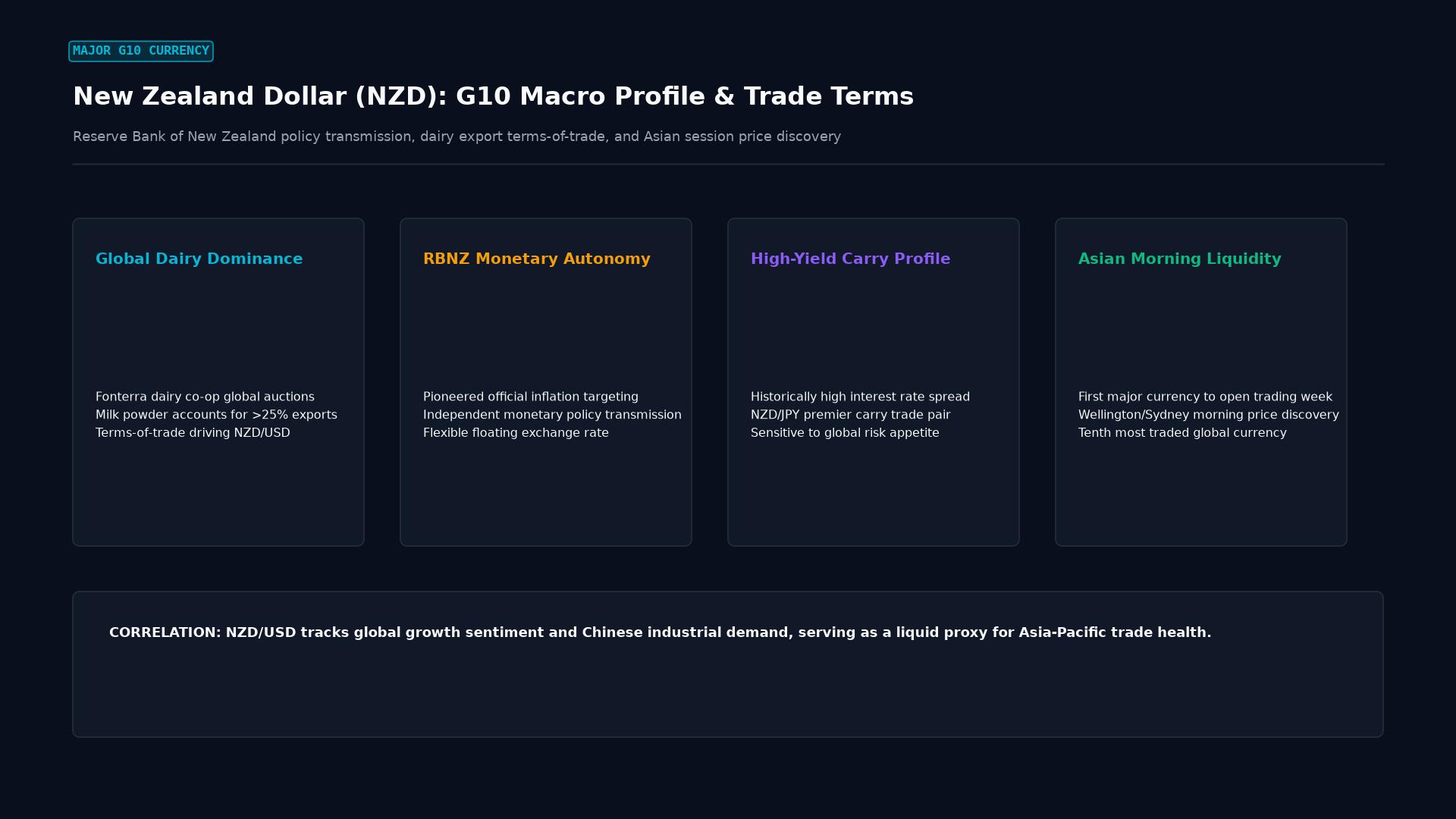 Figure: Reserve Bank of New Zealand policy transmission, dairy export terms-of-trade, and Asian session price discovery
Historical Origins and the Free-Market Revolution
From Imperial Sterling to Decimalization (1967)
For over a century following British colonization, New Zealand utilized the New Zealand Pound, maintaining parity with the British Pound Sterling and retaining the traditional non-decimal system of 20 shillings and 240 pence.
On July 10, 1967, the government completed a comprehensive decimalization program, introducing the New Zealand Dollar: $$1 \text{ New Zealand Pound} = 2 \text{ New Zealand Dollars (NZD)}$$ $$1 \text{ NZD} = 100 \text{ Cents}$$
Initially, the currency was pegged to the US Dollar at an exchange rate of $1.39 USD per 1.00 NZD. Over the following fifteen years, the currency operated under an administrative crawling peg and trade-weighted basket, repeatedly devalued in response to agricultural terms-of-trade shocks and the United Kingdom’s entry into the European Economic Community (which severed New Zealand’s guaranteed preferential agricultural export quotas).
Rogernomics and the Historic Float (March 4, 1985)
By mid-1984, New Zealand faced a full-blown constitutional and balance of payments crisis. The newly elected fourth Labour government, under Finance Minister Roger Douglas, initiated an aggressive series of free-market economic reforms known colloquially as Rogernomics:
- Dismantling Exchange Controls: On March 4, 1985, the RBNZ officially floated the New Zealand Dollar, completely removing capital controls and permitting market supply and demand to dictate the exchange rate.
- The 1989 RBNZ Act (Pioneering Inflation Targeting): In 1989, New Zealand passed landmark central bank legislation that fundamentally changed central banking globally. The Act granted statutory operational independence to the RBNZ, tasking it with a single, transparent objective: maintaining domestic price stability within an explicit numerical target band (originally 0% to 2%, later revised to 1% to 3%). This pioneered the modern Inflation Targeting Framework subsequently adopted by the Bank of England, the Bank of Canada, the European Central Bank, and the Federal Reserve.
                    NEW ZEALAND MONETARY POLICY MILESTONES

  1967 Decimalization            1985 Currency Float            1989 Inflation Targeting
  +-----------------------+      +-----------------------+      +-----------------------+
  | NZ Pound replaced by  | ===> | Rogernomics reforms;  | ===> | World's first official|
  | NZ Dollar (2:1 ratio) |      | complete removal of   |      | inflation-targeting   |
  | Decimal system born   |      | capital controls      |      | central bank mandate  |
  +-----------------------+      +-----------------------+      +-----------------------+
Macroeconomic Fundamentals: The Agricultural Dairy Engine
The New Zealand Dollar is classified as an advanced agricultural commodity currency. While peer commodity currencies such as the Australian Dollar (AUD) and Canadian Dollar (CAD) are driven by extractive hard commodities (iron ore, coal, crude petroleum), New Zealand’s terms of trade are anchored by pastoral agriculture:
                 THE DAIRY EXPORT PRICE TRANSMISSION CHAIN

  Global Dairy Trade (GDT) Bi-Weekly Auction Events in Auckland
                               |
                               v
  Whole Milk Powder (WMP) & Skim Milk Powder Clearing Prices
                               |
                               v
  Fonterra Farmgate Milk Price Forecast (Payouts to Domestic Farmers)
                               |
                               v
  Rural Economy Cash Flow, Capital Expenditures, and Commercial Bank Lending
                               |
                               v
  New Zealand Terms of Trade & Current Account Balance
                               |
                               v
  NZD Valuation vs. G10 Peers (NZD/USD, AUD/NZD, NZD/JPY)
1. The Global Dairy Trade (GDT) Benchmark
New Zealand is the world’s largest exporter of dairy products, commanding approximately one-third of total global dairy trade:
- Fonterra Co-operative Group: A massive farmer-owned cooperative that processes over 80% of New Zealand’s raw milk and dominates global dairy logistics.
- The GDT Pulse: Held twice monthly (on the first and third Tuesday of each month), the Global Dairy Trade (GDT) auction platform establishes global spot clearing prices for Whole Milk Powder (WMP), Skim Milk Powder (SMP), anhydrous milk fat, and butter.
Quantitative forex trading algorithms track the percentage change in the GDT Price Index upon release; substantial price beats generate immediate buying momentum in spot NZD/USD, while unexpected auction declines trigger rapid selling.
2. Trade Concentration with the People’s Republic of China
Following the signing of the historic New Zealand-China Free Trade Agreement in 2008 (the first comprehensive FTA China signed with an OECD nation), bilateral trade expanded dramatically. China is New Zealand’s single largest export destination, consuming approximately 30% of New Zealand’s total merchandise exports (primarily dairy, meat, and forestry products).
Consequently, the New Zealand Dollar displays high statistical correlation with Chinese macroeconomic indicators, including:
- China Caixin and Official Manufacturing PMIs.
- Chinese real estate construction activity (driving demand for New Zealand radiata pine logs).
- Fluctuations in the Chinese Yuan (USD/CNH).
The “Kiwi” Carry Trade and Global Microstructure
The New Zealand Dollar has historically served as a favorite instrument for international carry trade strategies:
+------------------------+--------------------------------------------------+
| Market Dimension       | NZD Operational Characteristics                  |
+------------------------+--------------------------------------------------+
| Primary Quote Pair     | NZD/USD (Quoted indirectly: US Dollars per 1 NZD)|
| High-Beta Crosses      | AUD/NZD (Trans-Tasman), NZD/JPY (Retail carry)   |
| Liquidity Horizon      | 24-Hour continuous trading (Starts the global    |
|                        | trading week in Wellington at 06:00 Local / UTC) |
| Standard Lot Size      | 100,000 NZD (Futures: CME Code 6N, 100,000 NZD)  |
| Interbank Settlement   | Continuous Linked Settlement (CLS) participant   |
| Settlement Standard    | Spot T+2                                         |
+------------------------+--------------------------------------------------+
1. The Trans-Tasman Cross (AUD/NZD)
The relationship between the Australian Dollar and New Zealand Dollar is one of the most closely watched regional cross-rates in global finance:
- Economic Integration: Australia and New Zealand share the Closer Economic Relations (CER) trade agreement, open labor migration, and interconnected commercial banking networks (New Zealand’s “Big Four” banks are wholly owned subsidiaries of Australia’s major banks: ANZ, ASB/CBA, BNZ/NAB, and Westpac).
- Terms of Trade Divergence: While both economies share close geographic proximity, their trade drivers diverge: Australia benefits from surges in steelmaking minerals (iron ore, coking coal), whereas New Zealand gains during food and soft commodity rallies.
- Monetary Policy Spreads: Shifts in the policy spread between the RBNZ Official Cash Rate (OCR) and the Reserve Bank of Australia (RBA) Cash Rate Target drive prolonged cyclical trends in the AUD/NZD exchange rate.
                    THE TRANS-TASMAN COMMODITY DRIVERS

  Australia (AUD)                               New Zealand (NZD)
  +-----------------------------------+         +-----------------------------------+
  | - Hard Mining Extractive Commodities|         | - Soft Agricultural Pastoral Goods|
  | - Iron Ore, Metallurgical Coal,   |         | - Whole Milk Powder, Dairy Fat,   |
  |   Gold, Liquefied Natural Gas     |         |   Lamb, Beef, Forestry Logs       |
  +-----------------------------------+         +-----------------------------------+
                   \                               /
                    \                             /
                     v                           v
              Divergence Drives Cyclical Swings in the AUD/NZD Cross
2. The Retail “Mrs. Watanabe” Carry Trade (NZD/JPY)
Historically, the RBNZ maintained relatively high structural interest rates to tame domestic housing booms, while the Bank of Japan maintained a Zero Interest Rate Policy (ZIRP) or Negative Interest Rate Policy (NIRP).
This persistent interest rate differential made the NZD/JPY pair a staple for Japanese retail margin investors (collectively termed “Mrs. Watanabe”) and international quantitative hedge funds:
- Investors borrow low-yielding Japanese Yen to buy high-yielding New Zealand Dollars, pocketing the positive daily rollover swap interest.
- However, during sudden global risk-off panics or liquidity shocks, carry trades unwind violently as investors scramble to repurchase yen, triggering sharp downside flash crashes in NZD/JPY.
Monetary Policy Mechanics of the RBNZ
The Reserve Bank of New Zealand steers domestic liquidity and guards price stability through the Official Cash Rate (OCR), introduced in March 1999:
- Policy Implementation: The RBNZ sets the OCR seven times per year. The OCR dictates the interest rate paid on overnight settlement cash balances held by registered banks in the Exchange Settlement Account System (ESAS).
- Symmetric Operating Corridor: The RBNZ operates an interest rate corridor around the OCR, maintaining standing facilities that provide automated liquidity at an interest rate spread above the OCR and paying interest on surplus reserves at the OCR.
- Macroprudential Loan-to-Value (LTV) Caps: To safeguard the financial system from domestic residential real estate bubbles without relying solely on blunt interest rate hikes, the RBNZ actively adjusts macroprudential speed limits on commercial banks, capping the proportion of high-LTV residential mortgages banks can originate.
Best Practices for Trading and Hedging NZD
- Trade Around the Global Dairy Trade (GDT) Calendar: Forex traders holding NZD/USD or AUD/NZD positions must align risk parameters with the bi-weekly GDT auctions (typically concluding around 13:00 to 15:00 UTC on auction Tuesdays). Unexpected shifts in Whole Milk Powder contract pricing frequently generate 50-to-100 pip immediate volatility spikes.
- Observe Wellington Asian Market Open: Because New Zealand is the first major financial market to open following the weekend (Wellington opens at 06:00 local time Monday morning, which is 18:00 UTC Sunday during Northern Hemisphere winter), initial weekend geopolitical news, election results, and unexpected macro headlines price directly into the New Zealand Dollar before European or US centers open.
- Analyze Housing Market Indicators as Leading Macro Clues: Because New Zealanders maintain high household wealth concentration in residential real estate, Real Estate Institute of New Zealand (REINZ) monthly house price index data provides vital forward guidance on future consumer spending, bank credit growth, and RBNZ policy tightening.
- Hedge Commercial Cash Flows via CME 6N Futures: Importers and exporters managing New Zealand Dollar exposure should utilize CME New Zealand Dollar futures (ticker:
6N), which offer deep electronic liquidity, standard contract units of 100,000 NZD, and full central counterparty clearing.
Frequently Asked Questions (FAQ)
Why is the New Zealand Dollar called the “Kiwi”?
The New Zealand Dollar is nicknamed the “Kiwi” in financial markets after the national bird of New Zealand, a small, flightless, nocturnal bird depicted on the reverse side of the physical one-dollar coin introduced in 1990. Forex traders globally refer to the currency simply as the “Kiwi” (e.g., “The Kiwi traded higher following the RBNZ rate decision”).
How does New Zealand’s economy differ fundamentally from Australia’s?
Although Australia and New Zealand are close geographical neighbors with deeply integrated banking sectors, their export profiles are fundamentally different. Australia is an extractive mining economy whose currency is driven primarily by bulk commodities like iron ore, metallurgical coal, gold, and liquefied natural gas. New Zealand is an agricultural soft-commodity economy whose currency is driven by pastoral agricultural exports, specifically whole milk powder, butter, lamb, beef, and timber.
What was the historic significance of the Reserve Bank of New Zealand Act 1989?
The Reserve Bank of New Zealand Act 1989 was a historic milestone in central banking history. It made the RBNZ the first central bank in the world to officially implement an explicit Inflation Targeting framework with statutory operational independence. This model proved so successful at anchoring long-term inflation expectations that it became the standard operating blueprint adopted by major central banks worldwide.
Ready to trade forex?
Open a free demo account with a regulated broker. Practice with virtual funds before risking real money.