AUD
AUD is the ISO 4217 currency code for the Australian Dollar, the official legal tender of the Commonwealth of Australia and several Pacific Island territories. Informally known on trading desks as the 'Aussie,' it ranks as the fifth most heavily traded currency in global foreign exchange markets.
What Is the Australian Dollar (AUD)?
The Australian Dollar, designated by the currency code AUD and currency symbol $ (or A$ to distinguish it from other dollar currencies), is the legal currency of Australia, Christmas Island, the Cocos (Keeling) Islands, Norfolk Island, and independent Pacific island nations including Kiribati, Nauru, and Tuvalu.
According to the Bank for International Settlements (BIS) Triennial Central Bank Survey, the Australian Dollar consistently ranks as the fifth most traded currency in the world, trailing only the US Dollar, the Euro, the Japanese Yen, and the British Pound. This immense global liquidity is remarkable given that Australia’s population represents less than 0.5% of the world’s total.
The currency’s outsized presence in international finance stems from several factors: Australia’s transparent legal system, a sound and stable banking sector, liquid financial markets, and its pivotal role as a primary supplier of vital natural resources to rapidly developing Asian economies.
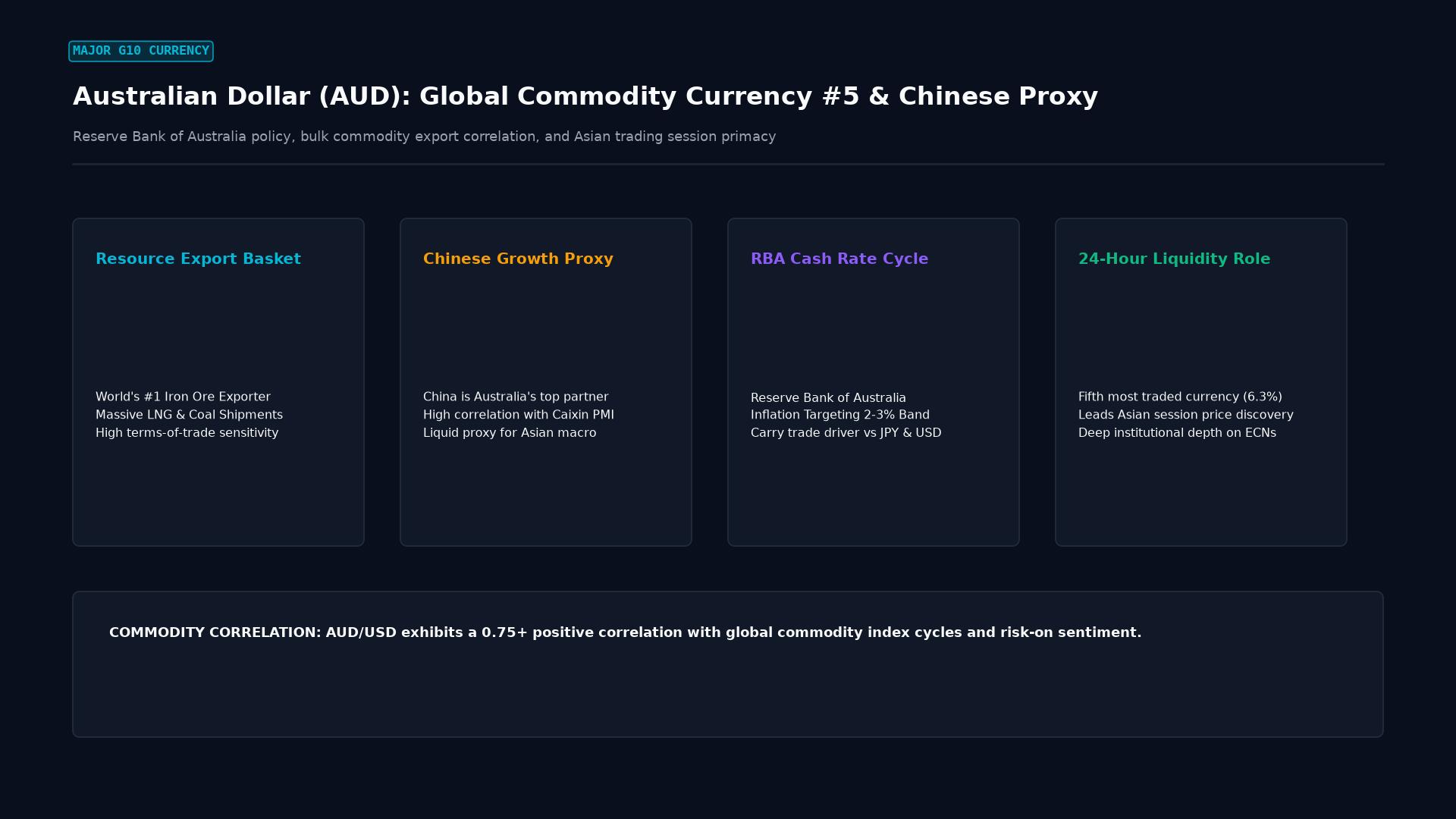 Figure: G10 commodity currency framework: Reserve Bank of Australia cash rate cycles, bulk mineral exports correlation, and 24-hour Asian session liquidity.
Key Characteristics of the AUD in Forex
Traders view the Australian Dollar through specific structural lenses that dictate how it behaves across market cycles:
1. The Archetypal “Commodity Currency”
Australia is one of the world’s largest exporters of industrial raw materials, including iron ore, metallurgical and thermal coal, liquefied natural gas (LNG), bauxite, and gold, along with agricultural products like wheat and beef. Because these bulk commodities constitute the overwhelming majority of Australia’s export revenues, the AUD exhibits a strong positive correlation with global commodity price indices. When global infrastructure spending and manufacturing boom, rising iron ore and energy prices expand Australia’s terms of trade, driving institutional demand for AUD. Conversely, when raw material prices slump, the Aussie dollar weakens.
2. The Global China Proxy
China is Australia’s largest two-way trading partner, historically purchasing over 30% of total Australian exports. Due to capital controls and currency restrictions on the Chinese Yuan (CNY/CNH), international portfolio managers frequently trade the Australian Dollar as a liquid, unregulated proxy for Chinese economic growth. When Chinese factory output, industrial profits, or real estate construction indices beat forecasts, the AUD rallies sharply. If Beijing introduces fiscal stimulus, AUD is often the first major currency to surge.
3. A High-Beta “Risk-On” Barometer
In financial market parlance, “beta” refers to sensitivity to broad market movements. The Australian Dollar is a classic high-beta risk asset. During periods of global economic expansion, rising stock markets, and general market optimism (“risk-on”), investors allocate capital into high-growth commodity economies, boosting the AUD. In contrast, during systemic crises, geopolitical conflicts, or liquidity contractions (“risk-off”), global funds rapidly unwind speculative positions in the Aussie, seeking refuge in the US Dollar, Swiss Franc, or Japanese Yen.
4. Carry Trade History
From the late 1990s through the mid-2010s, the Reserve Bank of Australia (RBA) maintained cash interest rates significantly higher than zero-bound economies like Japan and Switzerland. As a result, the AUD/JPY currency pair served as the premier vehicle for the global carry trade. Investors borrowed Yen at near-zero interest to purchase Australian government bonds yielding 5% to 7%, pocketing the yield differential alongside currency appreciation. While global interest rate environments have evolved, AUD crosses still attract substantial carry-oriented capital flows.
Major AUD Currency Pairs
- AUD/USD: Known as the “Aussie,” this major pair measures how many US Dollars equal one Australian Dollar. It is traded heavily around Asian and early European market sessions.
- AUD/JPY: Frequently monitored by institutional macro funds as a pure barometer of global market sentiment and risk tolerance. When AUD/JPY rallies, risk appetite is strong; when it breaks down, defensive hedging is underway.
- AUD/NZD: Known as the “Trans-Tasman cross.” Because both Australia and New Zealand are commodity-rich Pacific economies with close geographic ties, broad global factors affect both similarly. Traders play AUD/NZD to trade pure macroeconomic divergences, weather shocks, or central bank policy differences between the RBA and the Reserve Bank of New Zealand (RBNZ).
- EUR/AUD & GBP/AUD: Highly volatile European-Australian cross pairs characterized by wide daily average true ranges (ATR) exceeding 100 to 150 pips, favored by breakout and trend traders.
Practical Trading Example
Suppose an intraday trader prepares for the Asian trading session. The economic calendar highlights two crucial upcoming data points:
- 02:00 GMT: China National Bureau of Statistics (NBS) Manufacturing PMI
- 04:30 GMT: Reserve Bank of Australia (RBA) Interest Rate Decision and Statement
Prior to the releases, AUD/USD consolidates in a tight 20-pip range at 0.6520.
At 02:00 GMT, Chinese PMI arrives at 51.8, smashing the consensus estimate of 49.5 (signaling robust factory expansion) and iron ore futures in Singapore jump 3.5%. The positive surprise sparks immediate algorithmic buying of AUD/USD, lifting the pair through resistance up to 0.6555.
Two and a half hours later, the RBA announces that it is holding the cash rate steady, but its accompanying monetary statement explicitly warns of persistent domestic services inflation and refuses to rule out future rate hikes. Markets interpret the statement as hawkish.
Recognizing the confluence of strong Chinese industrial demand and an uncompromising central bank stance, the trader enters a long position at 0.6560 with a stop-loss set below previous session structure at 0.6535 (25 pips risk) and a target at the next major daily resistance level of 0.6620 (60 pips reward). Over the European and US sessions, the momentum sustains, hitting the 0.6620 target and delivering a 2.4:1 reward-to-risk return.
Key Takeaways
- AUD is the currency code for the Australian Dollar, nicknamed the “Aussie” and ranking as the 5th most traded currency globally.
- The currency functions as an archetypal commodity currency due to Australia’s massive export volumes of iron ore, coal, LNG, and gold.
- Global markets treat AUD as a liquid proxy for Chinese economic growth and Asian manufacturing demand.
- AUD acts as a high-beta “risk-on” asset that advances during periods of market confidence and sells off during market panics.
- Monetary policy set by the Reserve Bank of Australia (RBA) serves as the primary domestic catalyst for AUD exchange rates.
FAQ
Why is the Australian Dollar called the “Aussie”? Traders and market participants routinely use descriptive nicknames for convenience. “Aussie” is simply the traditional colloquial term for Australia and its citizens, adopted globally by foreign exchange dealing rooms.
What commodity has the biggest impact on the Australian Dollar? Iron ore is Australia’s single largest export by value, making iron ore futures and spot prices the most influential raw commodity input for the AUD. Coal and gold also exert notable influence.
How does China’s economic data affect the Australian Dollar? Because China purchases the majority of Australia’s mineral and energy output, any slowdown in Chinese industrial activity reduces demand for Australian exports. Disappointing Chinese economic data typically triggers an immediate sell-off in the AUD, while positive Chinese figures prompt rallies.
Ready to trade forex?
Open a free demo account with a regulated broker. Practice with virtual funds before risking real money.