Odd Lot
An odd lot is an order amount for a security or financial instrument that is smaller than the normal standardized unit of trading (round lot), such as fewer than 100 shares in equities or non-standard fractional units in retail and institutional foreign exchange.
What Is an Odd Lot?
In financial market microstructure, an odd lot refers to any transaction volume or resting order quantity that falls below the standardized trading increment—known as a round lot (traditionally 100 shares in US equity markets, or 100,000 units of base currency for a standard interbank foreign exchange contract). Any transaction that combines a standard round lot with an odd lot (such as 147 shares or 125,000 currency units) is referred to as a mixed lot.
Historically, odd-lot orders were treated as secondary flow. Floor specialists and designated market makers frequently charged manual routing differentials or widened bid-ask spreads on odd lots because odd-lot orders could not be posted directly to the consolidated tape or matched against the primary central limit order book (CLOB). In contemporary algorithmic markets, computerized matching engines and high-frequency trading (HFT) internalizers process odd lots alongside standard blocks; however, distinct pricing tiers, market-depth visibility rules, and routing considerations still apply across asset classes.
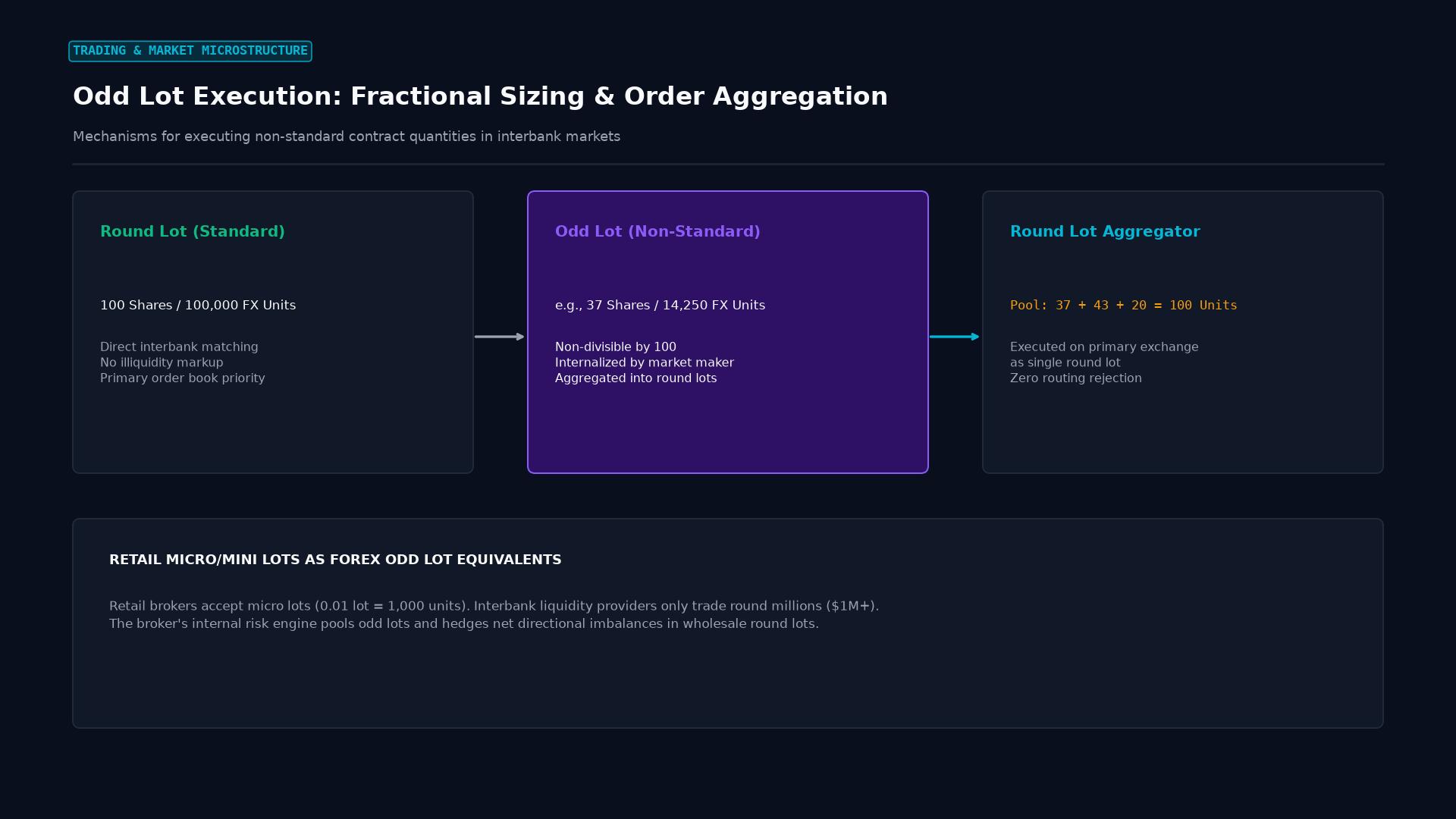 Figure: Non-standard contract execution: retail odd lots and micro-contracts aggregated by broker engines into interbank wholesale round lots.
Odd Lots Across Market Sectors
While the concept originated on physical equity trading floors, modern odd lots manifest differently across cash equities, fixed income, and spot forex.
1. Cash Equities
In equity markets regulated by the US Securities and Exchange Commission (SEC), Rule 611 of Regulation NMS historically protected only round lots (100 shares). This meant odd-lot limit orders resting inside the National Best Bid and Offer (NBBO) were not publicly displayed as the protected quote. While modern market data feeds (such as SIP feeds) have improved the inclusion of odd lots due to high-share-price stocks (e.g., Berkshire Hathaway Class A, tech equities trading at $500+), odd-lot executions frequently execute off-exchange in dark pools or retail wholesalers.
2. Spot Foreign Exchange
The interbank currency market trades in standard institutional clips, commonly increments of 1 million, 5 million, or 10 million units of base currency:
- Standard Lot (Interbank/Retail): 100,000 currency units.
- Mini Lot: 10,000 currency units.
- Micro Lot: 1,000 currency units.
- Nano or Broken Odd Lot: Any transaction not divisible by 1,000 units (e.g., buying 12,415 EUR/USD).
Retail brokerage platforms accommodate odd lots by utilizing liquidity aggregation algorithms. The retail broker acts as an internal clearinghouse, pooling odd-lot flows from thousands of retail accounts until a sufficient volume aggregates into a standard round lot for offsetting in Tier-1 bank liquidity pools.
3. Fixed Income and Municipal Bonds
In secondary bond markets, institutional round lots typically trade in par values of $1 million to $5 million. Bond transactions below $100,000 par are classified as odd lots. Because fixed-income instruments trade over-the-counter (OTC) without a centralized electronic book, odd-lot bond trades face a noticeable “liquidity haircut”—sellers often receive 50 to 200 basis points less than institutional round-lot valuations.
Round Lot vs. Mixed Lot vs. Odd Lot
The following table contrasts execution dynamics, pricing visibility, and market participation across order classifications:
| Feature | Round Lot | Mixed Lot | Odd Lot |
|---|---|---|---|
| Equities Standard | Multiple of 100 shares | Round lot + odd fraction (e.g., 245 shares) | Fewer than 100 shares (e.g., 17 shares) |
| Forex Standard | 100,000 base units (1.00 lot) | E.g., 1.37 lots (137,000 units) | Sub-micro or irregular clip (e.g., 850 units) |
| Order Book Display | Top of Book (NBBO display) | Split: round portion displayed, odd internalized | Internalized or private dark book |
| Execution Speed | Sub-millisecond direct match | Algorithmic split or multi-route | Instantaneous retail match; slow in OTC bonds |
| Pricing Efficiency | Pure wholesale interbank spread | Minor slippage on fractional remainder | Potential spread markups on boutique brokers |
| Primary Participant | Institutions, Hedge Funds, Banks | Discretionary traders, Algorithmic models | Retail accounts, Dollar-cost averaging (DCA) |
The Odd-Lot Theory: Historical Indicator vs. Modern Reality
In mid-20th-century market analysis, technicians developed the Odd-Lot Theory, an early contrarian sentiment indicator based on daily exchange clearing reports. The hypothesis posited:
- Small individual retail investors predominantly trade in odd lots.
- Retail investors make poor market timing decisions, buying aggressively at market tops and panic-selling at market bottoms.
- Therefore, calculating the Odd-Lot Short Ratio and net odd-lot purchases allowed contrarians to take the inverse side of aggregate odd-lot volume.
Mathematical Representation of Historical Odd-Lot Balance
$$\text{Odd-Lot Balance Index} = \frac{\text{Odd-Lot Purchases} - \text{Odd-Lot Sales}}{\text{Total Odd-Lot Volume}}$$
When the index spiked significantly positive near multi-month highs, contrarians interpreted it as an exhaustion signal preceding a market decline.
Why Odd-Lot Theory Collapsed
Modern market microstructure rendered the classic Odd-Lot Theory obsolete for two fundamental reasons:
- Algorithmic Slicing (TWAP / VWAP): Institutional quantitative funds broke down 50,000-share block orders into hundreds of random 15- to 45-share odd lots to minimize market footprint and avoid tipping off high-frequency predatory algorithms. Consequently, a massive percentage of odd-lot volume is institutional, not retail.
- Retail Fractional Investing: Modern commission-free brokers allow direct investment in exact dollar amounts ($50 in an expensive stock), transforming retail order routing into automated off-exchange wholesale sweeps.
Real-World Case Study: Algorithmic Odd-Lot Slicing in Volatile FX
During a European Central Bank (ECB) rate decision, an institutional asset manager needed to hedge €34,500,000 against USD without moving the market price during a period of wide interbank spreads.
- Standard Approach: Routing a single €34.5M order into the EBS or Currenex central book would consume top-of-book depth, slipping the execution price by 3.8 pips ($13,110 market impact).
- Algorithmic Execution: The desk employed a randomized execution algorithm that sliced the parent order into 420 child orders ranging between €50,000 (half round lot) and €95,000 (odd lot).
- Internalization: The executing broker’s smart order router (SOR) matched 40% of these child clips against incoming retail retail counterflow within its internal crossing network, securing midpoint pricing.
- Result: The parent order achieved an average execution price of 1.08422, saving 2.1 pips ($7,245) compared to direct block execution.
Frequently Asked Questions
Do odd-lot trades cost more in brokerage commissions?
In traditional fixed-income bonds and legacy full-service brokerages, yes—dealers charge a wider markup or flat handling fee for odd lots. However, in modern retail forex and zero-commission stock brokerages, odd lots trade at the same headline commission rate as round lots, though traders should monitor whether micro-account spreads are slightly wider than raw institutional accounts.
Can odd-lot orders influence the National Best Bid and Offer (NBBO)?
Historically, odd-lot limit orders were completely excluded from the NBBO calculation under SEC rules. Under modernized market data infrastructure rules, high-priced securities with odd lots resting inside the NBBO are increasingly collated and aggregated by exchange SIP feeds into round-lot equivalents, reducing the spread discrepancy between retail and institutional quotes.
What is the minimum lot size in spot forex?
On professional interbank matching engines (like EBS Market or Refinitiv Matching), the minimum round lot is typically 1 million base units. In contrast, retail MetaTrader and cTrader brokerages offer standard lots (100,000 units), mini lots (10,000 units), micro lots (1,000 units), and occasionally fractional nano lots (1 unit), allowing traders to customize position sizing down to individual cents.
Ready to trade forex?
Open a free demo account with a regulated broker. Practice with virtual funds before risking real money.