Partial Lot
A partial lot (often used synonymously with fractional lot or odd lot) is a trading order or open position size that represents a non-standard or fractional increment of a standard market lot, enabling granular position sizing, partial profit-taking, and tailored risk management.
What Is a Partial Lot?
In retail foreign exchange, CFD trading, and equity markets, a partial lot (frequently referred to as a fractional lot) is any transaction volume or active position size that does not conform to a single standard unit of trading (1.00 standard lot = 100,000 units of base currency).
Instead of being restricted to integer multiples of standard contracts (such as 1.0, 2.0, or 5.0 lots), modern electronic trading systems allow market participants to trade in fractional decimal increments:
- Mini Lots: 0.10 lots (10,000 currency units)
- Micro Lots: 0.01 lots (1,000 currency units)
- Partial Lot Increments: Any custom fractional size (e.g., 0.37 lots = 37,000 currency units, or 1.45 lots = 145,000 units).
The advent of partial lot functionality has revolutionized retail risk management by enabling traders to align their exact monetary risk (e.g., risking precisely 1.0% or $250 of account equity per trade) with specific stop-loss distances, rather than being forced to round their position size up or down to rigid integer lots.
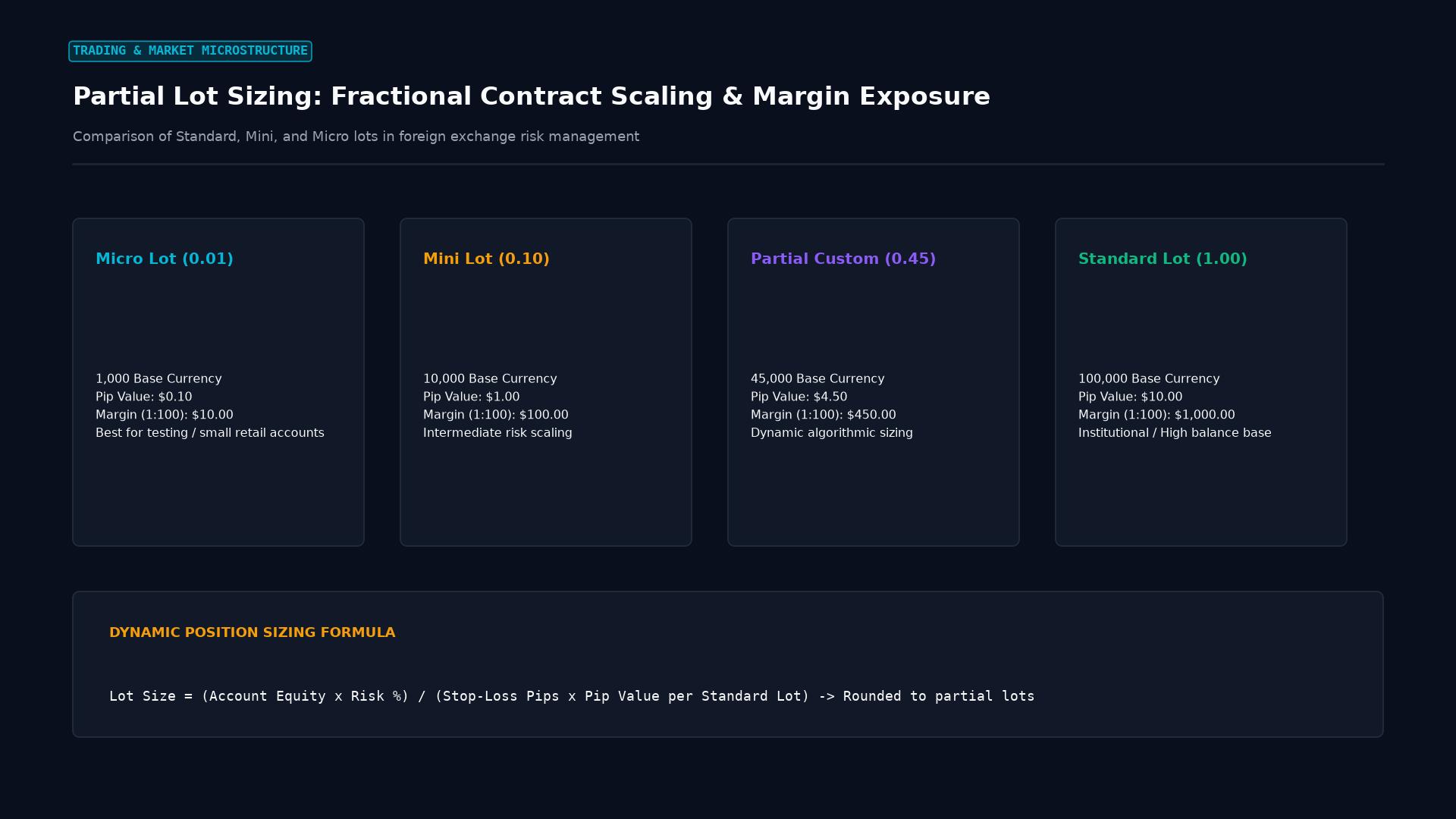 Figure: Contract sizing tiers: micro lots (0.01), mini lots (0.10), and standard lots (1.00) with dynamic equity-based lot sizing formulas.
Partial Lots in Position Sizing Math
Professional risk management mandates that trade volume should be determined mathematically by the distance to the structural invalidation point (stop-loss), not arbitrary round numbers:
$$\text{Position Size (Lots)} = \frac{\text{Account Capital} \times \text{Risk Percentage}}{\text{Stop-Loss Distance (pips)} \times \text{Pip Value per Standard Lot}}$$
Practical Position Sizing Calculation
Suppose an independent trader manages a $25,000 account and adheres to a strict 1.5% maximum risk rule ($375) on a EUR/USD swing setup:
- Entry Price: 1.0850
- Stop-Loss Price: 1.0792 (58 pips risk distance)
- Pip Value per Standard Lot: $10.00 USD
- Position Calculation: $$\text{Position Size} = \frac{$375}{58 \ \text{pips} \times $10.00} = \frac{$375}{$580} \approx \mathbf{0.646 \ \text{Lots}}$$
Without partial lot support, the trader would be forced to choose between rounding down to 0.10 mini-lot increments (0.60 lots, risking only $348) or rounding up to 1.00 standard lot (risking $580, which violates their 1.5% risk rule). By submitting a partial lot order of 0.65 lots, the trader deploys optimal risk efficiency.
Strategic Applications of Partial Lots
Partial lot execution is foundational to advanced trade execution strategies:
1. Scaling In (Layering / Pyramiding)
Rather than executing a single large block order at one price, institutional algorithms and discretionary traders slice the position into partial lots. By adding partial lots (e.g., 0.20 lots, then 0.30 lots, then 0.50 lots) as the market moves favorably, the trader confirms trend strength while maintaining low initial capital exposure.
2. Scaling Out (Partial Profit Taking)
When a market reaches an initial key technical target (such as Take-Profit 1 at a 1:2 Risk-Reward ratio), a trader can execute an offsetting partial close:
- If holding an initial position of 1.20 lots, the trader closes 0.80 lots to lock in realized cash profit.
- The remaining 0.40 partial lot is left running with a stop-loss moved to breakeven, allowing the trader to capture potential extended macro runners risk-free.
                   SCALING OUT VIA PARTIAL LOT CLOSURES

  [T0: Enter 1.00 Lot @ 1.2500] --------------------------------------------+
                                                                            |
  [T1: Target 1 Reached @ 1.2600] ---> Close 0.70 Partial Lot (+70 pips)    |
                                       - $700 Realized Profit Locked In     |
                                       - Move Stop-Loss on remainder to B/E |
                                                                            v
  [T2: Target 2 Reached @ 1.2750] ---> Close Remaining 0.30 Partial Lot     |
                                       - +$750 Additional Profit Locked In  |
                                       - Total Realized Gain: $1,450        |
Partial Lots vs. Standard Lots vs. Micro Lots
The operational characteristics across volume tiers include:
| Metric | Standard Lot (1.00) | Mini Lot (0.10) | Micro Lot (0.01) | Custom Partial Lot (e.g., 0.37) |
|---|---|---|---|---|
| Units of Base Currency | 100,000 units | 10,000 units | 1,000 units | 37,000 units |
| EUR/USD Pip Value | $10.00 per pip | $1.00 per pip | $0.10 per pip | $3.70 per pip |
| Minimum Account Size Recommended | $25,000+ | $2,500+ | $250+ | Scalable to any balance |
| Broker Aggregation | Direct interbank routing | Pooled internalizer | Pooled internalizer | Retail netting engine |
| Slippage Susceptibility | High during low liquidity | Low | Extremely low | Low to moderate |
Real-World Case Study: Managing Volatility Through Multiple Partial Closes
During a major US Non-Farm Payrolls (NFP) report, a swing trader held an open long position of 2.50 lots of GBP/USD from 1.2620, with a floating profit of +80 pips (spot trading at 1.2700).
- The Problem: The impending NFP release carried binary event risk; an upside surprise in US job creation could cause an immediate 100-pip drop, erasing all floating profits.
- The Partial Close Execution: At 8:28 AM EST (two minutes before the release), the trader submitted a partial close order for 1.75 lots (70% of the position) at 1.2700, locking in: $$\text{Realized Profit} = 1.75 \ \text{lots} \times 80 \ \text{pips} \times $10.00 = +$1{,}400 \ \text{USD}$$
- The Remainder: The remaining 0.75 partial lot was protected with a trailing stop at 1.2640 (+20 pips guaranteed).
- The Post-News Volatility: NFP printed significantly weaker than expected, causing GBP/USD to spike another 120 pips to 1.2820. The trader exited the final 0.75 lot at 1.2815, generating an additional +$1,462.50.
- Outcome: Partial lot flexibility allowed the trader to de-risk ahead of binary event volatility while extracting maximum trend expansion on the remaining fraction.
Frequently Asked Questions
Can I execute a partial close on MetaTrader 4 / 5?
Yes. To close a partial lot in MetaTrader, right-click the open position in the Terminal/Toolbox, select Modify or Delete Order, change the type to Market Execution, adjust the Volume field to the desired partial amount you wish to close (e.g., 0.50 out of 1.00), and click the yellow Close button.
What is the difference between an odd lot and a partial lot?
In traditional equity markets, an odd lot refers to any share quantity below 100 shares. In modern forex trading, a partial lot refers to trading in non-integer decimal increments of standard lots (such as 0.25 or 1.15 lots), facilitating precise micro-risk management.
Do brokers charge higher spreads or commissions on partial lots?
On reputable STP/ECN brokerages, commission and spread rates are strictly proportional to the traded volume. For example, if a broker charges a commission of $7.00 per standard lot round-turn, trading a partial lot of 0.25 lots will incur an exact proportional commission of $1.75.
Ready to trade forex?
Open a free demo account with a regulated broker. Practice with virtual funds before risking real money.