One-Cancels-the-Other Order (OCO)
A One-Cancels-the-Other (OCO) order is a conditional order pairing two pending orders, where the execution or fill of one order automatically and instantly cancels the remaining order.
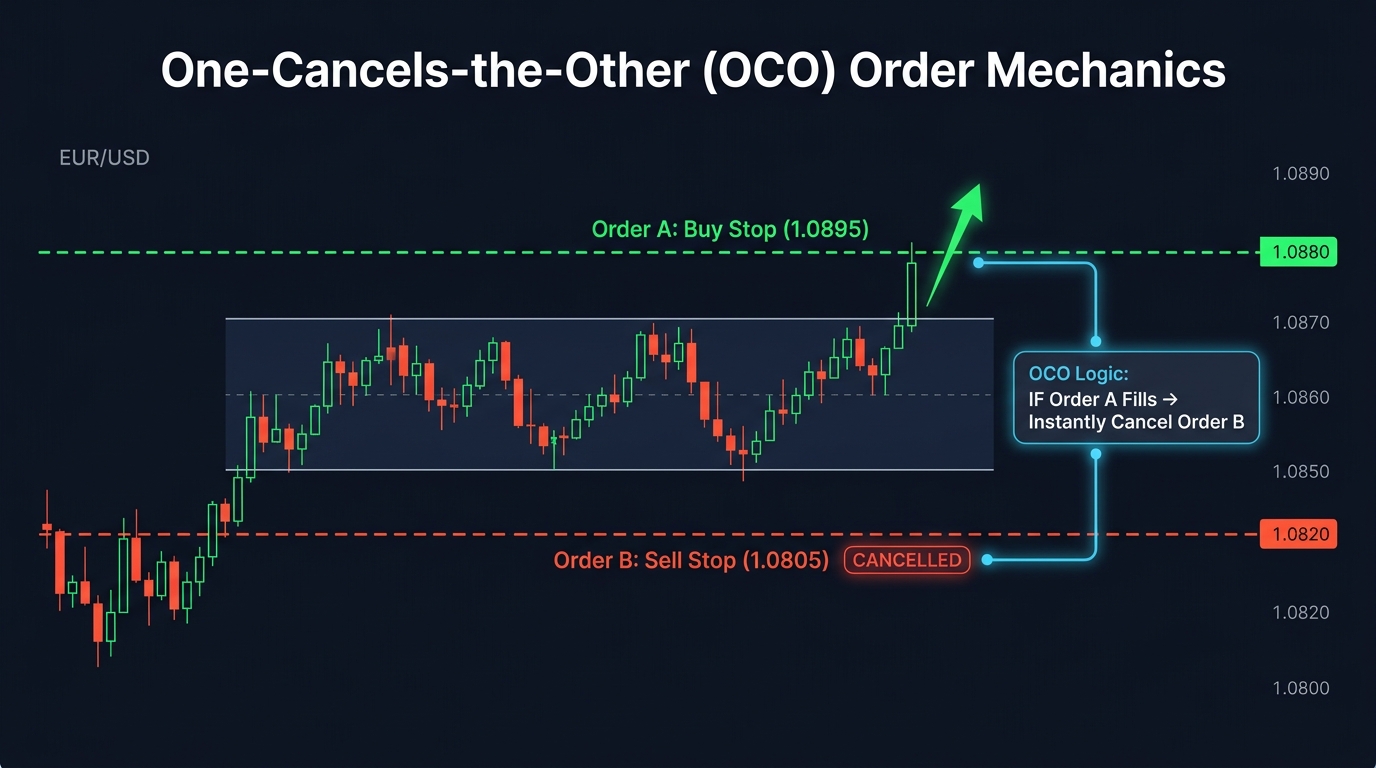
A One-Cancels-the-Other (OCO) order—frequently termed an “order cancels order”—is a paired conditional order structure commonly utilized by professional currency traders. It links two pending orders together through automated broker logic: as soon as market conditions trigger the execution of one order, the trading engine instantly extinguishes and cancels the alternative unexecuted order.
By automating trade management, OCO orders eliminate the danger of double execution, allowing traders to capture breakouts or secure profits without needing to manually monitor their screens around the clock.
How OCO Logic Operates
The conditional architecture of an OCO order relies on strict binary execution logic:
$$\text{Trigger}(\text{Order}_A) \longrightarrow \text{Execute}(\text{Order}_A) \quad \text{AND} \quad \text{Cancel}(\text{Order}_B)$$
If neither price level is reached, both orders remain resting peacefully on the broker’s server until manually canceled or until their specified expiration time (such as Good-Till-Cancelled or Day Order) arrives.
The Two Primary Applications of OCO Orders
1. The Pre-News Breakout Straddle
Ahead of major market-moving macroeconomic releases—such as U.S. Non-Farm Payrolls (NFP), Consumer Price Index (CPI) reports, or central bank rate decisions—currency pairs often coil inside tight consolidation ranges. Traders know an explosive directional move is imminent, but the direction depends on whether the data beats or misses expectations:
- A Buy Stop order is placed 10 to 15 pips above the upper resistance boundary.
- A Sell Stop order is placed 10 to 15 pips below the lower support boundary.
- When the news release triggers a violent rally, the Buy Stop fills, and the OCO engine immediately purges the pending Sell Stop, preventing an accidental whipsaw entry if the market later reverses.
2. Position Protection: The Bracket Order
When a trader enters an active trade, they must manage two opposing potential outcomes: securing gains at their profit target or limiting downside if the market turns. An OCO order links these two exits:
- A Take-Profit (Limit Order) placed at a favorable price level.
- A Stop-Loss (Stop Order) placed at a defensive invalidation level.
- Whichever order fills first automatically cancels the other. Without an OCO link, an unmonitored take-profit fill would leave a “naked” stop-loss resting on the order book, which could inadvertently open a reverse trade if prices later revisit that level.
Order Comparison: OCO vs. Standard Pending Orders
| Order Type | Structure | Primary Advantage | Best Use Case |
|---|---|---|---|
| OCO (One-Cancels-the-Other) | Two linked pending orders | Prevents accidental double exposure; automates breakout trades | News straddles, range breakouts, bracket exit management |
| OTO (One-Triggers-the-Other) | Sequential chain (parent-child) | Automatically places a stop and target once entry fills | Multi-stage automated trade execution |
| Standard Limit / Stop | Single standalone order | Simple entry or exit at a designated price | Routine support/resistance trading |
Practical Example: Symmetrical Triangle Straddle on EUR/USD
Consider EUR/USD consolidating into the apex of a symmetrical triangle ahead of a Federal Open Market Committee (FOMC) interest rate decision:
- Current market price: 1.0850
- Upper triangle resistance: 1.0880
- Lower triangle support: 1.0820
The OCO Configuration
The trader creates a linked OCO pending order on their terminal:
- Order A (Buy Stop): Buy 1.0 standard lot at 1.0895 (with a Take-Profit at 1.0970 and Stop-Loss at 1.0855).
- Order B (Sell Stop): Sell 1.0 standard lot at 1.0805 (with a Take-Profit at 1.0730 and Stop-Loss at 1.0845).
Execution Sequence
- The Federal Reserve issues a dovish surprise, signaling forthcoming rate cuts.
- The U.S. dollar sells off aggressively. EUR/USD spikes from 1.0850 to 1.0910 within 30 seconds.
- Price pierces 1.0895, executing Order A (Buy Stop).
- The broker’s execution server instantaneously cancels Order B (Sell Stop).
- The trader rides the upward momentum with defined risk, completely protected from lingering pending orders below the market.
Pitfalls and Risks of Trading with OCO Orders
While OCO orders provide powerful tactical automation, high-volatility environments introduce specific hazards:
- Slippage on News Releases: During volatile economic releases, liquidity evaporates momentarily. A Buy Stop set at 1.0895 may experience negative slippage and fill at 1.0910, altering the intended risk-reward ratio.
- Spread Widening: Right at the release of tier-1 news, the bid-ask spread can temporarily widen from 0.8 pips to 15 or 20 pips. An extreme spread flare can trigger a Buy Stop on the Ask price while simultaneously triggering a Sell Stop on the Bid price before the cancellation command processes, creating an accidental double fill. To avoid this, set OCO entry orders with sufficient buffer beyond the immediate consolidation boundaries.
Key Takeaways
- Automated Binary Logic: An OCO order links two pending orders such that the execution of one immediately cancels the other.
- Breakout Freedom: Enables traders to set up “straddle” strategies on both sides of a consolidating range ahead of high-impact economic news releases.
- Bracket Security: Serves as a standard framework for bracketing open positions with simultaneous take-profit and stop-loss orders.
- Elimination of Orphan Orders: Prevents forgotten pending orders from remaining active on the broker’s server and triggering unintended trades later.
- Spread Awareness: Traders must maintain adequate price buffers during news events to prevent widening bid-ask spreads from prematurely firing both sides.
Frequently Asked Questions
Are OCO orders supported on MetaTrader 4 and 5?
MetaTrader 4 does not support native single-click OCO orders out of the box (bracket stop-loss and take-profit orders are handled within the open trade window). However, traders frequently implement OCO straddle functionality on MT4 and MT5 using automated scripts, expert advisors (EAs), or specialized trade panels. Platforms like cTrader, TradingView, and NinjaTrader support OCO orders natively.
What happens if an OCO order experiences slippage?
If market volatility causes slippage, the order will execute at the next best available price. Once that execution is recorded by the broker’s server, the companion order is immediately canceled, regardless of any slippage on the filled leg.
What is the difference between an OCO and an OTO order?
An OCO (One-Cancels-the-Other) order cancels the alternate order when one executes. An OTO (One-Triggers-the-Other) order does the opposite: it holds a secondary order in a dormant state and activates it only after the primary parent order is filled.
Ready to trade forex?
Open a free demo account with a regulated broker. Practice with virtual funds before risking real money.