Outright Deal
An outright deal is a standalone foreign exchange or financial market transaction—executed either for immediate spot delivery or a future forward date—that is committed as a single independent purchase or sale without being bundled with a simultaneous opposing leg, distinguishing it from an FX swap.
What Is an Outright Deal?
In international banking, treasury management, and foreign exchange dealing, an outright deal (also called an outright transaction) is any independent trade where a participant buys or sells a specified currency amount against another currency for settlement on a defined date, with zero accompanying or reverse commitment.
The term exists primarily to distinguish standard single-leg transactions from foreign exchange swaps (FX swaps). In an FX swap, a market participant simultaneously executes two linked legs (e.g., buying spot today and selling forward in three months) to roll liquidity without creating net directional currency exposure. In contrast, an outright deal is a pure single-leg commitment:
- An Outright Spot Deal: An agreement to exchange currencies at the spot rate for standard delivery in two business days ($T+2$).
- An Outright Forward Deal: An agreement to exchange currencies at a locked forward exchange rate on a specified future date (e.g., six months from today), without a simultaneous spot transaction.
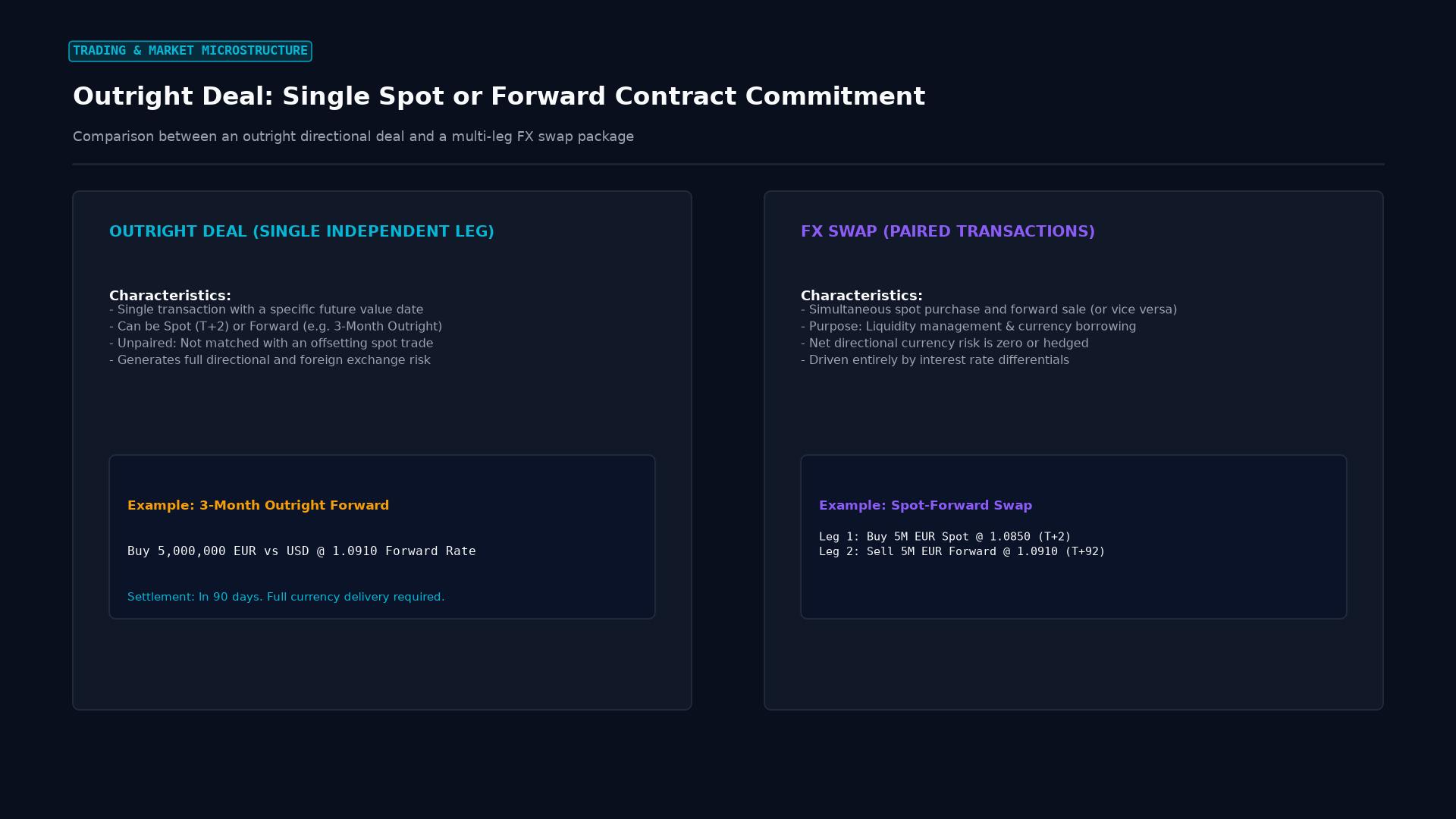 Figure: Single outright directional trade execution (spot or forward delivery) contrasted with paired, delta-neutral FX swap commitments.
Types of Outright Deals in Forex Dealing
Outright deals are executed through two primary settlement timeframes:
1. Outright Spot Transactions
The most common outright deal in global finance. Counterparties agree to buy or sell currencies at the prevailing spot exchange rate, with settlement taking place on the conventional spot date (typically $T+2$ for most currency pairs, or $T+1$ for USD/CAD, USD/TRY, and USD/PHP). The buyer assumes open directional risk from the moment of execution.
2. Outright Forward Transactions
An outright forward is a customized over-the-counter (OTC) contract locking in a guaranteed exchange rate for settlement beyond the spot date. Unlike currency futures traded on standardized exchanges, outright forwards are tailored to the exact corporate requirement (e.g., settling on October 14 for an exact sum of £4,231,500).
The forward exchange rate is determined mathematically by adding or subtracting forward points (swap points) from the spot rate, reflecting the interest rate differential between the two currencies according to Covered Interest Parity (CIP):
$$\text{Forward Rate} = \text{Spot Rate} \times \left[\frac{1 + (r_{\text{quote}} \times \frac{d}{360})}{1 + (r_{\text{base}} \times \frac{d}{360})}\right]$$
Market Architecture: Outright Deals vs. FX Swaps
According to the Bank for International Settlements (BIS) Triennial Central Bank Survey, foreign exchange swaps account for over 50% of daily global FX turnover, while outright forwards and spot deals represent the remainder. The functional distinctions include:
| Operational Feature | Outright Deal (Spot or Forward) | FX Swap |
|---|---|---|
| Number of Legs | Single leg (One discrete buy or sell). | Two linked legs (Spot vs. Forward or Forward vs. Forward). |
| Net Market Exposure | Directional: Creates an open long/short currency risk. | Neutral: Currency risk is eliminated; exposed only to interest rate differentials. |
| Primary User | Importers, exporters, asset managers, directional speculators. | Commercial banks, sovereign treasuries, multinational cash desks. |
| Primary Purpose | Complete payment settlement, asset acquisition, or macro speculation. | Liquidity management, short-term funding, rolling existing hedge contracts. |
| Capital Requirement | Consumes credit lines and requires settlement margin. | Lower credit risk weighting because principal is returned at maturity. |
Pricing Mechanics: How Dealers Price Outright Forwards
In interbank dealing rooms, dealers rarely price an outright forward directly from scratch. Instead, the dealer prices an outright forward synthetically by decomposing it into two interbank components:
- The Spot Market: The dealer executes a spot deal at the prevailing interbank rate to eliminate immediate currency risk.
- The Swap Market: The dealer executes an FX swap to shift the settlement date from spot ($T+2$) to the desired forward maturity date.
$$\text{Outright Forward Rate} = \text{Spot Price} \pm \text{Forward Points (from FX Swap)}$$
Because the interbank swap market is significantly more liquid than the outright forward market, this synthetic decomposition allows market makers to quote razor-thin bid/ask spreads to commercial corporate clients.
Real-World Case Study: Hedging Aircraft Delivery with an Outright Forward Deal
In March 2023, a European airline contracted to purchase a fleet of commercial passenger jets from an American aerospace manufacturer, with a final milestone delivery payment of $250,000,000 USD due on December 15, 2023.
- The Problem: The airline’s operational revenues are in Euros (€), while the delivery obligation is in US Dollars ($). In March, EUR/USD traded at 1.0700. If the Euro depreciated to 1.0000 by December, the jet purchase would cost €250,000,000 instead of €233,645,000—an unhedged operational loss of over €16 million.
- The Execution: The corporate treasury executed an Outright Forward Deal with a syndicate of three relationship banks, agreeing to buy $250,000,000 against EUR for settlement on December 15, 2023, at an agreed forward rate of 1.0820 (incorporating US-Euro interest rate differentials).
- The Settlement: On December 15, regardless of prevailing market turbulence, the airline paid exactly €231,053,604 to receive $250,000,000, successfully eliminating directional FX risk in a single, unbundled outright commitment.
Frequently Asked Questions
Can an outright forward deal be terminated before its maturity date?
An outright forward contract is a legally binding OTC obligation and cannot simply be voided. However, if a corporate client no longer needs the currency, they can execute an offsetting outright forward or an early spot reversal with the dealing bank, settling the net mark-to-market cash difference.
What is the difference between an outright deal and a currency future?
An outright deal (such as an outright forward) is an over-the-counter (OTC) bilateral agreement negotiated between a client and a bank, customized in date and amount, with settlement through bank clearing accounts. A currency future is a standardized contract traded on a public exchange (like the CME) with fixed contract sizes and mandatory daily cash variation margin.
Why do banks charge forward points on outright forward deals?
Forward points are not an arbitrary dealer fee or commission; they represent the mathematical interest rate differential between the two national currencies over the life of the contract, preventing riskless cross-border arbitrage under Covered Interest Parity (CIP).
Ready to trade forex?
Open a free demo account with a regulated broker. Practice with virtual funds before risking real money.