Outright Forward
An outright forward is an over-the-counter (OTC) foreign exchange contract between two parties to purchase or sell a specified quantity of currency at an agreed-upon exchange rate on a fixed future date beyond the standard spot settlement cycle.
What Is an Outright Forward?
An outright forward (often referred to simply as an FX forward or forward contract) is a customized, legally binding bilateral agreement traded in the over-the-counter (OTC) foreign exchange market. Under an outright forward, two counterparties lock in an exact exchange rate today to buy or sell a specified amount of currency on an agreed calendar date in the future—ranging from three days to several years past the standard spot settlement date ($T+2$).
Unlike standard exchange-traded currency futures (which have standardized contract sizes and fixed quarterly expiration dates), outright forwards are fully customized to the exact cash flow needs of multinational corporations, institutional asset managers, and sovereign treasuries.
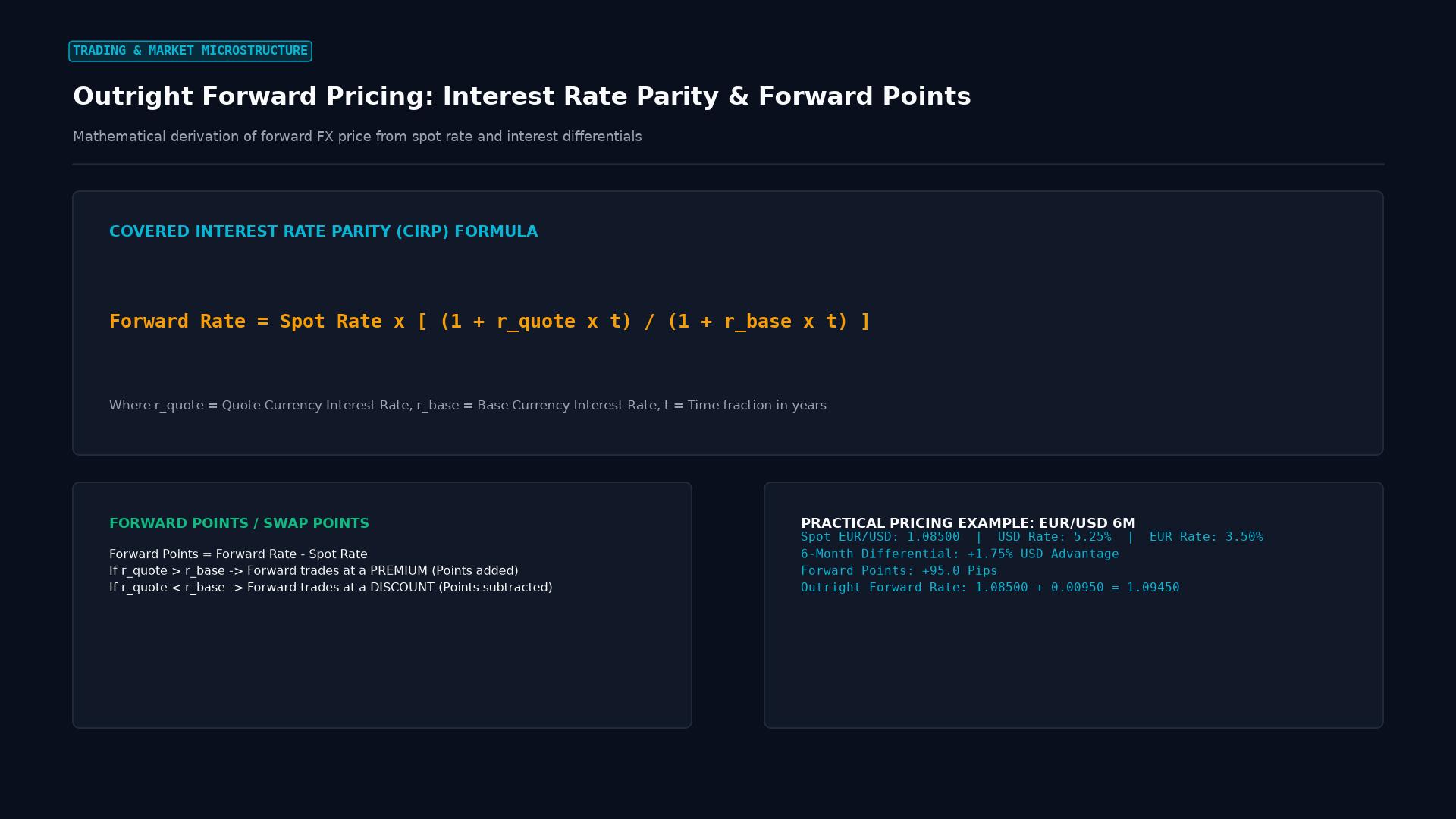 Figure: Covered interest rate parity formula: spot rate adjusted by forward swap points based on interest rate differentials to derive outright forward price.
Forward Rate Pricing and Covered Interest Parity (CIP)
A common misconception among retail traders is that a forward exchange rate represents a bank’s speculative forecast of where the currency will trade in the future. In institutional banking, the forward rate is determined by the mathematical relationship between the interest rates of the two currencies, governed by Covered Interest Parity (CIP):
$$\text{Forward Rate} = \text{Spot Rate} \times \left[\frac{1 + \left(r_{\text{quote}} \times \frac{\text{Days}}{\text{Year}}\right)}{1 + \left(r_{\text{base}} \times \frac{\text{Days}}{\text{Year}}\right)}\right]$$
Where:
- $r_{\text{base}}$ = Short-term risk-free interest rate of the base currency (e.g., Euro).
- $r_{\text{quote}}$ = Short-term risk-free interest rate of the quote currency (e.g., US Dollar).
- $\text{Days}$ = Number of days to forward maturity.
- $\text{Year}$ = Money market day-count convention (typically 360 days, or 365 days for GBP).
Forward Points (Swap Points)
The difference between the forward rate and the spot rate is expressed in forward points:
$$\text{Forward Points} = \text{Forward Rate} - \text{Spot Rate}$$
- Forward Premium: If the base currency has a lower interest rate than the quote currency, the forward rate trades at a premium (forward points are positive and added to spot).
- Forward Discount: If the base currency has a higher interest rate than the quote currency, the forward rate trades at a discount (forward points are negative and subtracted from spot).
Outright Forwards vs. Currency Futures
Corporate risk managers evaluate outright forwards against exchange-traded futures based on operational requirements:
| Operational Feature | Outright Forward (OTC) | Currency Future (Exchange-Traded) |
|---|---|---|
| Trading Venue | Over-the-counter (Bilateral bank dealing). | Centralized electronic exchange (e.g., CME). |
| Contract Size | Fully customized (e.g., €3,412,850). | Standardized contract sizes (e.g., €125,000 per lot). |
| Settlement Date | Any valid business banking day requested. | Fixed quarterly cycles (March, June, September, December). |
| Cash Flow / Margin | No daily cash calls (settles at maturity or via ISDA credit line). | Mandatory daily mark-to-market variation margin. |
| Credit / Counterparty Risk | Bilateral bank counterparty credit exposure. | Mitigated by central clearinghouse novation. |
| Regulation | Dodd-Frank / EMIR trade reporting rules. | CFTC / Exchange oversight. |
Delivery: Physical vs. Non-Deliverable Forwards (NDF)
Depending on the convertibility of the underlying currency, outright forwards settle via two mechanisms:
- Deliverable Outright Forwards: Standard for freely convertible G10 currencies (USD, EUR, GBP, JPY, CHF, CAD, AUD, NZD). On settlement date, actual gross currency amounts are transferred between correspondent bank accounts via the Continuous Linked Settlement (CLS) system.
- Non-Deliverable Forwards (NDF): Utilized for emerging market currencies with capital controls or non-convertibility restrictions (such as Indian Rupee - INR, Brazilian Real - BRL, or Korean Won - KRW). No physical currency is exchanged; instead, the net profit or loss is settled in US Dollars based on the difference between the agreed NDF rate and the official central bank fixing rate at maturity.
Real-World Case Study: Eliminating Margin Drag in Corporate Treasury
In January 2024, a Japanese automotive manufacturer operating in the United States projected $500,000,000 USD in revenue from US vehicle sales to be repatriated to Japan in six months.
- Market Parameters: Spot USD/JPY was 148.00. US 6-month Treasury yield was 5.30%, while Japanese 6-month interbank yield was 0.00%.
- The Pricing: Because USD carried a 530 bps yield advantage, USD/JPY forward points were deeply negative (trading at a large forward discount): $$\text{USD/JPY 6-Month Forward} \approx 144.15$$
- The Forward Execution: The automaker entered an outright forward with a bank syndicate to sell $500,000,000 at 144.15 on July 15, 2024, locking in ¥72,075,000,000.
- Why Forwards Over Futures: Had the corporate treasurer used CME currency futures, sudden swings in USD/JPY would have required hundreds of millions of dollars in cash variation margin, tying up operational working capital. The OTC outright forward locked in the exact Yen revenue without any intraday cash margin drain.
Frequently Asked Questions
Can an outright forward be extended or rolled over if business plans change?
Yes. If the underlying commercial transaction is delayed, the corporate client can request an FX forward roll or swap with the bank. The bank closes the original forward on its settlement date and executes a new forward for the revised maturity date, adjusting for prevailing forward points.
What is the difference between an outright forward and an FX swap?
An outright forward is a single transaction locking in future delivery of one currency against another. An FX swap involves two simultaneous transactions—typically buying spot today and selling forward in the future—used to roll currency liquidity without creating net directional exchange rate exposure.
Are outright forwards accessible to retail forex traders?
Outright forwards are predominantly an institutional tool due to bilateral credit agreement requirements (ISDA Master Agreements). Retail traders primarily use spot forex contracts (which automatically roll forward daily via Tom-Next swaps) or retail micro-futures.
Ready to trade forex?
Open a free demo account with a regulated broker. Practice with virtual funds before risking real money.