Counterparty
A counterparty is the opposite legal or financial entity participating in a bilateral transaction, assuming the inverse position (buyer versus seller) and bearing reciprocal performance and credit obligations.
What Is a Counterparty?
In financial markets, a counterparty is the legal, corporate, or individual entity that stands on the opposite side of a financial contract or commercial transaction. Every financial trade requires two distinct counterparties: a buyer (who agrees to purchase an asset) and a seller (who agrees to deliver the asset or assume the underlying obligation).
The legal relationship between counterparties establishes mutual rights, financial claims, and potential credit liabilities. In exchange-traded markets (such as futures and equities), counterparty exposure is novated and guaranteed by a Central Counterparty (CCP) clearinghouse. However, in decentralized, Over-the-Counter (OTC) markets—including spot forex, bilateral currency forwards, and bespoke swaps—counterparties face direct counterparty credit risk: the hazard that one entity will default, enter bankruptcy, or fail to honor its contractual commitments before settlement is finalized.
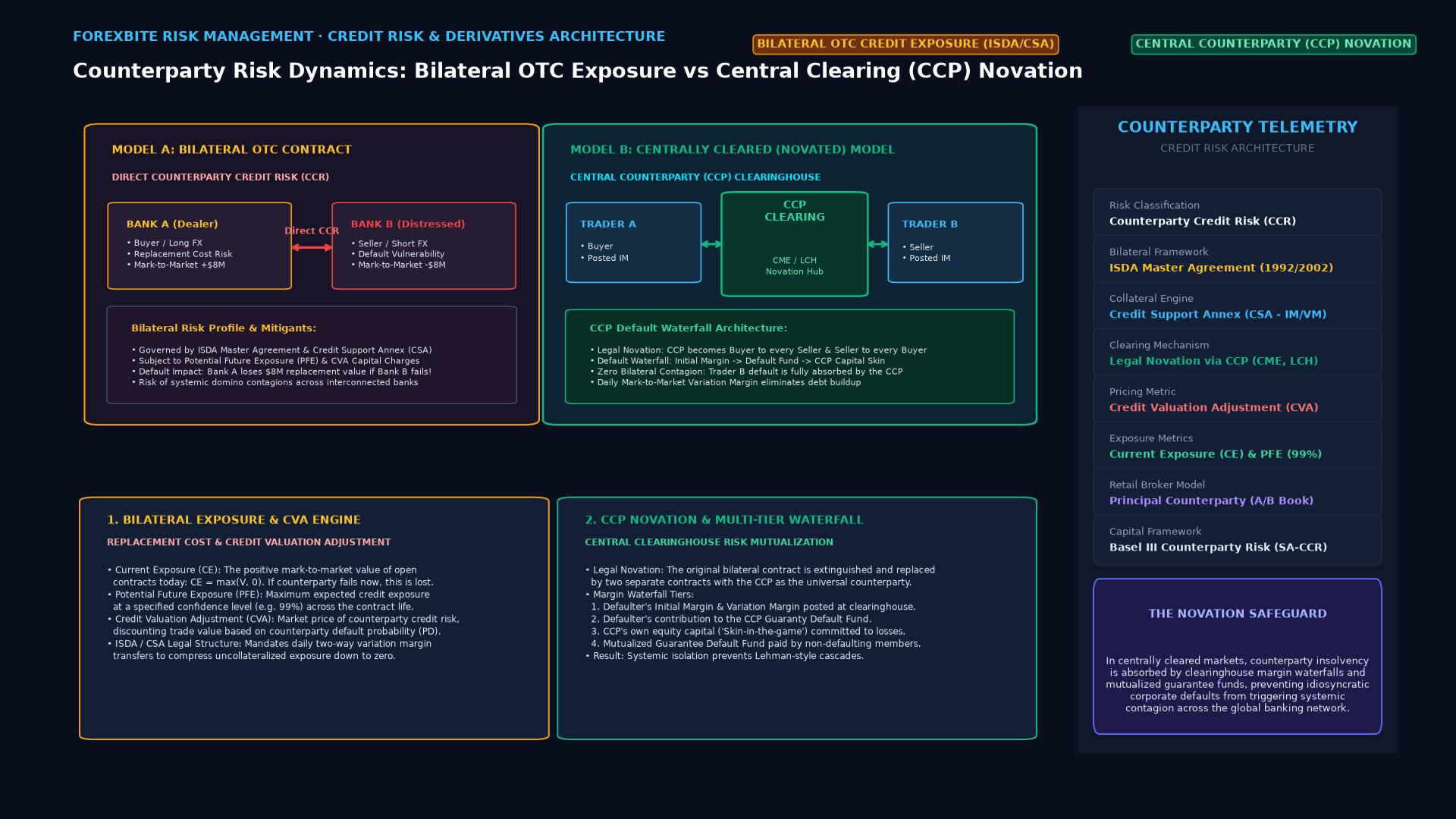 Figure: Comparison between bilateral OTC counterparty credit exposure (ISDA/CSA rules) and central counterparty clearinghouse (CCP) novation with multi-tier default waterfall.
Key Takeaways
- Reciprocal Obligations: In foreign exchange, counterparties simultaneously exchange two currencies, creating mutual settlement and replacement cost exposures.
- Counterparty Credit Risk (CCR): The financial risk that a counterparty fails to fulfill their settlement obligations due to insolvency, operational failure, or sovereign intervention.
- Bilateral vs. Centrally Cleared: In exchange-traded derivatives, a clearinghouse acts as the legal counterparty to both sides through novation, virtually eliminating bilateral default risk.
- Retail Broker as Principal: In standard retail spot forex, the retail brokerage firm acts as the direct contractual counterparty to the retail client, regardless of whether the broker hedges the flow externally (A-book) or absorbs it internally (B-book).
Counterparty Risk Profiles Across Financial Segments
Counterparty relationships function differently across the institutional and retail tiers of the financial ecosystem:
| Market Tier | Counterparty Architecture | Legal & Protective Framework | Primary Risk Vector |
|---|---|---|---|
| Interbank Institutional FX | Bilateral Tier-1 Money Center Banks (e.g., JPMorgan, Citi, UBS) | ISDA Master Agreement & Credit Support Annex (CSA) | Replacement cost risk; Herstatt settlement risk (mitigated by CLS) |
| Exchange-Traded Futures | Central Counterparty Clearinghouse (e.g., CME Clearing, LCH) | Statutory exchange rules, SPAN daily mark-to-market, default waterfalls | Clearing member default mutualization |
| Prime Brokerage | Prime Broker stands between client and executing dealer | Tri-party give-up agreements, collateral haircut schedules | Client liquidation slippage exceeding deposited margin |
| Retail Spot Forex / CFDs | Retail Broker acts as Principal counterparty to the retail client | Client terms of business, regulatory licensing (FCA, ASIC, NFA) | Broker insolvency, platform execution manipulation, withdrawal freezes |
Quantifying Counterparty Credit Exposure
Financial institutions model counterparty exposure into two distinct analytical dimensions:
1. Pre-Settlement (Replacement Cost) Risk
If Party B defaults while a multi-month currency forward is running in Party A’s favor, Party A does not lose their principal, but they lose the unrealized profit and must replace the contract at prevailing market rates:
$$\text{Current Exposure} = \max(0, V_{\text{mark-to-market}})$$
$$\text{Potential Future Exposure (PFE)} = \text{Current Exposure} + \text{Add-On for Volatility over Horizon } T$$
Institutions adjust derivative valuations using Credit Valuation Adjustment (CVA), which discounts the contract value to account for the probability of counterparty default:
$$\text{CVA} \approx (1 - R) \int_0^T \text{EE}(t) \cdot d\text{PD}(t)$$
Where $R$ is the recovery rate, $\text{EE}(t)$ is expected exposure, and $\text{PD}(t)$ is the cumulative probability of default.
2. Settlement (Principal) Risk
Settlement risk occurs on the value date when Party A delivers currency to Party B before verifying that Party B has delivered the opposite currency. In 1974, this caused the catastrophic collapse of Bankhaus Herstatt, ultimately resolved in 2002 by the creation of Continuous Linked Settlement (CLS Bank).
Real-World Case Study: The 2015 Swiss National Bank “Black Swan”
On January 15, 2015, the Swiss National Bank (SNB) unexpectedly discontinued its 1.20 floor on EUR/CHF without warning.
The Breakdown of Counterparty Solvency:
- The Move: EUR/CHF crashed by over 2,000 pips in minutes, trading down to 0.8500 amidst an absolute void of interbank liquidity.
- Retail Trader Deficits: Thousands of retail traders holding leveraged long EUR/CHF positions suffered catastrophic negative account balances that vastly exceeded their deposited margin.
- The Broker Counterparty Cascade: Because retail clients could not repay millions in negative balances, several major retail brokerages faced immediate insolvency.
- Alpari UK: Declared formal insolvency within 24 hours as client deficits wiped out broker equity.
- FXCM: Incurred $225 million in negative equity losses, requiring an emergency rescue financing package from Leucadia to avoid bankruptcy.
- Lesson: A retail trader’s profits and capital are only as secure as the financial solvency of their direct counterparty broker.
Risk Mitigation Tools in Counterparty Relationships
To insulate portfolios against counterparty default, institutional desks deploy standardized structural defenses:
- Credit Support Annex (CSA): An annex to the ISDA agreement requiring counterparties to post cash or government bond collateral daily to cover net mark-to-market exposures.
- Multilateral Netting: Consolidating hundreds of bilateral trades into a single net payment obligation, drastically minimizing gross credit exposure.
- Segregated Client Accounts: Regulated brokers must hold client trading deposits in segregated trust accounts at top-tier commercial banks, legally separating client money from operational broker funds in the event of liquidation.
Frequently Asked Questions
Can an ECN broker eliminate counterparty risk for retail traders?
No. While an ECN (Electronic Communication Network) or STP (Straight-Through Processing) broker passes retail orders directly to institutional liquidity providers, the broker remains the legal counterparty on the retail client’s trading statement. If the broker enters liquidation, the client must seek recovery through legal bankruptcy proceedings or national investor protection schemes (e.g., FSCS in the UK up to £85,000).
What is the role of a Central Counterparty (CCP)?
A Central Counterparty interposes itself between buyers and sellers in a market through a legal process called novation. By becoming the buyer to every seller and seller to every buyer, the CCP absorbs bilateral credit risk and manages defaults using a mutualized default fund.
How do ratings agencies evaluate counterparty risk?
Agencies such as Moody’s, S&P, and Fitch assign credit ratings (e.g., AAA, A-, BBB) to financial institutions. These ratings assess capital adequacy, liquidity buffers, and asset quality, directly dictating the margin haircuts and credit limits other banks will extend to them.
Ready to trade forex?
Open a free demo account with a regulated broker. Practice with virtual funds before risking real money.