Interbank Market
The interbank market is the top-tier, decentralized over-the-counter wholesale network where major global commercial and investment banks trade currencies and interest rate derivatives directly with one another.
What Is the Interbank Market?
The interbank market—also referred to as the interdealer market—is the foundational wholesale core of the global foreign exchange ecosystem. Unlike equity markets, which operate through centralized public exchanges like the New York Stock Exchange or London Stock Exchange, the foreign exchange market is entirely over-the-counter (OTC). The interbank market represents the private financial network where the world’s largest commercial, investment, and central banks execute multi-million-dollar currency transactions directly with one another.
Transactions in the interbank market determine global benchmark exchange rates. While institutional participants trade to facilitate multinational client commerce, balance sovereign reserve assets, and hedge foreign debt portfolios, a substantial percentage of interbank volume represents proprietary market making and speculative positioning.
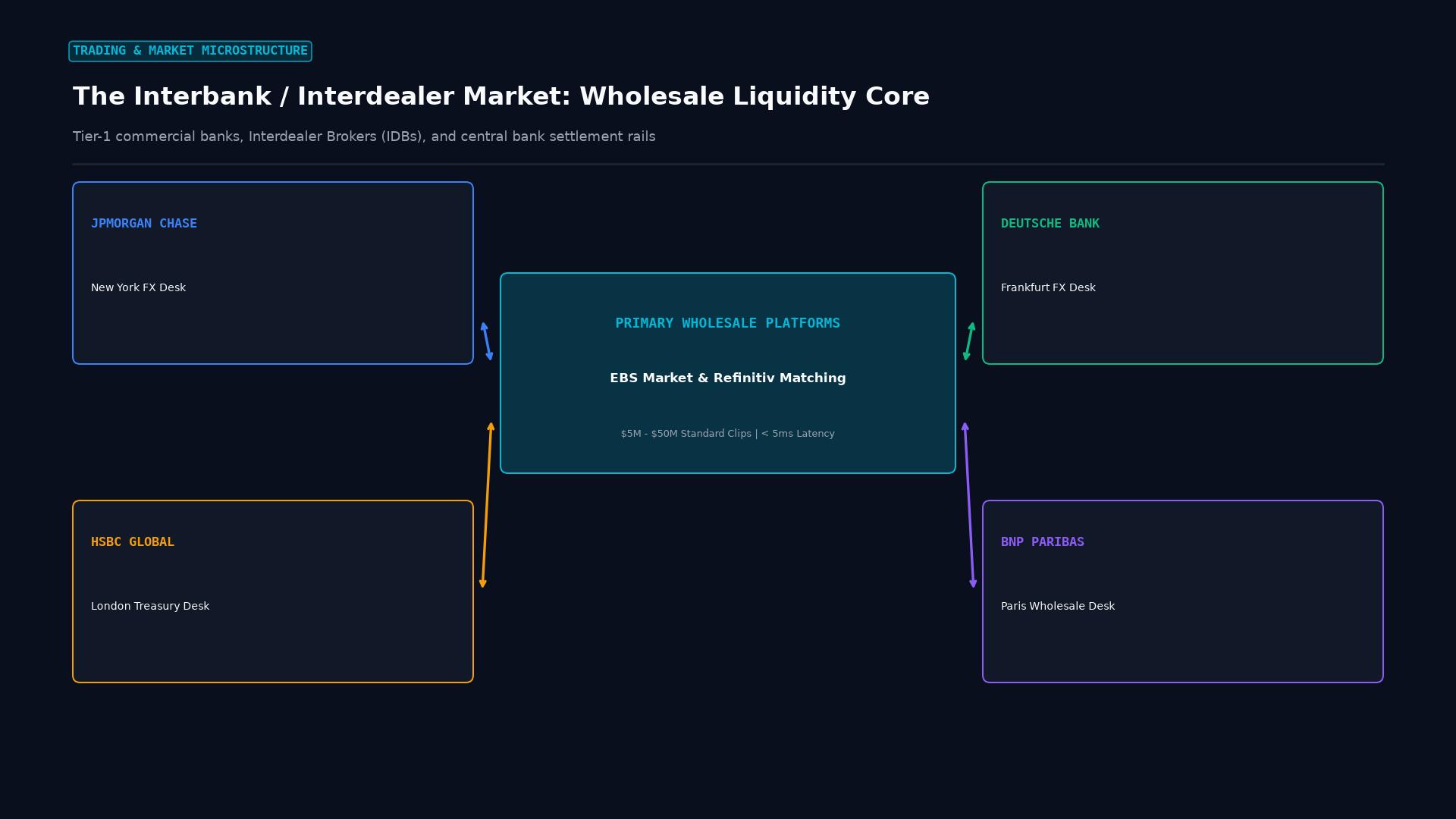 Figure: Wholesale liquidity infrastructure: Tier-1 global dealer banks executing multi-million dollar currency blocks via Interdealer Brokers (IDBs) and primary ECN matching networks.
The Structural Anatomy of the Interbank Market
The interbank market functions through a stratified hierarchy of institutions, clearing facilities, and electronic execution venues:
1. Tier-1 Liquidity Providers (Money-Center Banks)
At the pinnacle of the market sits a select group of global investment banks—such as JPMorgan Chase, Citigroup, Deutsche Bank, UBS, Barclays, HSBC, and Goldman Sachs. These institutions maintain massive internal balance sheets and provide continuous two-way prices (bids and asks) in standard institutional transaction sizes, typically ranging from $5 million to $50 million USD per single ticket.
2. Primary Interdealer Brokerage Networks
To trade anonymously with one another without revealing proprietary order flow, Tier-1 banks execute trades through specialized electronic broking engines:
- EBS (Electronic Broking Services): The dominant global interbank platform for major currency pairs including EUR/USD, USD/JPY, and USD/CHF.
- Refinitiv (formerly Reuters Dealing / Matching): The historical interbank benchmark for Commonwealth currencies, including GBP/USD, AUD/USD, NZD/USD, and USD/CAD.
3. Bilateral Credit Lines and ISDA Agreements
Entry into the Tier-1 interbank club is strictly regulated by creditworthiness. Banks do not trade with counterparties without formal ISDA (International Swaps and Derivatives Association) Master Agreements and established bilateral credit limits. If Bank A does not have an approved credit line with Bank B, the electronic matching engine will automatically mask Bank B’s quotes from Bank A’s order screen.
Interbank Spreads vs. Retail Broker Spreads
The fundamental economic difference between institutional interbank trading and retail foreign exchange lies in transaction costs and order execution:
| Parameter | Interbank Market | Retail Forex Brokerage |
|---|---|---|
| Typical EUR/USD Spread | 0.0 to 0.2 pips | 0.8 to 1.5 pips (or raw spread + commission) |
| Transaction Size | $1M to $50M+ standard lots | Micro (0.01) to Standard (1.0) lots |
| Execution Model | Bilateral credit settlement (CLS Bank) | Margin deposit / Leverage facility |
| Order Book Transparency | Full Level-2 interdealer book | Broker internal liquidity pool or bridge |
| Counterparty Solvency | Sovereign / Investment grade | Dependent on broker regulatory licensing |
The Role of Prime-of-Prime (PoP) Brokers
Individual retail traders cannot trade on EBS or Reuters directly because they lack the required $50 million credit facilities. To bridge this divide, Prime-of-Prime (PoP) institutions sit between Tier-1 dealers and retail brokers. PoPs pool retail order flow, clear it through their institutional prime brokerage accounts, and stream aggregated interbank liquidity down to retail MT4, MT5, and cTrader servers.
Settlement and Systemic Risk: CLS Bank
In 1974, the failure of German bank Bankhaus Herstatt exposed severe systemic vulnerabilities in the interbank market. Herstatt took in Deutsche Mark payments from counterparties in Frankfurt during European business hours, but collapsed before releasing corresponding US Dollar payments in New York, giving rise to the term “Herstatt Risk” (cross-currency settlement risk).
To eliminate this vulnerability, the international banking community created CLS Bank (Continuous Linked Settlement) in 2002. CLS operates a simultaneous Payment-versus-Payment (PvP) settlement engine, ensuring that a currency delivery is executed only if the offsetting currency payment is simultaneously confirmed, settling trillions of dollars in daily interbank turnover with zero counterparty settlement risk.
Key Takeaways
- The interbank market is the decentralized, wholesale network where major global banks trade currencies directly.
- Benchmark global exchange rates are determined by interdealer transactions executed on EBS and Refinitiv.
- Trading requires bilateral credit lines governed by ISDA Master Agreements.
- Wholesale interbank spreads on major pairs typically fluctuate between 0.0 and 0.2 pips.
- CLS Bank provides simultaneous Payment-versus-Payment settlement, eliminating international Herstatt counterparty risk.
Frequently Asked Questions
Can a private individual open an account directly on the interbank market?
No. Individual retail traders lack the corporate structure, regulatory licensing, and multi-million-dollar collateral balance sheets required to establish bilateral credit relationships with Tier-1 investment banks. Retail participants must access the market via regulated retail brokers.
What is the difference between an ECN broker and a Market Maker regarding the interbank market?
An Electronic Communication Network (ECN) or Straight-Through Processing (STP) broker routes client orders externally to Prime-of-Prime aggregators that stream live interbank quotes. A Market Maker (Dealing Desk) broker creates an internal market, taking the opposing side of client trades without routing orders into interbank channels.
What hours does the interbank forex market operate?
The interbank market operates continuously 24 hours a day, 5.5 days a week, opening on Monday morning in Wellington, New Zealand (Sunday 5:00 PM ET) and closing on Friday afternoon in New York (Friday 5:00 PM ET).
Ready to trade forex?
Open a free demo account with a regulated broker. Practice with virtual funds before risking real money.