Overnight Limit
An overnight limit is an internal risk management threshold established by a bank, brokerage, or trading institution that dictates the maximum net open position (long or short) or aggregate currency exposure a dealer or desk may carry past the daily market close into the next trading session.
What Is an Overnight Limit?
In institutional banking, investment management, and proprietary trading, an overnight limit is a mandatory risk-control ceiling set by a firm’s Chief Risk Officer (CRO) and Risk Management Committee. It defines the maximum allowable net open position (NOP)—measured in total notional currency units, Value at Risk (VaR), or regulatory capital exposure—that a trading desk or individual dealer is permitted to keep open past the daily market close (5:00 PM EST in foreign exchange).
During active daytime trading hours, dealers operate under higher intraday limits to provide two-way liquidity to corporate and institutional clients. However, when the desk closes and liquidity shifts to foreign time zones, trading desks face reduced market depth, wider bid-ask spreads, and inability to monitor positions continuously. Consequently, risk policies require traders to square up, hedge, or significantly reduce their commitments to conform to strict, lower overnight limits.
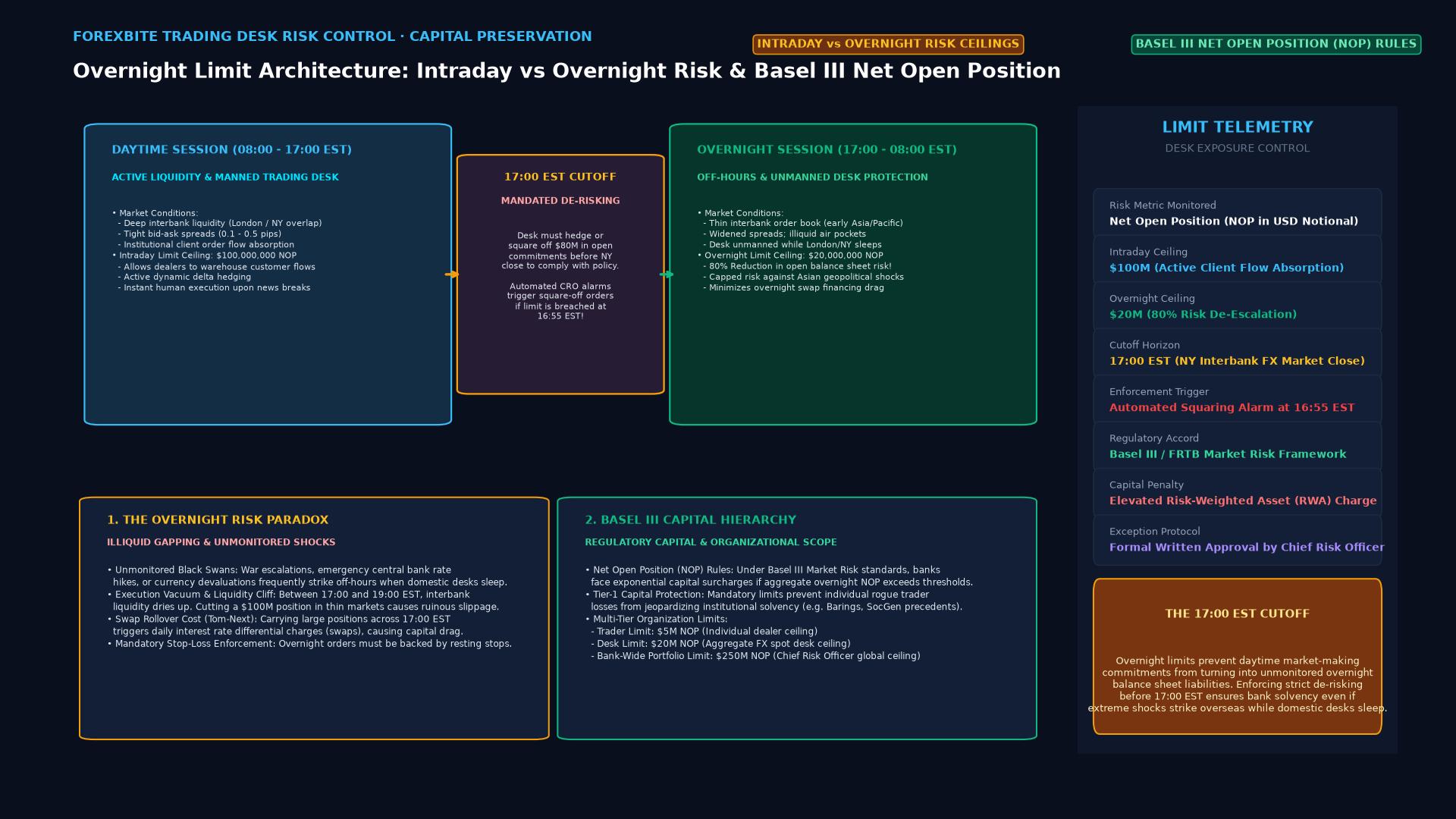 Figure: Institutional trading desk limit architecture: 17:00 EST de-risking transition from $100M intraday liquidity to $20M overnight net open position (NOP) cap.
Why Financial Institutions Enforce Overnight Limits
Overnight limits protect financial institutions from several catastrophic operational and structural risks:
1. Unmonitored Macro and Geopolitical Shocks
While a London or New York dealing desk is asleep, breaking geopolitical events (e.g., military conflicts, emergency central bank interest rate interventions, or unscheduled political elections) can occur in Asian sessions. Overnight limits guarantee that an adverse price shock will not breach the bank’s Tier-1 capital reserves.
2. Illiquid Gapping and Execution Vacuum
Off-hour trading sessions (such as the early Pacific-Asian session between 5:00 PM and 7:00 PM EST) feature thin interbank order books. If a desk carries an excessively large position into an illiquid market, attempting to cut losses during a sudden emergency will trigger severe market impact and execution slippage.
3. Regulatory Capital Compliance (Basel III)
Under Basel III banking standards, national regulators (such as the Federal Reserve, the UK Prudential Regulation Authority, and the European Central Bank) monitor Net Open Position (NOP) rules. Banks that carry outsized overnight foreign exchange positions are penalized with elevated market risk-weighted asset (RWA) capital charges, reducing institutional return on equity (ROE).
Structure of Institutional Limit Hierarchies
A comprehensive institutional risk framework establishes multi-layered overnight limit structures across different organizational tiers:
| Limit Level | Organizational Scope | Metrics Monitored | Enforcement Action |
|---|---|---|---|
| Trader Overnight Limit | Individual dealer or quantitative execution algorithm. | Gross notional ($) & Net directional exposure ($) per currency pair. | Mandatory automated square-off orders executed at 4:55 PM EST if breached. |
| Desk Overnight Limit | Entire G10 spot forex, emerging markets, or bond desk. | Aggregate desk NOP and 1-day 99% Value at Risk (VaR). | Head of Trading must approve temporary excess or reallocate limits among dealers. |
| Firm-Wide Overnight Limit | Entire corporate investment bank or hedge fund. | Stress-tested portfolio VaR, cross-asset correlation shocks. | Chief Risk Officer intervention; forced hedging across global branches. |
| Stop-Loss Overnight Limit | Cumulative mark-to-market loss threshold. | Unrealized floating loss ($) accrued overnight. | Automatic hard liquidation by the risk monitoring system regardless of trader intent. |
Real-World Case Study: The 1995 Barings Bank Overnight Breach
The catastrophic danger of lax overnight limit enforcement was immortalized in February 1995 by the collapse of Barings Bank, Britain’s oldest merchant bank (founded in 1762).
- The Setup: Nick Leeson, the sole head of settlement and trading for Barings Futures Singapore (BFS), held unauthorized proprietary positions in Nikkei 225 futures and Japanese government bonds.
- The Control Failure: Because Leeson was permitted to settle his own trades and oversee the internal “Error Account 88888,” the bank failed to enforce overnight position limits.
- The Breach: Rather than holding an overnight limit capped at a few million dollars, Leeson accumulated an unhedged overnight long position of over 61,000 Nikkei 225 futures contracts (a gross notional commitment exceeding $7 billion).
- The Black Swan: On January 17, 1995, the massive Kobe earthquake struck Japan. The Nikkei index plummeted over 1,000 points.
- The Collapse: Because Leeson carried this gargantuan position overnight without risk limits, Barings suffered losses of £827 million ($1.3 billion)—more than double the bank’s entire capital base—forcing the 233-year-old institution into immediate bankruptcy for a token sale price of £1 to ING.
Frequently Asked Questions
Can an overnight limit be temporarily extended?
Yes. If an institutional client executes a massive late-afternoon transaction (such as a $250 million corporate acquisition hedge at 4:45 PM EST) that the desk cannot unwind before 5:00 PM without severe market impact, the Head of Trading and the Risk Department can grant a formal, time-limited overnight limit waiver, typically conditional on active monitoring by an overnight branch (e.g., passing the risk book to Singapore or Tokyo).
How does an overnight limit differ from an intraday limit?
An intraday limit governs trading size during normal market hours when the desk is fully manned and market liquidity is deepest. An overnight limit applies after trading hours and is typically 50% to 80% smaller than the intraday limit to insulate the firm against unmonitored gap risk.
Do retail forex traders have overnight limits?
Retail traders do not have formal corporate overnight limit policies; instead, retail brokers enforce margin requirements and stop-out levels. However, sophisticated retail traders voluntarily impose personal overnight limits by reducing position size or closing intraday scalps before the 5:00 PM EST rollover to avoid high overnight swap fees and weekend gap risk.
Ready to trade forex?
Open a free demo account with a regulated broker. Practice with virtual funds before risking real money.