Overnight
Overnight refers to any financial position, lending transaction, or trading exposure held continuously past the daily market close (5:00 PM Eastern Standard Time in foreign exchange), triggering automatic settlement rollover (Tom-Next swap) and subjecting the account to overnight financing interest rates.
What Does “Overnight” Mean in Financial Markets?
In global finance, banking, and foreign exchange trading, the term overnight describes any position, credit facility, money market loan, or derivative commitment that remains unsettled at the end of the standard trading business day and is held open into the subsequent calendar business day.
In spot foreign exchange—which trades 24 hours a day across global financial hubs—the institutional cutoff that delineates one trading day from the next is universally standardized at 5:00 PM Eastern Standard Time (EST) / New York close (22:00 UTC). When an open FX position is held across this 5:00 PM EST threshold, it does not settle into physical currency delivery; instead, the broker and interbank clearinghouse automatically roll the settlement date forward to the next business banking day via a Tomorrow-Next (Tom-Next) swap, applying an overnight rollover fee (swap) to the trader’s account.
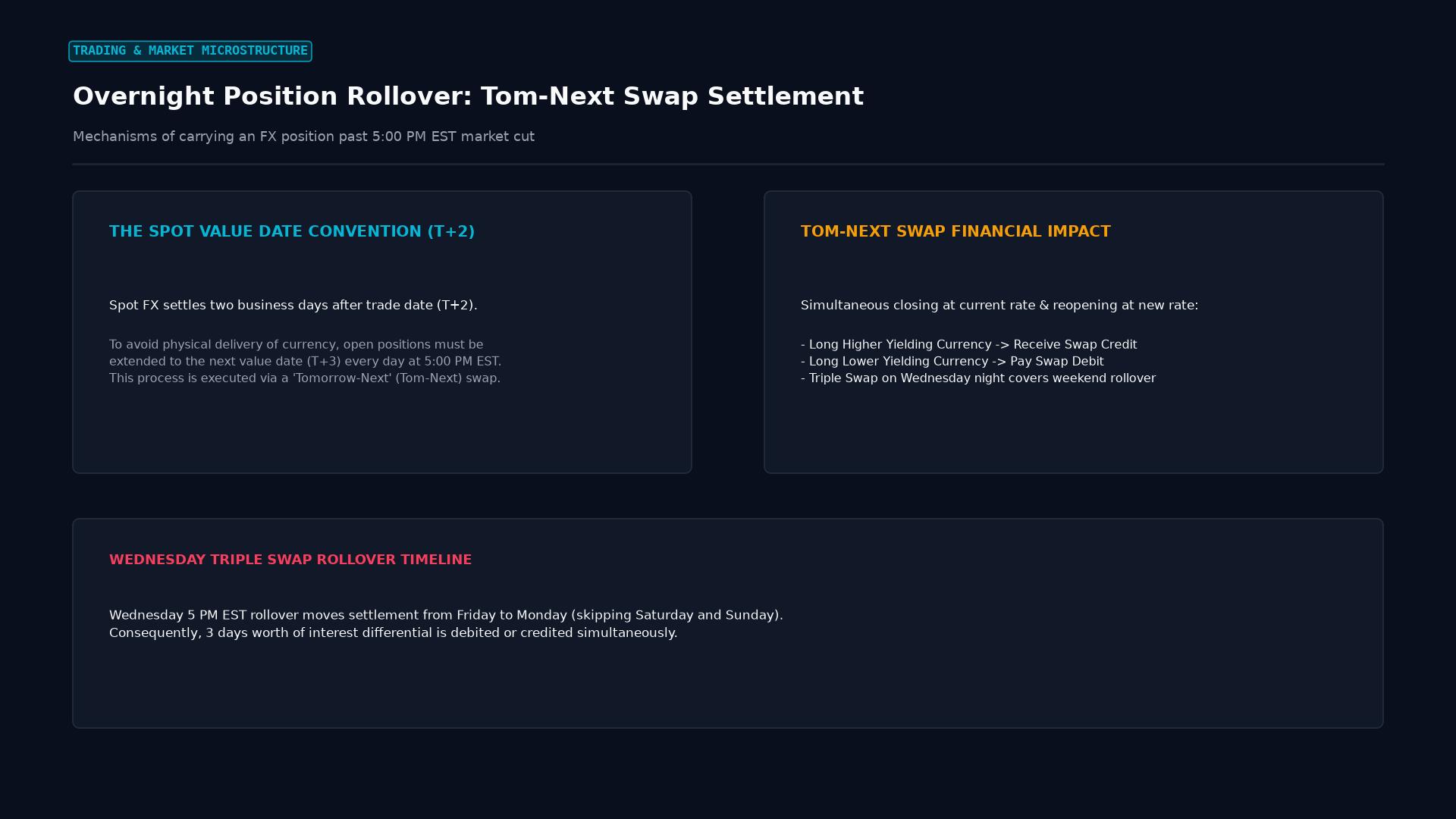 Figure: Tom-next rollover mechanics at 5:00 PM EST: rolling spot settlement date from T+2 to T+3, applying daily interest differentials, and Wednesday triple rollover.
Mechanics of Overnight Forex Rollover (Tom-Next Swaps)
Under standard international interbank rules, spot foreign exchange trades settle on a $T+2$ basis (two business banking days after execution date).
If a retail or institutional trader maintains an open position past 5:00 PM EST, they must avoid physical cash settlement. The executing broker facilitates this by automatically executing a Tom-Next (Tomorrow to Next Day) swap:
- The broker synthetically sells the open position at the end-of-day rate for tomorrow’s value date ($T+1$).
- The broker simultaneously repurchases the position at the same rate for the subsequent value date ($T+2$).
- The net financial difference between the two interest rates earned and paid on the base and quote currencies is reflected as a daily swap credit (positive carry) or daily swap debit (negative carry).
Mathematical Calculation of Overnight Swap
$$\text{Swap} = \left(\frac{\text{Contract Size} \times (r_{\text{base}} - r_{\text{quote}} - \text{Broker Markup})}{360}\right) \times \text{Current Spot Price}$$
Where:
- $r_{\text{base}}$ = Central bank overnight deposit rate of the base currency.
- $r_{\text{quote}}$ = Central bank overnight borrowing rate of the quote currency.
The Wednesday “Triple Swap” Rule
One of the most critical structural quirks of holding forex positions overnight is the Triple Swap on Wednesday:
Because commercial banking clearing systems (like Fedwire, Target2, and CHAPS) are closed on Saturday and Sunday, transactions executed on Wednesday settle on Friday ($T+2$). When a position is rolled over on Wednesday at 5:00 PM EST, the settlement date cannot move to Saturday; it must skip the entire weekend and roll to Monday ($T+2$ to $T+4$).
Consequently, on Wednesday evening at 5:00 PM EST, brokers apply three days’ worth of overnight financing charges or credits (covering Friday, Saturday, and Sunday) in a single rollover transaction. For traders holding carry trades, Wednesday presents a massive swap collection opportunity; for traders in negative-carry pairs, Wednesday imposes a heavy financing drain.
       WEDNESDAY 3-DAY ROLLOVER CALENDAR TRANSMISSION

  Position Open on:       Settles on:        Rollover Days Applied:
  -----------------------------------------------------------------
  Monday 5 PM EST   --->  Wednesday (T+2)    1 Day of Swap
  Tuesday 5 PM EST  --->  Thursday (T+2)     1 Day of Swap
  Wednesday 5 PM EST ---> Monday (T+4)      3 Days of Swap (Weekend covered!)
  Thursday 5 PM EST --->  Monday (T+2)       1 Day of Swap
  Friday 5 PM EST   --->  Tuesday (T+2)      1 Day of Swap
Overnight Money Markets and Benchmark Reference Rates
Outside of spot forex, the term “overnight” designates the foundational benchmark interest rates of sovereign economies. Commercial banks lend trillions of dollars to one another on an unsecured or collateralized overnight basis to balance reserve requirements:
| Sovereign Currency | Benchmark Overnight Rate | Structural Architecture | Historical Predecessor |
|---|---|---|---|
| US Dollar (USD) | SOFR (Secured Overnight Financing Rate) | Fully collateralized by US Treasury repurchase agreements (Repos); ~$1.5T daily volume. | LIBOR (Unsecured) |
| Euro (EUR) | €STR (Euro Short-Term Rate) | Wholesale unsecured overnight borrowing rate calculated by the European Central Bank. | EONIA |
| British Pound (GBP) | SONIA (Sterling Overnight Index Average) | Unsecured overnight lending transactions brokered in the London interbank market. | Sterling LIBOR |
| Japanese Yen (JPY) | TONA (Tokyo Overnight Average Rate) | Uncollateralized overnight call rate published daily by the Bank of Japan. | JPY LIBOR |
| Swiss Franc (CHF) | SARON (Swiss Average Rate Overnight) | Volume-weighted average rate based on collateralized overnight repo transactions. | CHF LIBOR |
Real-World Case Study: Overnight Carry Trade Yield vs. Capital Risk
During the 2022–2023 global monetary cycle, the US Federal Reserve raised benchmark interest rates to 5.50%, while the Bank of Japan anchored overnight borrowing rates at -0.10%, creating a monumental 560 basis point interest rate differential in USD/JPY.
- The Overnight Setup: A macro retail fund held a long position of 10 standard lots ($1,000,000 notional) of USD/JPY overnight for six months.
- The Daily Carry:
- Earning ~5.25% on USD deposits, paying -0.10% on JPY borrowing, net of broker financing haircuts.
- Daily positive swap credited at 5:00 PM EST: +$115 per day ($345 on Wednesdays).
- Over 180 days, the accumulated overnight swap earned was +$20,700.
- The Overnight Risk: On Friday, July 28, 2023, the Bank of Japan unexpectedly modified its Yield Curve Control (YCC) policy overnight. USD/JPY plunged 350 pips in Asian trading hours before the New York open, causing a temporary $24,000 mark-to-market drawdown.
- Takeaway: While holding positions overnight captures consistent interest yield, it subjects portfolios to overnight gap risk, foreign central bank policy announcements, and illiquid trading sessions.
Frequently Asked Questions
What happens if I close my trade at 4:59 PM EST?
If you open and close a trade within the same trading session before the official 5:00 PM EST daily cutoff, the trade is classified as an intraday trade. You will not pay or receive any overnight swap fees, regardless of the size of the position or the pair traded.
Why do bid-ask spreads widen dramatically at 5:00 PM EST?
At 5:00 PM EST, institutional banks and prime brokers pause for two to five minutes to process daily account reconciliation, batch-clearing operations, and Tom-Next swap rollovers. During this brief window, interbank liquidity is extremely thin, causing market maker algorithms to widen bid-ask spreads dramatically to protect against mispricing.
What is the difference between an overnight repo and a term repo?
An overnight repurchase agreement (repo) matures in exactly one business day, with securities and cash returned the following morning. A term repo has a specified maturity horizon extending beyond one day—typically 7 days, 14 days, 30 days, or several months.
Ready to trade forex?
Open a free demo account with a regulated broker. Practice with virtual funds before risking real money.