Open Position
An open position is an active, unsettled trade or investment commitment in a financial market that exposes the holder to price movements, market risk, and unrealized floating profit or loss until closed through an offsetting transaction or delivery.
What Is an Open Position?
In financial markets, an open position represents any trade, derivative contract, or securities commitment that has been executed but has not yet been neutralized, liquidated, or settled. As long as a position remains open, the market participant holds active directional or volatility exposure to the underlying asset, and the trade’s financial value fluctuates in real time according to prevailing market quotations.
An open position exists in one of two directional states:
- Long Position (Bought): The trader has purchased the asset expecting its market price to appreciate. A rising price increases unrealized profit, while a declining price generates unrealized loss.
- Short Position (Sold): The trader has borrowed or contracted to sell the asset expecting its price to decline. A falling price increases unrealized profit, while a rising price generates unrealized loss.
Once an open position is liquidated through an offsetting transaction (e.g., selling a long or buying back a short), the position becomes a closed position, and all floating mark-to-market valuations are permanently converted into realized cash gains or losses.
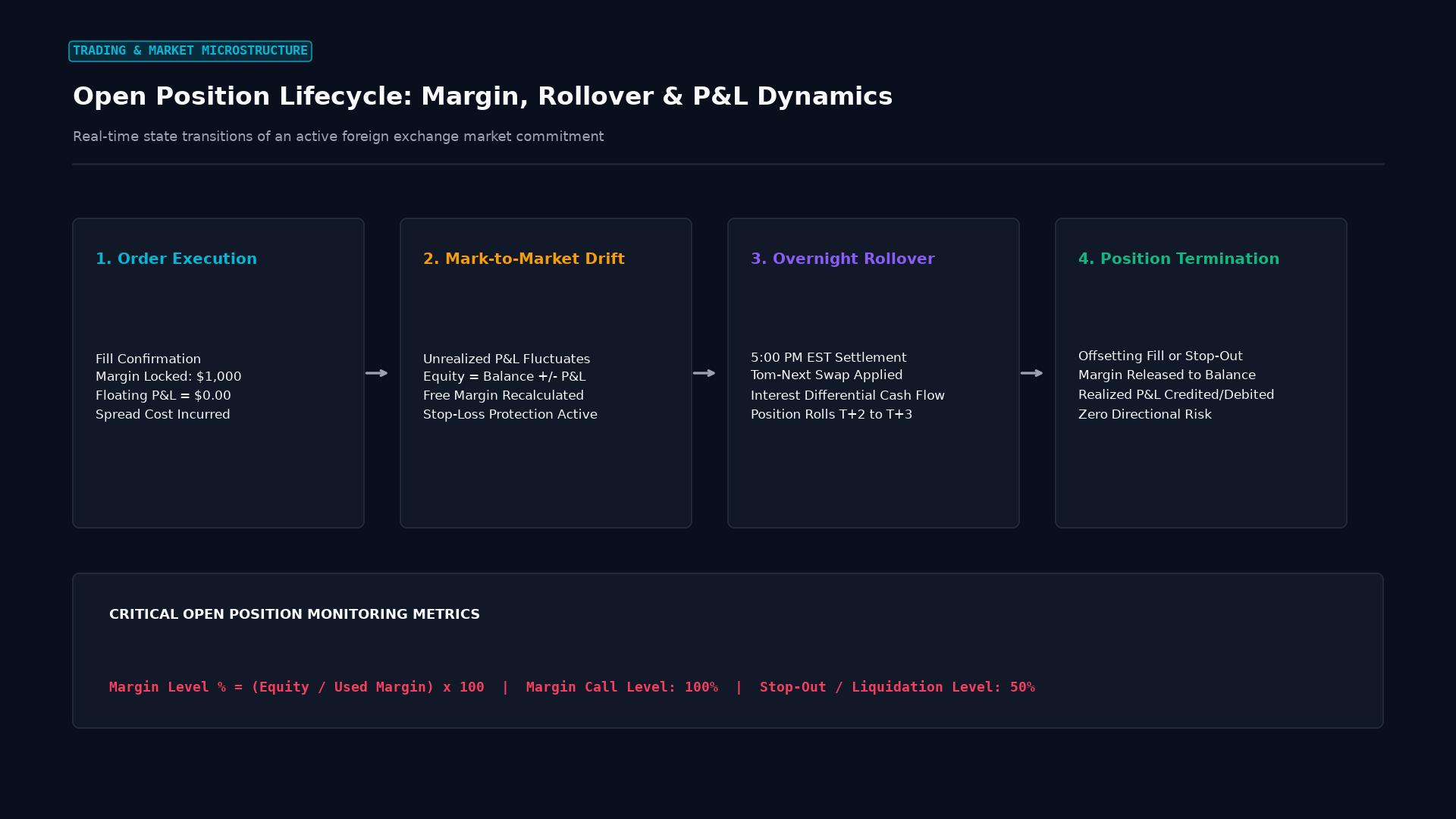 Figure: Active position lifecycle: order execution, real-time mark-to-market drift, overnight tom-next rollover, and margin level monitoring.
The Financial Mechanics of an Open Position
Holding an open position requires ongoing capital allocation and risk management across three primary dimensions:
1. Margin and Leverage Dynamics
When opening a leveraged position (such as a 100,000 EUR/USD contract with 1:100 leverage), the trader does not deploy the full $108,000 notional value. Instead, the broker sets aside Used Margin (e.g., $1,080) as a good-faith performance bond.
- Account Equity: $\text{Equity} = \text{Cash Balance} + \text{Unrealized Profit} - \text{Unrealized Loss}$
- Margin Level (%): $\text{Margin Level} = \left(\frac{\text{Equity}}{\text{Used Margin}}\right) \times 100%$
If an adverse price move causes account equity to decline below the broker’s Margin Call threshold (typically 100%) or Stop-Out level (typically 50% or 20%), the broker’s automated liquidation engine will unilaterally close the open position at market prices to prevent a negative account balance.
2. Floating Mark-to-Market (MTM) Valuation
Unlike closed trades that are recorded statically on accounting ledgers, open positions are continuously marked to market. In interbank trading and institutional asset management, open positions are revalued at the end of each trading day against official settlement prices to calculate daily Variation Margin.
3. Overnight Financing and Rollover (Swaps)
In foreign exchange and CFD markets, open positions held past the daily clearing cutoff (5:00 PM Eastern Standard Time / New York close) are automatically rolled over to the next value date via Tomorrow-Next (Tom-Next) swaps. Depending on the benchmark interest rate differential between the base and quote currencies, the open position will either accrue positive carry interest or incur a daily financing debit.
Open Position vs. Closed Position vs. Net Position
Understanding portfolio structure requires distinguishing between these closely related market concepts:
| Dimension | Open Position | Closed Position | Net Position |
|---|---|---|---|
| Market Exposure | Active; subject to price and liquidity risk. | Zero; exposure eliminated. | The algebraic aggregate of all longs and shorts in an asset. |
| P&L State | Unrealized (Floating mark-to-market). | Realized (Cash balance adjusted). | Net floating P&L across combined lots. |
| Margin Requirement | Consumes active maintenance margin. | Releases locked margin immediately. | Margin calculated on net directional exposure (or hedged tiers). |
| Holding Duration | Intraday, swing, or multi-year hold. | Historical record in account statement. | Dynamic; shifts as child tickets open and close. |
| Tax Status | Tax-deferred in most cash jurisdictions (unless marked-to-market). | Crystallizes a formal capital gains tax event. | Blended cost basis (FIFO or average cost basis). |
Real-World Case Study: Managing Open Positions Through Weekend Risk
On Friday, May 5, 2017, ahead of the final round of the French presidential election between Emmanuel Macron and Marine Le Pen, an institutional foreign exchange trader held an open long position of €20,000,000 in EUR/USD at 1.0980.
- Weekend Exposure: While markets were officially closed over the weekend, geopolitical risk remained active. A Le Pen victory posed systemic Eurozone fragmentation risks, while a Macron victory favored political stability.
- The Margin Buffer: The desk calculated that an adverse 300-pip gap-down at Sunday’s market open would create a $600,000 floating loss, potentially triggering liquidity covenants.
- The Monday Gap: On Sunday evening (5:00 PM EST), early election projections confirmed Macron’s victory. EUR/USD opened with a massive 150-pip bullish breakaway gap at 1.1130.
- Trade Management: Rather than letting the open position float indefinitely, the trader capitalized on the liquidity surge to execute an offsetting sell order for €20M at 1.1145, locking in a realized gain of: $$\text{Realized Profit} = €20{,}000{,}000 \times (1.1145 - 1.0980) = +$330{,}000$$
Frequently Asked Questions
What is the maximum duration an open position can be held in forex?
In spot forex, there is theoretically no expiration date. An open position can be held indefinitely for days, months, or years, provided the trading account maintains sufficient equity to meet margin requirements and absorb cumulative overnight financing (swap) charges.
What is the difference between an open order and an open position?
An open order is an unexecuted instruction (such as a pending buy limit or stop order) resting on the order book waiting for the market price to trigger it. An open position is an order that has already executed and is currently live in the market with active capital at risk.
Can an open position be liquidated automatically without my consent?
Yes. If the market moves sharply against your open position and your account equity falls below the broker’s mandatory Stop-Out margin level, the broker’s risk management engine will automatically execute a forced liquidation (stop-out) at the prevailing market price to prevent an unsecured deficit.
Ready to trade forex?
Open a free demo account with a regulated broker. Practice with virtual funds before risking real money.