Net Position
A net position is the total directional market exposure held by a trader, desk, or institution in a financial asset or currency pair, calculated as the mathematical difference between aggregate long positions and aggregate short positions.
What Is a Net Position?
In financial trading, risk management, and portfolio accounting, a net position represents the overall directional exposure an individual trader, institutional desk, or financial institution maintains in a specific financial instrument or currency. It is calculated by summing all open purchase commitments (longs) and subtracting all open sell commitments (shorts):
$$\text{Net Position} = \sum \text{Long Positions} - \sum \text{Short Positions}$$
Regardless of how many individual trades, tickets, or sub-accounts a trader maintains, the financial market ultimately treats their market risk through this single mathematical figure. Depending on the final balance, an account sits in one of three states:
- Net Long: Aggregate longs exceed aggregate shorts ($\text{Net} > 0$). The position gains value if the market advances.
- Net Short: Aggregate shorts exceed aggregate longs ($\text{Net} < 0$). The position gains value if the market declines.
- Net Flat (or “Square”): Aggregate longs exactly equal aggregate shorts ($\text{Net} = 0$). The trader has zero open directional exposure to future price fluctuations.
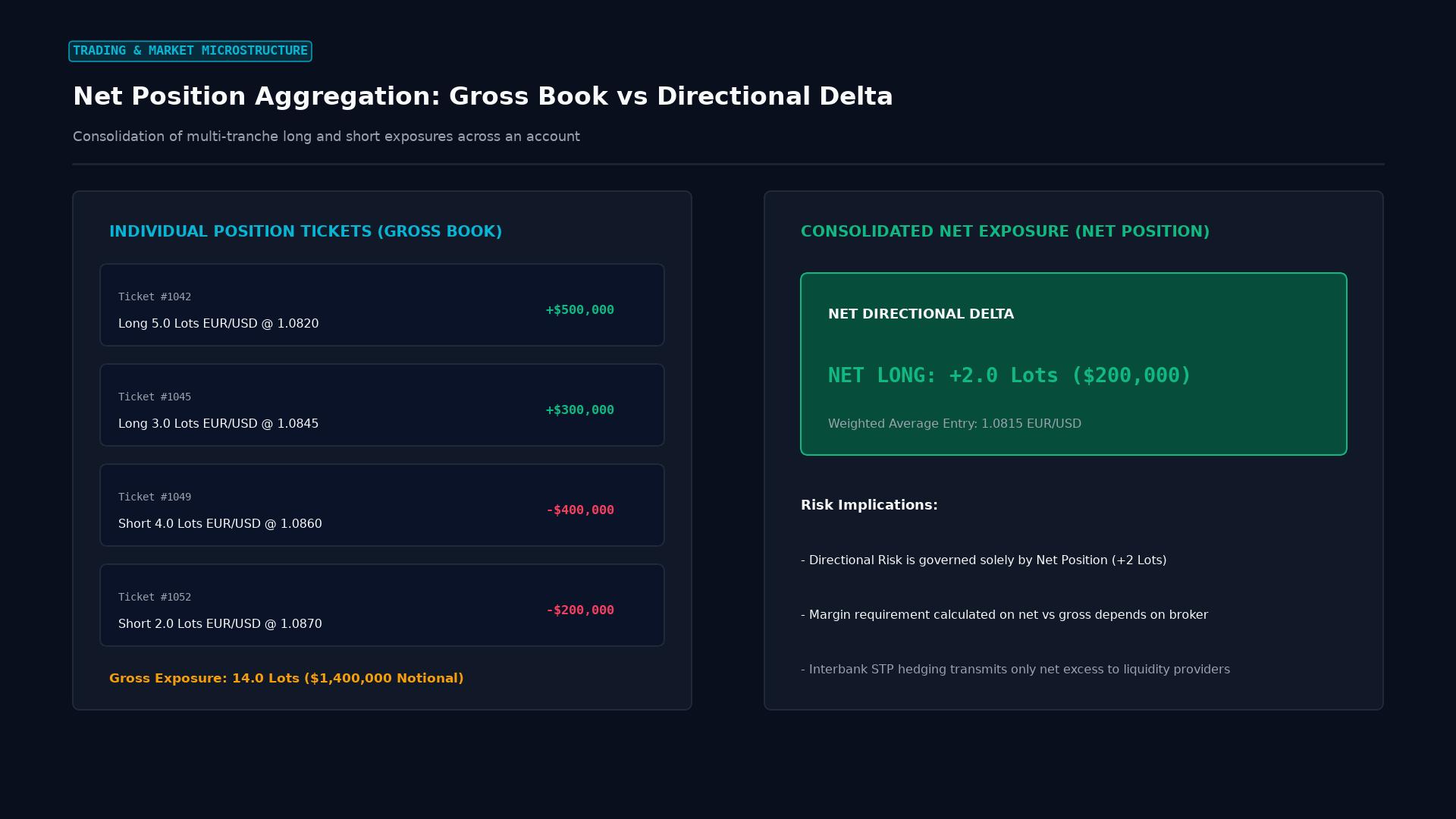 Figure: Consolidation of multi-tranche long and short tickets into a single net directional exposure for risk management and interbank STP hedging.
Key Takeaways
- The Measure of True Market Risk: While gross exposure determines margin turnover and transaction fees, only the net position dictates true portfolio sensitivity to market price movements.
- Hedging vs. Netting Platform Models: Under a Hedging Model (standard MT4), traders can hold simultaneous long and short tickets in the same pair. Under a Netting Model (standard MT5 and U.S. CFTC-regulated accounts), the platform automatically consolidates all orders into a single net position.
- Net Open Position (NOP) Limits: Central bank banking supervisors mandate strict Net Open Position limits on commercial banks to ensure currency trading desks do not assume excessive unhedged overnight currency risks.
- The CFTC Commitments of Traders (COT) Metric: Institutional macro analysts track the weekly Net Speculative Position of non-commercial hedge funds in CME futures contracts to detect extreme sentiment and market exhaustion.
- Spread Drag in Hedged Portfolios: Holding simultaneous long and short positions on the same pair instead of closing to flat achieves zero net market risk, but incurs double the spread costs and negative swap financing drag.
Comparative Taxonomy: Netting vs. Hedging Account Paradigms
| Structural Feature | Netting Account Paradigm (MT5 / Exchange / US) | Hedging Account Paradigm (MT4 / Offshore / EU) | | :— | :— | :— | :— | | Simultaneous Long & Short?| Strictly Prohibited | Permitted (Opens opposite tickets) | | Ticket Management | One single consolidated position per asset | Multiple distinct independent order tickets | | Order Consolidation | Opposite order reduces or flips existing position | Opposite order creates a separate hedge ticket | | U.S. NFA Compliance | 100% compliant with NFA Rule 2-43b (No hedging)| Prohibited for U.S. retail forex residents | | FIFO Enforcement | Inherently enforces First-In, First-Out | Allows selective manual ticket closures | | Financing Cost Efficiency| Maximum (Zero unnecessary swap fees paid) | Poor (Double financing fees on hedged legs)|
Institutional Dealing Desks: Managing the Net Open Position (NOP)
At Tier-1 investment banks (such as JPMorgan, Deutsche Bank, or Citigroup), hundreds of corporate and institutional client orders hit the trading desk every hour. A dealer desk does not hedge each client order individually; instead, the risk engine calculates the desk’s aggregate Net Open Position (NOP):
$$\text{Bank Desk NOP} = \sum \text{Client Inflows} - \sum \text{Client Outflows}$$
$$\text{Interbank Hedge Execution} = \text{Desk NOP} - \text{Authorized Overnight Desk Limit}$$
Practical Desk Scenario:
- Throughout the European morning, corporate exporters sell €250,000,000 to the bank, and corporate importers buy €180,000,000 from the bank.
- The desk’s internal matching engine internalizes the overlapping €180,000,000, earning the full bid-ask spread with zero market risk.
- The bank’s remaining Net Position is Long €70,000,000.
- If the bank’s internal risk policy caps overnight Euro exposure at €20,000,000, the head trader immediately executes an interbank market order selling €50,000,000 EUR/USD on EBS.
- The desk’s net position drops to +€20,000,000, satisfying regulatory NOP risk limits while locking in spread profits across all €430M of gross corporate volume.
Real-World Case Study: The CFTC COT Report Net Speculative Squeeze
Every Friday afternoon, the U.S. Commodity Futures Trading Commission (CFTC) publishes the Commitments of Traders (COT) report, detailing the aggregate open interest held by Commercial Hedgers and Non-Commercial Speculators (Hedge Funds).
- The Extreme Net Position: In late 2020, institutional hedge funds accumulated a historic Net Short Position in the U.S. Dollar Index (DXY) of over -$34 billion, expecting indefinite Federal Reserve zero-interest-rate policy.
- The Sentiment Trap: Because virtually every macro fund was already net short, the market ran out of marginal sellers: the net position reached maximum historical saturation.
- The Catalyst: When U.S. Treasury yields began rising in early 2021, the USD stopped falling.
- The Net Squeeze: Hedge funds holding massive net short positions were forced to buy back dollars to cover their exposure. This unwinding of the extreme net position unleashed a violent 18-month dollar rally, driving the DXY from 89.50 to over 114.00 in 2022.
Common Tactical Mistakes Regarding Net Positions
- The “Locking” Illusion: Retail traders holding a losing trade often open an opposite trade on the same pair (e.g., buying 1 lot while holding 1 losing short lot), calling it a “hedge” to freeze losses. In reality, their net position is $0.00. They have locked in the loss permanently while paying double broker spreads and daily negative swap financing charges. Closing the trade achieves the exact same economic outcome with zero fee drag.
- Ignoring Net Correlation Across Currency Pairs: A trader holding Long EUR/USD, Long GBP/USD, and Short USD/CHF often believes they are diversified across three trades. In reality, they are holding a massive, unified Net Short U.S. Dollar position, exposing the account to a triple-sized margin call if the Dollar rallies.
Frequently Asked Questions (FAQ)
What does it mean to be “square” in terms of net position?
Being “square” or “flat” means your net position in an asset is exactly zero ($0.00). You hold no open market commitments, have zero directional exposure, and are completely insulated from future price volatility.
Why does the U.S. ban hedging accounts for retail forex traders?
Under National Futures Association (NFA) Rule 2-43(b), retail brokers in the United States must operate under a strict netting model and enforce the First-In, First-Out (FIFO) rule. Regulators banned retail hedging because holding simultaneous long and short positions on the same pair forces unsophisticated retail traders to pay double financing and spread fees without providing any real economic protection.
How do I calculate my net position if I trade multiple currency crosses?
You must decompose each currency cross into its individual base and counter legs. For example, holding 1 lot Long EUR/GBP and 1 lot Long GBP/USD results in a Net Long position in Euro (EUR), a Net Short position in U.S. Dollar (USD), and a Net Flat (0) position in British Pound (GBP), as the long and short GBP legs cancel each other out.
Ready to trade forex?
Open a free demo account with a regulated broker. Practice with virtual funds before risking real money.