Owner
An owner is an individual, corporate entity, or institution holding legal title or beneficial entitlement to a financial account, security, real property, or contractual derivative position, carrying all associated property rights, financial gains, voting privileges, and legal liabilities.
What Is an Owner in Financial Markets?
In securities law, institutional banking, and global wealth management, an owner is the legal or beneficial party that maintains proprietary entitlement over capital, financial accounts, or economic assets. While seemingly straightforward, modern financial infrastructure draws a strict legal distinction between two separate forms of ownership:
- Legal (Nominee / Record) Ownership: The entity whose name is registered formally on the books of the issuer, bank, or central securities depository (such as Cede & Co. for DTC in the United States).
- Beneficial Ownership (Ultimate Beneficial Owner, or UBO): The actual natural person or institutional investor who enjoys the underlying economic benefits (dividends, interest, capital appreciation) and holds the ultimate power to direct transactions or vote corporate shares.
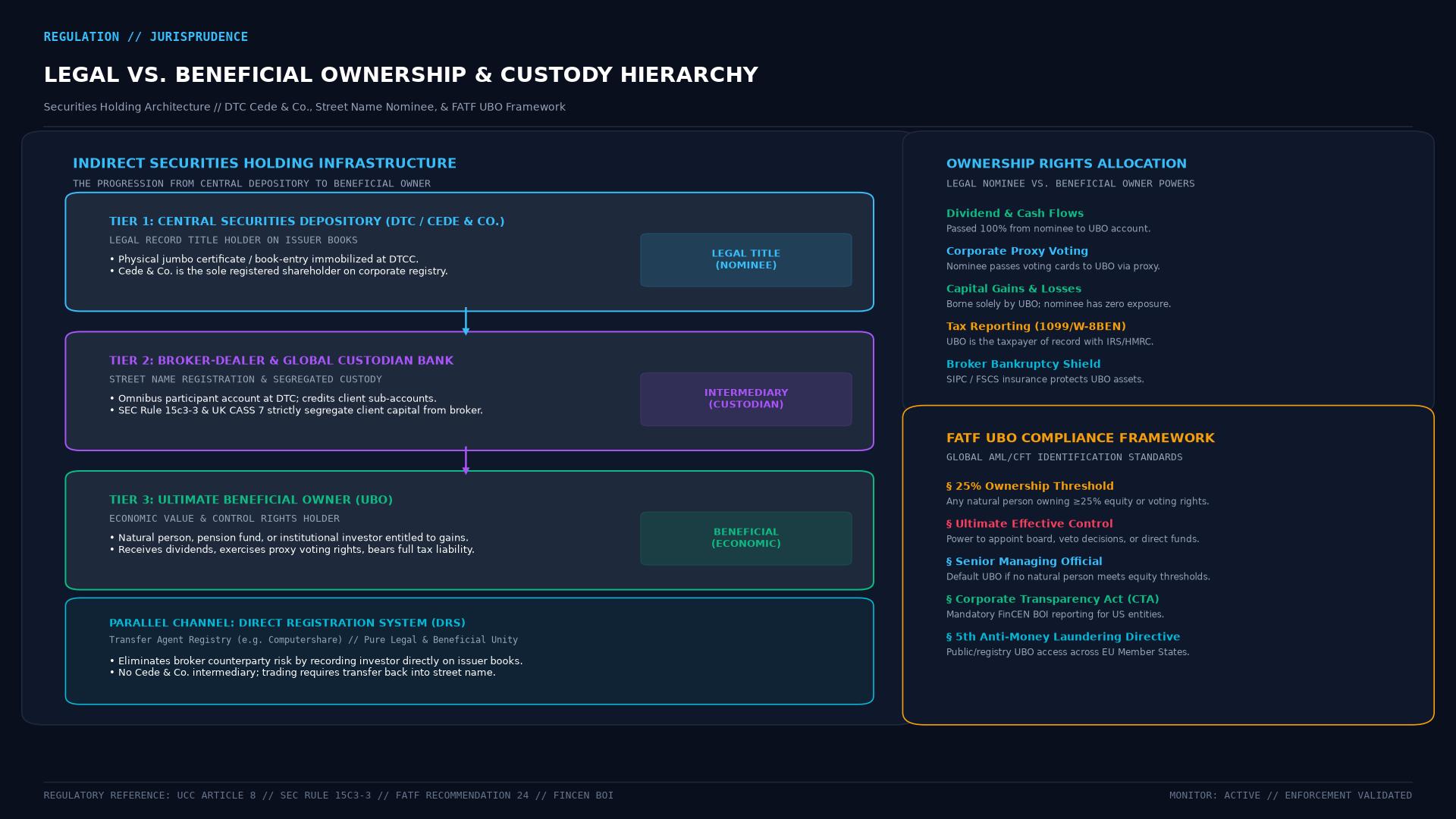 Figure: Legal vs. beneficial ownership hierarchy across CSD depositories (Cede & Co. / DTC), street-name nominee broker custodians, and Ultimate Beneficial Owners (UBOs) under global regulatory disclosure mandates.
Legal Formats: “Street Name” vs. Direct Registration
The vast majority of modern publicly traded securities and foreign exchange accounts are held under indirect holding systems:
1. “Street Name” Holding (Nominee Ownership)
When an investor opens a brokerage or forex trading account, their shares and currency balances are registered in “street name”—meaning the broker or its custodial clearing firm appears as the legal owner on public records.
- Operational Benefit: Enables instantaneous electronic trading, clearing, and netting without physically re-registering stock certificates every time an asset changes hands.
- Investor Protection: Although held in the broker’s legal name, client assets are segregated from broker operational capital under regulatory rules (such as SEC Rule 15c3-3 and UK CASS 7).
2. Direct Registration System (DRS)
The Direct Registration System allows an investor to hold securities electronically directly in their own personal name on the books of the company’s transfer agent (e.g., Computershare) without holding a physical paper certificate. This eliminates broker counterparty risk, but requires transferring shares back to a brokerage before executing immediate market sales.
Regulatory Compliance: The Ultimate Beneficial Owner (UBO)
Under global Anti-Money Laundering (AML) and Counter-Financing of Terrorism (CFT) frameworks established by the Financial Action Task Force (FATF), financial institutions are legally prohibited from opening anonymous accounts.
| Regulatory Standard | Governing Jurisdiction | Mandatory Ownership Disclosure Rules |
|---|---|---|
| Corporate Transparency Act (CTA) | United States (FinCEN) | Mandates reporting of beneficial owners who directly or indirectly own $\ge 25%$ of equity or exercise substantial control over corporate entities. |
| 5th & 6th Anti-Money Laundering Directives (AMLD) | European Union | Establishes centralized national registers of beneficial ownership accessible to competent authorities and financial institutions. |
| SEC Schedule 13D / 13G | United States (SEC) | Requires any investor or group acquiring $> 5%$ beneficial ownership of a public company’s voting shares to file public disclosures within 5 to 10 days. |
| FATCA & CRS Frameworks | Global (US IRS & OECD) | Requires foreign financial institutions to identify the tax residency of beneficial owners holding accounts, preventing offshore tax evasion. |
Ownership Rights in Corporate Governance
Holding beneficial ownership in public securities conveys statutory rights defined by corporate law:
- Voting Rights: Common shareholders hold the right to vote on the election of corporate directors, executive compensation, independent auditor selection, and major corporate events (mergers, acquisitions, or restructuring).
- Dividend Entitlement: Owners of record on the designated Record Date are legally entitled to receive declared corporate cash dividends or stock distributions.
- Liquidation Claim: In corporate bankruptcy, equity owners hold the residual claim. Under the absolute priority rule, secured creditors, bondholders, and preferred shareholders must be made whole before common equity owners receive any remaining capital.
Real-World Case Study: SEC Schedule 13D Enforcement
In early 2022, an institutional activist investor accumulated significant equity ownership in a major publicly traded technology firm.
- The Accumulation: The investor crossed the statutory 5.0% beneficial ownership threshold on March 14, 2022, accumulating 9.2% of the company’s common stock through open-market purchases and derivative options.
- The Violation: Under Section 13(d) of the Securities Exchange Act of 1934, the investor was legally required to disclose their beneficial ownership to the public and the SEC within 10 calendar days of crossing 5.0% (by March 24).
- The Delay: The investor did not file Schedule 13D until April 4—ten days late. During those ten days, the investor purchased millions of additional shares at artificially lower prices, saving an estimated $140 million before the public announcement caused the stock price to surge 27%.
- Regulatory Enforcement: The SEC initiated regulatory scrutiny and subsequently implemented tighter disclosure rules under Rule 13d-1, shortening the filing deadline from 10 days to 5 business days to protect the market from undisclosed ownership accumulations.
Frequently Asked Questions
What is an Ultimate Beneficial Owner (UBO)?
An Ultimate Beneficial Owner (UBO) is the natural individual person who ultimately owns or controls a customer account, business entity, or financial asset, or on whose behalf a transaction is being conducted. In international banking compliance, any individual owning 25% or more of an entity is classified as a UBO.
If my broker goes bankrupt, do I still own my shares?
Yes. Under statutory client segregation rules (such as SIPC in the United States or FSCS in the United Kingdom), client securities held in “street name” are segregated from the broker’s proprietary balance sheet. In the event of broker insolvency, client-owned assets are transferred intact to another solvent clearing firm or returned directly to the investor.
What is the difference between an owner and an authorized trader?
An owner has legal and beneficial title to the account and its capital, remaining legally liable for tax obligations and account deficits. An authorized trader (or power-of-attorney holder) is an agent authorized by the owner to place buy and sell orders, but possesses no ownership claim over the capital.
Ready to trade forex?
Open a free demo account with a regulated broker. Practice with virtual funds before risking real money.