Net Worth
Net worth is the definitive measure of the financial health and total economic wealth of an individual, corporation, or entity, calculated as total assets minus total liabilities.
What Is Net Worth?
Net worth is the foundational quantitative benchmark of economic health and accumulated wealth for individuals, corporate enterprises, and sovereign governments. Expressed simply, net worth represents what remains after an entity sells everything it owns and pays off everything it owes:
$$\text{Net Worth} = \text{Total Assets} - \text{Total Liabilities}$$
In corporate accounting, an enterprise’s net worth is formally classified on the balance sheet as Shareholders’ Equity or Book Value, satisfying the core balance-sheet equation: $\text{Assets} = \text{Liabilities} + \text{Equity}$. A positive net worth signifies solvency and financial stability, whereas a negative net worth indicates that debts exceed owned resources, signaling balance-sheet insolvency.
In the retail and institutional trading sectors, net worth plays a vital regulatory gatekeeping role. Regulators (such as the SEC, CFTC, FCA, and ESMA) require brokers to assess a client’s Total Net Worth and Liquid Net Worth during the account opening process. These figures determine the trader’s eligibility for high-tier leverage, access to complex derivatives, and classification as an Accredited Investor or Elective Professional Trader.
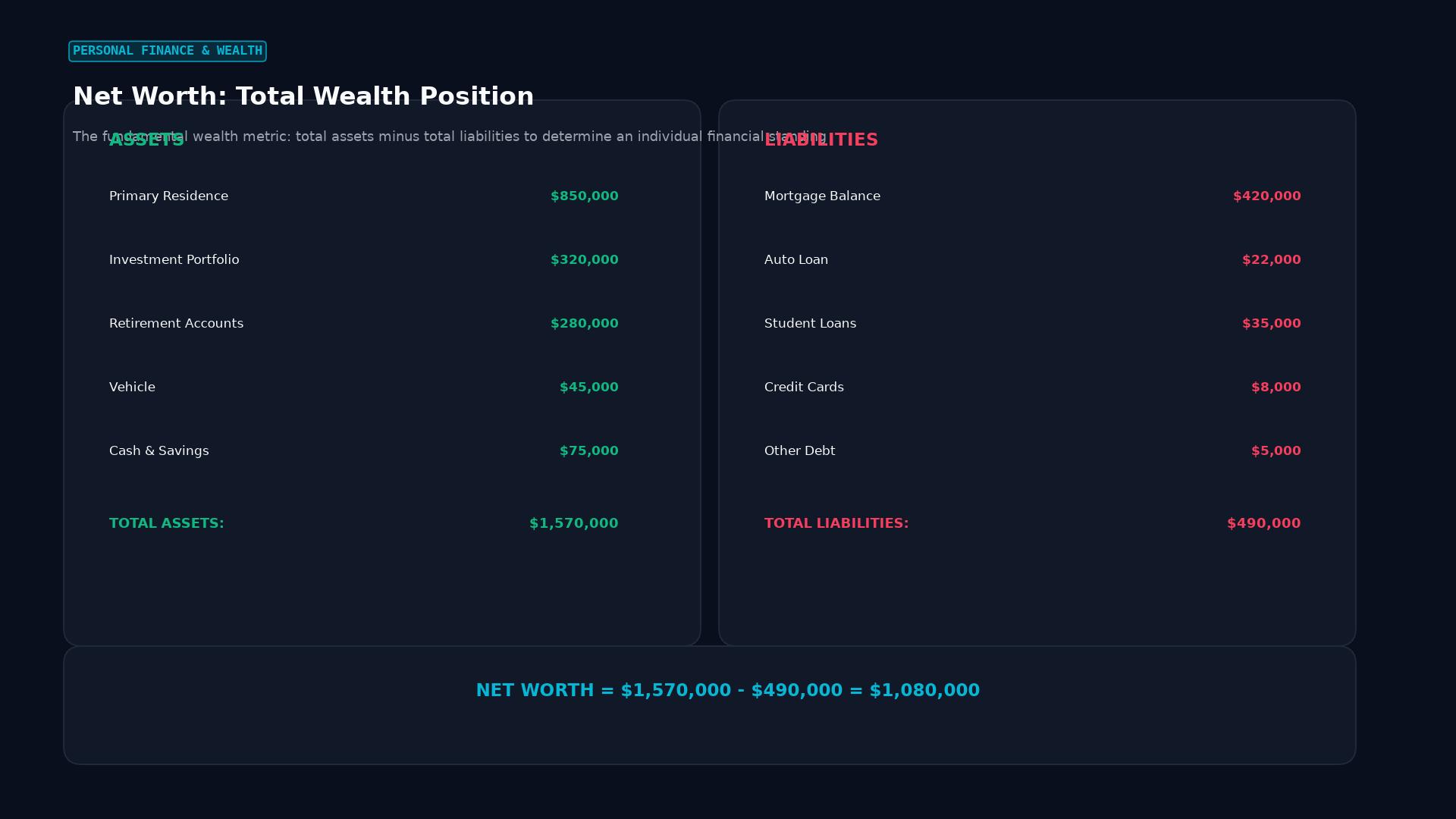 Figure: The fundamental wealth metric: total assets minus total liabilities to determine an individual financial standing
Key Takeaways
- The Measure of True Wealth: Net worth strips away the illusion of gross asset ownership by directly accounting for the debts used to finance those assets.
- Liquid vs. Total Net Worth: Total net worth includes illiquid property (real estate, private business equity), while Liquid Net Worth includes only assets that can be converted into cash within days without significant loss of capital.
- The “Risk Capital” Rule: Professional trading guidelines mandate that a retail trader should never allocate more than 5% to 10% of their liquid net worth to high-risk leveraged foreign exchange or derivatives trading.
- Regulatory Professional Classification: Under ESMA and FCA rules, retail traders wishing to bypass the 1:30 leverage cap and access 1:100+ institutional leverage must prove a liquid investment portfolio exceeding €500,000.
- Solvency and Creditworthiness: Banks and prime brokers evaluate net worth when underwriting institutional credit lines, setting margin thresholds, and negotiating ISDA Master Agreements.
Comparative Taxonomy: Wealth and Liquidity Metrics
| Financial Metric | What It Measures | Assets Included | Primary Application |
|---|---|---|---|
| Total Net Worth | Comprehensive lifetime balance sheet wealth | All assets (Liquid + Real Estate + Private Business) | Estate planning, mortgage lending, net solvency |
| Liquid Net Worth | Readily deployable cash wealth | Cash, public equities, bonds, cash-settled funds | Broker suitability tests, margin qualification |
| Working Capital | Short-term operating liquidity | Current Assets minus Current Liabilities | Corporate treasury day-to-day liquidity |
| Corporate Book Value | Net asset equity belonging to common stockholders | Total balance sheet assets minus debt and preferred stock | Fundamental equity valuation (Price-to-Book ratio) |
Net Worth and Regulatory Investor Categorization
Financial supervisory agencies enforce rigorous net worth suitability thresholds to prevent retail consumers from being wiped out by high-risk financial derivatives:
1. United States: Accredited Investor Standard
Under SEC Rule 501 of Regulation D, an individual qualifies as an Accredited Investor (granting access to private hedge funds, venture capital, and unhedged derivatives) if they meet either of the following criteria:
- An individual net worth (or joint net worth with spouse) exceeding $1,000,000, strictly excluding the value of their primary residence.
- An individual annual income exceeding $200,000 (or $300,000 joint) in each of the two most recent years.
2. European Union & UK: Elective Professional Trader
Under MiFID II regulations, retail traders are locked to a maximum leverage of 1:30 on major forex pairs. To bypass this restriction and access up to 1:500 leverage, a trader must qualify as an Elective Professional by satisfying at least two of the following criteria:
- Significant trading volume (at least 10 trades of significant size per quarter over the previous four quarters).
- Size of financial instrument portfolio (including cash deposits and financial instruments) exceeding €500,000.
- At least one year of professional experience in the financial sector in a role requiring knowledge of derivative transactions.
Real-World Case Study: Managing Risk Capital Relative to Net Worth
Consider two prospective traders who each deposit $20,000 into a leveraged retail forex margin account:
-
Trader A (Reckless Over-Allocation):
- Total Net Worth: $$25,000$ (Entire life savings).
- Liquid Net Worth: $$20,000$.
- The trader allocates 100% of their liquid net worth to the forex account.
- Psychological Reality: Every 20-pip market fluctuation directly threatens the trader’s rent and food security. When a trade moves against them, intense panic leads to irrational revenge trading, refusal to take stop-losses, and inevitable total account liquidation within two months.
-
Trader B (Institutional Risk Framework):
- Total Net Worth: $$600,000$ ($350,000 home equity, $250,000 liquid portfolio).
- Liquid Net Worth: $$250,000$.
- The trader allocates $20,000 (8% of liquid net worth) to the forex account.
- Psychological Reality: Even a complete 100% loss of the trading account would reduce total liquid wealth by only 8%, leaving their household lifestyle completely undisturbed. The trader executes their strategy with calm mechanical discipline, honors stop-losses, and achieves consistent risk-adjusted returns.
Critical Wealth Traps and Pitfalls
- Confusing High Income with High Net Worth: A corporate executive earning $350,000 annually who spends $340,000 on luxury leases, mortgages, and lifestyle inflation may have a negligible or negative net worth, leaving them highly vulnerable to sudden income disruptions.
- Illiquidity Trap in Margin Calls: Having an impressive $2,000,000 total net worth composed entirely of commercial real estate and illiquid private stock will not help you meet an urgent $50,000 cash margin call from your broker on a Friday afternoon; brokers demand liquid cash, not illiquid property deeds.
Frequently Asked Questions (FAQ)
Why do brokers exclude home equity when calculating liquid net worth?
Your primary residence cannot be liquidated into cash in seconds to settle a trading loss or meet a sudden margin deficit. Real estate takes months to sell and incurs substantial closing costs, making it completely illiquid from a trading risk perspective.
Can a corporation have a negative net worth?
Yes. If a company accumulates massive debt or endures consecutive years of heavy operational losses that exceed its initial capital and retained earnings, its liabilities will exceed its assets. This results in negative shareholders’ equity, signaling technical bankruptcy unless bailed out or restructured.
How often should an active trader calculate their net worth?
Professional traders calculate their net worth at least quarterly or annually. Reviewing your broader liquid balance sheet ensures you maintain proper perspective, verifying that trading profits are systematically transferred into secure, long-term wealth-building assets (like index funds and debt repayment).
Ready to trade forex?
Open a free demo account with a regulated broker. Practice with virtual funds before risking real money.