PIT
A trading pit is an octagonal, tiered physical arena on an exchange floor where market participants execute futures, options, and commodity contracts via the open-outcry auction system.
What is a Trading Pit?
In the history of financial markets, a trading pit was a purpose-built, octagonal or polygonal tiered arena on the floor of an organized commodity, futures, or options exchange. Inside these tiered physical rings, traders, market makers, and brokers gathered to determine prices and execute transactions using the open-outcry auction system.
The trading pit represented the physical heartbeat of global price discovery throughout the 19th and 20th centuries across major exchanges, including the Chicago Board of Trade (CBOT), the Chicago Mercantile Exchange (CME), the New York Mercantile Exchange (NYMEX), and the London International Financial Futures and Options Exchange (LIFFE).
While the majority of physical trading pits were decommissioned between 2000 and 2021 due to the rise of electronic matching engines and algorithmic trading, the terminology, microstructure concepts, and market dynamics developed inside the pits continue to form the conceptual foundation of modern financial market architecture.
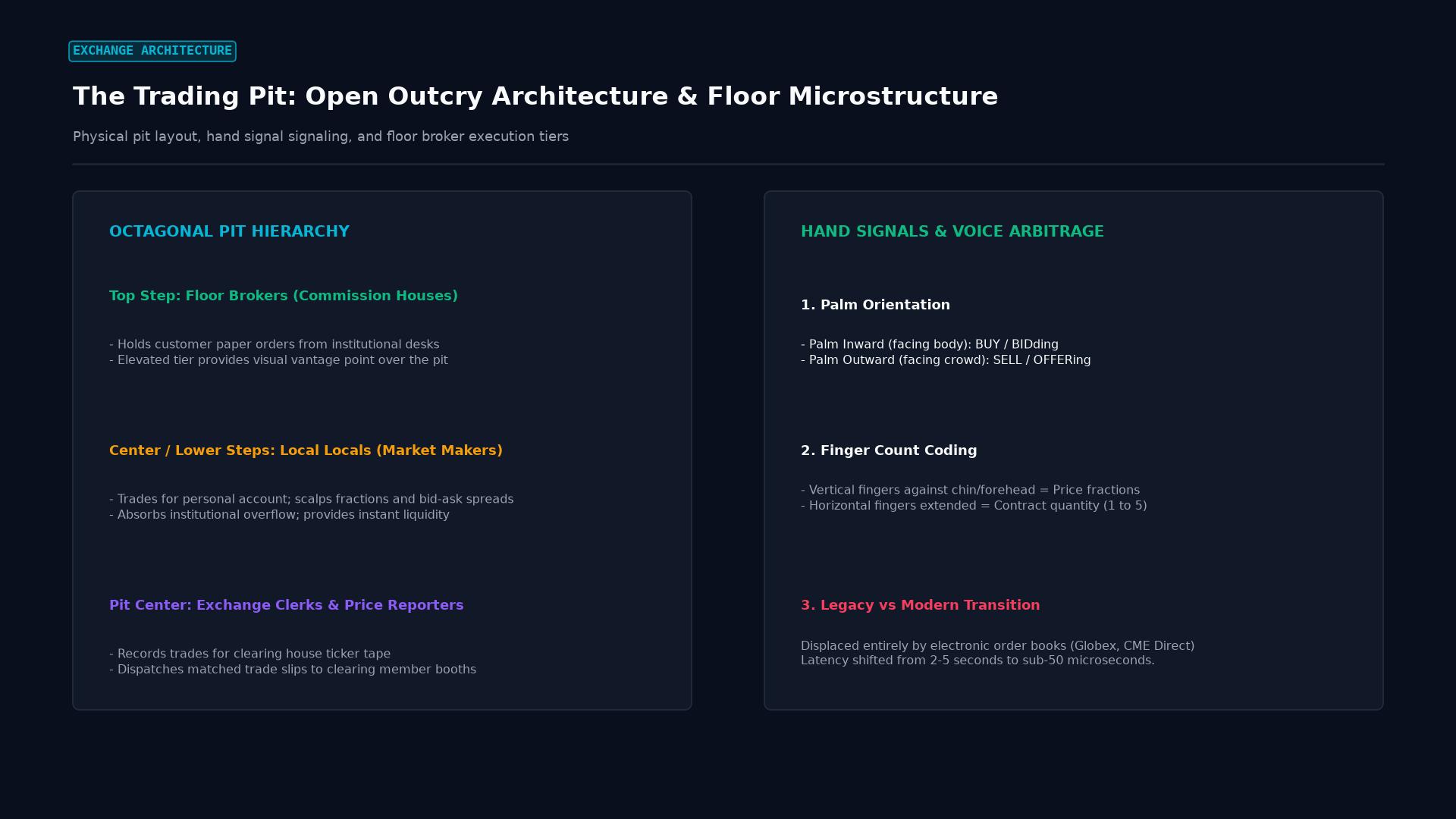 Figure: Exchange floor structure: octagonal tiered trading pits, hand signals, floor brokers holding client tickets, and local market makers scalping spreads.
(Note: In tax accounting and corporate finance, the acronym PIT also stands for Personal Income Tax, representing government levies imposed on individual wage earnings and non-corporate capital gains).
Architectural Design and Physical Microstructure
The physical architecture of a trading pit was engineered to optimize visual communication, sound projection, and crowd dynamics under conditions of intense market volatility.
                  =============================================
                  TOP STEP: Long-Dated / Deferred Option Months
                  =============================================
                     \                                     /
                      \  MIDDLE STEP: Secondary Active    /
                       \ Contract Settlement Deliveries  /
                        \                               /
                         ==============================
                         LOWEST TIER / FLOOR OF THE PIT:
                         Lead (Front) Month Futures
                         Maximum Volume & Liquidity Core
                         ==============================
                        /                               \
                       /  MIDDLE STEP: Secondary Active  \
                      /   Contract Settlement Deliveries  \
                     /                                     \
                  =============================================
                  TOP STEP: Long-Dated / Deferred Option Months
                  =============================================
The Concentric Stepped Design
A trading pit was structured as a shallow amphitheater featuring descending concentric steps leading down to a central floor:
- Visibility and Sightlines: The stepped arrangement ensured that traders standing on outer tiers could see over the heads of those standing in front of them, maintaining unbroken lines of sight across the entire ring.
- Contract Maturity Geography: The floor of the pit was divided into designated zones based on contract delivery months. The most active, liquid contracts, the front month (lead month), were traded at the bottom of the pit or along the most accessible front steps. Longer-dated, deferred expiration contracts were traded on the higher, outer perimeter steps.
- Badge Identification: Every participant wore a brightly colored, individualized jacket and a large plastic identification badge displaying an exchange-registered 3- or 4-letter member acronym. Jackets identified the trader’s clearing firm or proprietary affiliation, allowing brokers to confirm the counterparty of a shouted trade.
Market Participants: Floor Brokers vs. Locals
Order execution in a trading pit relied on a symbiotic relationship between two primary classes of market participants:
+------------------------------------------------------------------------------------+
|                         TRADING PIT PARTICIPANT TAXONOMY                           |
+--------------------+---------------------------------------------------------------+
| ROLE               | FUNCTION & CAPITAL PROFILE                                    |
+--------------------+---------------------------------------------------------------+
| Floor Broker       | Executes orders on behalf of off-floor institutional clients  |
| (Dual-Trader)      | (pension funds, commercial hedgers, commodity trading funds). |
|                    | Earns commission per contract; bears no principal price risk. |
+--------------------+---------------------------------------------------------------+
| Local              | Independent market maker trading personal proprietary capital.|
| (Market Maker)     | Provides continuous two-sided liquidity; scalps bid-ask       |
|                    | spreads; holds inventory for seconds or minutes.              |
+--------------------+---------------------------------------------------------------+
| Floor Clerk        | Stationed at telephone desks along the trading floor walls.    |
| (Runner / Comm.)   | Receives customer orders via telephone, writes paper tickets, |
|                    | and flashes hand signals or sends runners to the pit.         |
+--------------------+---------------------------------------------------------------+
The Dynamics of Pit Execution
When an institutional customer entered an order:
- An institutional order desk at a bank or brokerage telephoned the order to their firm’s telephone booth on the exchange floor.
- The phone clerk flashed hand signals to the firm’s floor broker inside the pit or dispatched a runner carrying a paper order slip.
- The floor broker stepped into the designated contract step and shouted the order into the crowd:
- For example: “Buy 50 July at 4!”
- A “local” standing across the pit accepted the trade by shouting back:
- “Sold!” or gesturing with palm outward.
- Both traders immediately recorded the transaction on standardized paper trading cards, noting the quantity, price, counterparty badge acronym, and exchange clearing code.
       Institutional Client Phones Order to Brokerage Desk
                                │
                                ▼
       Floor Clerk Transmits Order via Hand Signals
                                │
                                ▼
       Floor Broker Shouts Bid: "Buy 100 Dec at 50!"
                                │
                                ▼
       Locals Compete; Local "XYZ" Yells "Sold!"
                                │
                                ▼
       Both Record Trade on Carbon Paper Trading Cards
       Cards Stamped via Mechanical Time-Clocks for Clearing
Hand Signals and Non-Verbal Communication
Because exchange trading floors hosted thousands of yelling traders, ambient noise levels frequently exceeded 100 decibels. To communicate across crowded rooms, pit traders developed an elaborate sign language.
+-----------------------------------------------------------------------------------+
|                        COMMON PIT TRADING HAND SIGNALS                            |
+-------------------+---------------------------------------------------------------+
| SIGNAL INTENT     | PHYSICAL HAND GESTURE                                         |
+-------------------+---------------------------------------------------------------+
| Buying (Bid)      | Palm of the hand facing inward toward the trader's face.      |
| Selling (Offer)   | Palm of the hand facing outward toward the trading crowd.     |
+-------------------+---------------------------------------------------------------+
| Contract Quantity | Fingers extended vertically away from the body.               |
| (1 through 5)     | 1 finger = 1 contract; 5 fingers = 5 contracts (or 50/500).   |
+-------------------+---------------------------------------------------------------+
| Contract Quantity | Touching fingers to the chin or cheek horizontally indicates  |
| Multipliers       | tens, hundreds, or thousands depending on contract norms.     |
+-------------------+---------------------------------------------------------------+
| Price Fractions   | Hand held horizontally; fingers extended sideways to indicate  |
| (Ticks / Eighths) | quarters, eighths, or sixteenths of a point.                  |
+-------------------+---------------------------------------------------------------+
| Stop-Loss / Out   | Placing a flat hand across the throat ("cut throat" gesture). |
+-------------------+---------------------------------------------------------------+
This non-verbal vocabulary enabled orders to move from telephone booths along the trading floor perimeter to the center of the pit in seconds, bypassing acoustic noise.
The Transition from Open-Outcry to Electronic Trading
The dominance of the physical trading pit began to decline in the late 1980s and accelerated rapidly with the introduction of high-speed electronic communication networks.
1992: Launch of CME Globex
Electronic trading begins outside floor hours
                        │
                        ▼
Late 1990s: European Floor Closures
LIFFE, Matif, and DTB convert completely to screens;
Eurex overtakes CBOT Bund contract volume
                        │
                        ▼
2000-2010: Side-by-Side Trading
Hybrid model; screen volume rapidly cannibalizes floor volume;
Spreads compress from ticks to sub-ticks
                        │
                        ▼
2015: CME Group Floor Decommissioning
CBOT and CME close almost all commodity and futures pits;
Only select options pits remain active
                        │
                        ▼
2020-2021: COVID-19 and Permanent Closures
Temporary pandemic shutdowns become permanent;
Electronic order matching handles >99% of global derivatives
Drivers of Electronic Replacement
- Latency and Efficiency: A trade executed in a physical pit required 10 to 60 seconds from customer telephone call to final confirmation stamp. Electronic matching engines (such as CME Globex) reduced execution latencies to milliseconds, and later microseconds.
- Spread Compression: In physical pits, minimum tick sizes were constrained by vocal quoting customs (e.g., quarters or eighths of a cent). Electronic matching allowed finer price increments, narrowing bid-ask spreads and reducing transaction costs for institutional hedgers.
- Audit Trail and Fairness: Electronic limit order books (CLOBs) enforce strict price-time priority (FIFO matching), eliminating disputes over which floor broker shouted first or whether preferred counterparties received favorable execution fills.
Surviving Pits in the Modern Era
While physical futures pits have virtually vanished, physical trading floors did not disappear overnight.
Open-outcry floor trading survived longest in complex index and equity options markets:
- Cboe Global Markets (Chicago): The Chicago Board Options Exchange preserves an active physical trading floor for SPX (S&P 500 Index) and VIX options.
- New York Stock Exchange (NYSE): Maintains designated market maker (DMM) posts on the iconic Wall Street floor for equity opening and closing auctions.
In deep, multi-leg options combinations (such as complex volatility iron condors, calendar spreads, or custom flex options involving hundreds of strike combinations), human floor brokers can discuss, evaluate, and price large-volume non-standard structural risks more effectively than automated order books that lack bespoke liquidity pools.
Comparison: Trading Pit vs. Electronic Matching Engine
+------------------------------------------------------------------------------------+
|                         TRADING PIT VS. ELECTRONIC ENGINE                          |
+---------------------+-------------------------------+------------------------------+
| ATTRIBUTE           | OPEN-OUTCRY TRADING PIT       | ELECTRONIC MATCHING ENGINE   |
+---------------------+-------------------------------+------------------------------+
| Matching Algorithm  | Visual and acoustic auction;  | Strict algorithmic priority  |
|                     | broker discretion on fills    | (Price-Time / FIFO / Pro-Rata|
+---------------------+-------------------------------+------------------------------+
| Execution Latency   | 5 to 60 Seconds               | Sub-millisecond (Microseconds)|
+---------------------+-------------------------------+------------------------------+
| Market Transparency | High for floor insiders;      | Universal real-time Level 2  |
|                     | Low/Delayed for retail public | market depth feeds           |
+---------------------+-------------------------------+------------------------------+
| Physical Capacity   | Limited by physical floor area| Scales with server racks and |
|                     | and vocal reach of humans     | fiber-optic bandwidth        |
+---------------------+-------------------------------+------------------------------+
| Liquidity Access    | Local market maker inventory  | Global algorithmic funds,    |
|                     | and exchange seat holders     | HFTs, retail broker networks |
+---------------------+-------------------------------+------------------------------+
Key Takeaways
- Physical Trading Ring: A trading pit was a tiered, octagonal arena designed to facilitate continuous visual and verbal open-outcry auctions for futures, options, and commodities.
- Specialized Roles: Trading relied on floor brokers who executed client orders on commission and independent “locals” who supplied liquidity using their own capital.
- Hand Signal Infrastructure: Traders developed a complex hand-signal language to transmit bids, offers, prices, and quantities across noisy exchange floors.
- Electronic Disruption: The launch of automated networks like CME Globex in 1992 initiated a migration toward electronic trading, compressing spreads and cutting latency.
- Floor Decommissioning: Major futures pits closed between 2015 and 2021, with open-outcry surviving only for complex institutional index options strategies (such as at the Cboe).
- Secondary Meaning: In tax accounting, PIT denotes Personal Income Tax, representing direct taxes assessed on individuals rather than corporations.
Frequently Asked Questions (FAQ)
What was the purpose of the brightly colored jackets worn in trading pits?
Traders, brokers, and clerks wore brightly colored and patterned jackets to provide instant visual identification in crowded pits. Clear visual recognition allowed floor participants to distinguish a counterparty’s clearing firm, broker affiliation, or independent status from across a noisy room. Many firms used distinct neon colors, stripes, or geometric patterns, combined with large plastic member badges, to ensure that completed trades could be recorded quickly on clearing cards.
What does “open outcry” mean, and why was it legally required in pits?
“Open outcry” is a public auction method where every bid to buy and offer to sell must be shouted loudly and signaled openly so that all market participants in the pit have an equal opportunity to compete for the trade. Exchange regulations strictly prohibited private, quiet agreements between brokers. By mandating open outcry, exchanges ensured transparent price discovery and prevented brokers from giving preferential prices to favored clients at the expense of other market participants.
Why do some options pits still operate when futures pits have closed?
While simple futures contracts trade efficiently on electronic limit order books, complex multi-leg options strategies (involving multiple strike prices, expirations, and delta hedges) can be challenging for automated order books to quote simultaneously without exposing market makers to execution risk. In physical options pits, such as the Cboe SPX pit, market makers can negotiate large, customized, multi-legged institutional positions directly with floor brokers, providing pricing and size that automated algorithms cannot easily replicate.
Ready to trade forex?
Open a free demo account with a regulated broker. Practice with virtual funds before risking real money.