PKR
PKR (Pakistani Rupee) is the official currency of the Islamic Republic of Pakistan, issued and regulated by the State Bank of Pakistan (SBP).
What is the Pakistani Rupee (PKR)?
The Pakistani Rupee (ISO code: PKR, Urdu: پاکستانی روپیہ, symbol: ₨ or Rs.) is the official monetary unit of the Islamic Republic of Pakistan. The currency is issued, managed, and regulated by the nation’s central monetary authority, the State Bank of Pakistan (SBP). The rupee is subdivided into 100 paisa, though paisa coins have ceased to circulate in everyday commerce due to historical currency depreciation.
In global foreign exchange markets, the PKR is classified as a frontier emerging market currency. The exchange rate regime operates as a managed float that has undergone repeated structural realignments under International Monetary Fund (IMF) stabilization programs.
The valuation of the rupee is governed by structural balance-of-payments challenges: extensive reliance on imported petroleum products, high sovereign external debt servicing, and vulnerability to global commodity cycles, balanced by substantial inflows of remittances sent home by millions of overseas Pakistani workers.
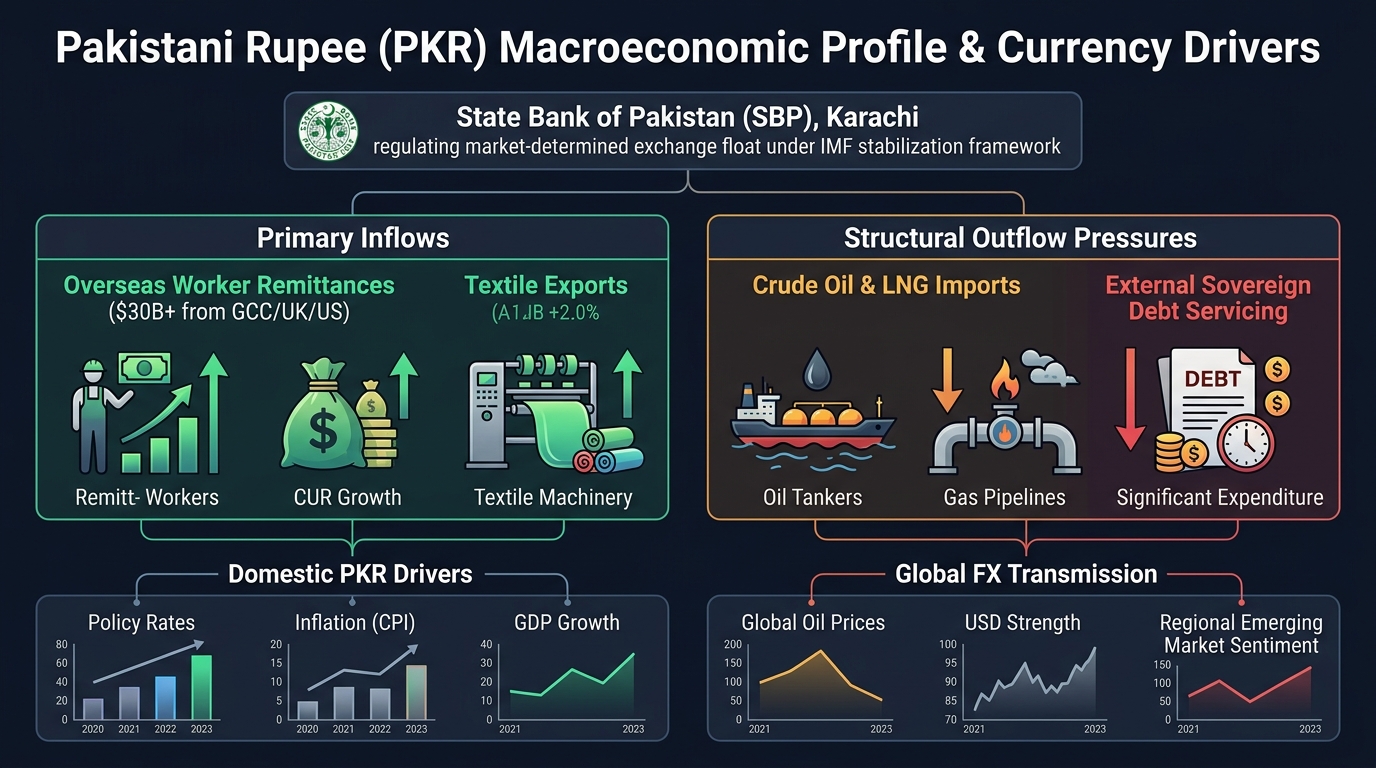
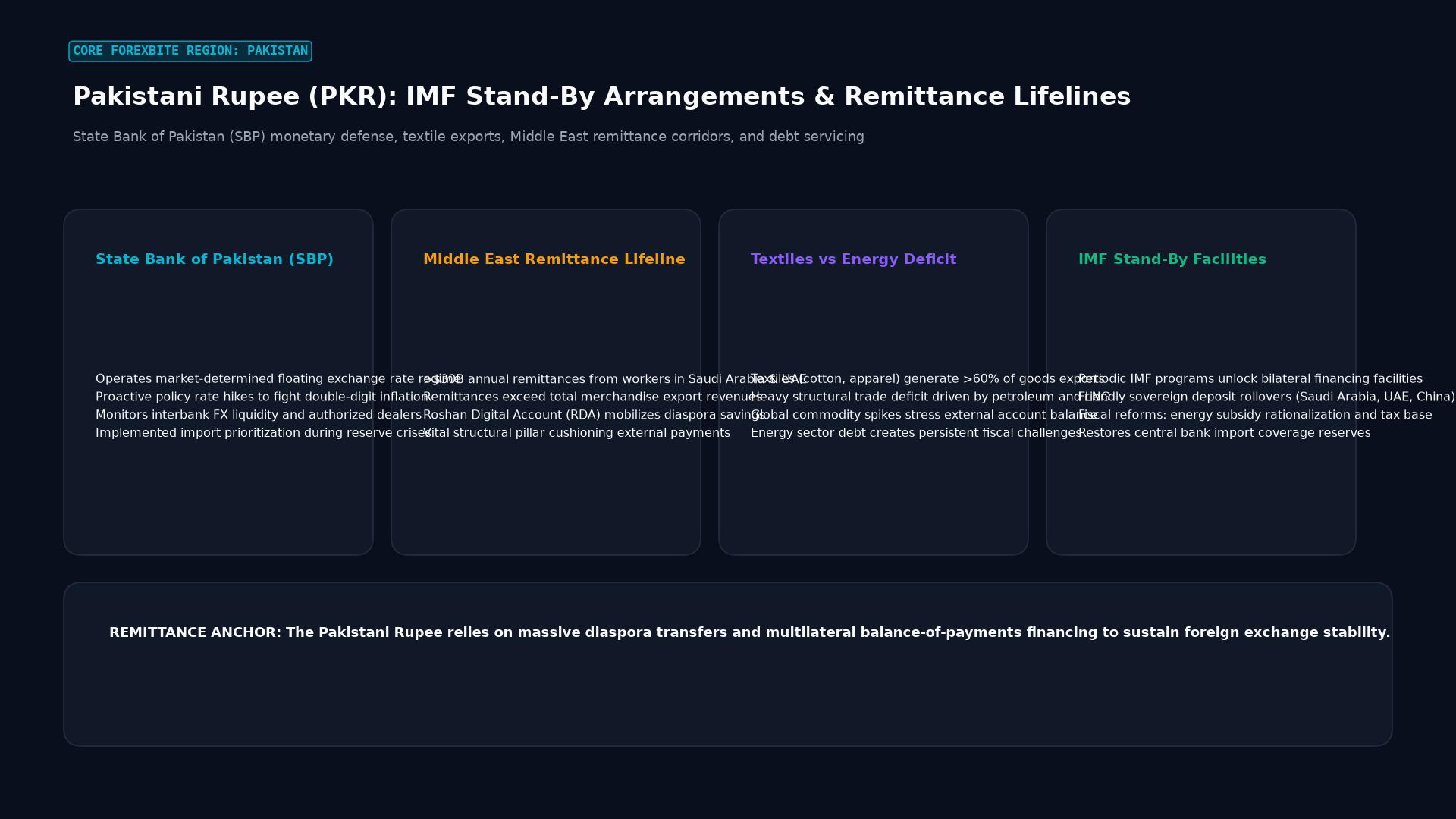 Figure: State Bank of Pakistan (SBP) monetary defense, textile exports, Middle East remittance corridors, and debt servicing
Historical Evolution of the Pakistani Rupee
The monetary history of the Pakistani Rupee mirrors the economic, geopolitical, and structural development of modern South Asia.
The 1947 Partition and the Reserve Bank of India
Following the partition of British India in August 1947, Pakistan lacked an operational central bank and sovereign mint infrastructure. Under the Pakistan (Monetary System and Reserve Bank) Order of 1947:
- The Reserve Bank of India (RBI) continued to serve as the monetary authority for both independent dominions until mid-1948.
- The initial currency circulating in the new nation consisted of standard British Indian rupee notes overstamped with the English words “Government of Pakistan” and the Urdu inscription “Hukumat-e-Pakistan”.
August 1947: Partition of British India
Circulation of Overstamped Reserve Bank of India Notes
                    │
                    ▼
July 1, 1948: Inauguration of State Bank of Pakistan (SBP)
SBP assumes sole authority to issue sovereign currency;
First national rupee notes printed via Thomas De La Rue
                    │
                    ▼
1961: Decimalization
Rupee converted from 16 Annas (64 Paise) to 100 Paisa
                    │
                    ▼
1971: Separation of East Pakistan (Bangladesh)
Reorganization of national liabilities;
Devaluation of 1972 aligns currency with external balances
                    │
                    ▼
1982: Delinking from the British Pound
Transition to managed floating against a trade-weighted basket
                    │
                    ▼
2000-Present: IMF Facilities & Market Modernization
Adoption of market-determined exchange rate mechanism;
Elimination of dual interbank-open market exchange premiums
The State Bank of Pakistan (1948)
On July 1, 1948, Pakistan’s founder, Muhammad Ali Jinnah, formally inaugurated the State Bank of Pakistan (SBP). The central bank assumed sole control over the money supply, replacing overstamped Indian paper with newly designed Pakistani Rupee notes. In October 1948, the government introduced the first official Pakistani coins.
Decimalization (1961)
Originally, following British colonial monetary conventions, one Pakistani rupee was divided into 16 annas, with each anna containing 4 paise (totaling 64 paise per rupee). On January 1, 1961, Pakistan decimalized its currency, subdividing the rupee into 100 paisa.
1982: Delinking from Sterling and Floating Transition
From independence through 1981, the rupee maintained a fixed peg directly to the British Pound Sterling (GBP) and later to the United States Dollar (USD). On January 8, 1982, the administration of General Zia-ul-Haq delinked the rupee from the USD, shifting to a managed floating exchange rate system linked to a trade-weighted basket of partner currencies.
While this policy shielded exporters from rigid dollar appreciation, periodic balance-of-payments deficits required recurring official devaluations throughout the late 1980s and 1990s.
Macroeconomic Drivers of the Pakistani Rupee
The value of the Pakistani Rupee against major international currencies, particularly the US dollar (USD/PKR), is driven by fundamental macroeconomic forces.
1. The Critical Lifeline of Worker Remittances
Personal remittances from overseas Pakistanis represent the primary stabilizer of the country’s external account. Over 9 million Pakistanis live and work abroad, concentrated primarily in the Gulf Cooperation Council (GCC) states (Saudi Arabia, the United Arab Emirates, Qatar, Kuwait, Oman), the United Kingdom, the European Union, and the United States.
+------------------------------------------------------------------------------------+
|                      PAKISTAN WORKER REMITTANCE DYNAMICS                           |
+------------------------------------------------------------------------------------+
|  ANNUAL INFLOW VOLUME |  Averages between $27 Billion and $32 Billion USD annually |
|  PRIMARY SOURCE REGION|  GCC Nations (>50% of total inflows; Saudi Arabia & UAE)   |
|  ECONOMIC SCALE       |  Equivalent to nearly 8% to 10% of national GDP            |
|  BALANCE OF PAYMENTS  |  Offsets approximately 70% to 90% of the trade deficit     |
+------------------------------------------------------------------------------------+
These cash inflows provide non-debt-creating foreign currency liquidity. When remittances flow through formal banking channels, commercial banks sell foreign currency into the interbank market, helping stabilize the rupee’s exchange rate.
2. Textile and Agricultural Export Dependency
Pakistan’s merchandise export base is heavily concentrated in the textile sector. Cotton yarn, knitwear, bedwear, denim, and finished garments generate roughly 60% of total merchandise export earnings.
- When global consumer demand in Europe and North America contracts, textile export volumes drop, reducing foreign exchange inflows.
- Domestic agricultural harvests, particularly raw cotton and basmati rice, directly affect trade balances. Severe climate events, such as the catastrophic Indus River basin floods of 2022 that submerged one-third of the country’s agricultural land, destroy cotton crops, forcing textile mills to import expensive raw fiber and increasing downward pressure on the rupee.
Extreme Climate Event / Crop Damage
               │
               ▼
Domestic Cotton Production Collapses
               │
               ▼
Textile Mills Must Import Raw Cotton from Abroad
               │
               ▼
Export Volumes Drop & Import Dollar Demand Surges
               │
               ▼
Rapid Depreciation Pressure on Pakistani Rupee (USD/PKR Rises)
3. The Energy Import Bill and Trade Deficit
Pakistan is a structural net importer of energy. The country depends heavily on foreign supplies of:
- Crude oil and refined petroleum fuels (gasoline and diesel).
- Liquefied Natural Gas (LNG) long-term contracts and spot cargoes.
- Imported thermal coal for power generation.
When international crude oil (Brent) and spot natural gas prices rise, Pakistan’s import bill expands quickly. Because domestic industrial output depends on imported fuel, high energy prices widen the trade deficit and deplete the SBP’s foreign exchange reserves.
The Dual Exchange Rate Challenge: Interbank vs. Kerb Market
A historical feature of the Pakistani foreign exchange market is the structural tension between the official interbank rate and the open market (kerb) rate.
+------------------------------------------------------------------------------------+
|                         PAKISTANI FOREIGN EXCHANGE SEGMENTS                        |
+--------------------+---------------------------------------------------------------+
| MARKET SEGMENT     | OPERATING CHARACTERISTICS                                     |
+--------------------+---------------------------------------------------------------+
| Interbank FX       | Wholesale market between authorized commercial banks and SBP. |
|                    | Used exclusively for documented trade letters of credit (LCs) |
|                    | and sovereign debt service payments.                          |
+--------------------+---------------------------------------------------------------+
| Open Market (Kerb) | Retail market operated by licensed Foreign Exchange Companies.|
|                    | Used for private travel, education allowances, medical expenses,|
|                    | and cash foreign currency notes.                              |
+--------------------+---------------------------------------------------------------+
| Parallel (Hundi /  | Unregulated, informal value transfer network (Hawala).        |
| Hawala) Channel    | Settles cash offshore without touching formal banking ledgers.|
+--------------------+---------------------------------------------------------------+
The Spread Gap and Remittance Diversion
During periods of external reserve pressure, administrative attempts to hold down the interbank exchange rate have caused the open market kerb rate and informal Hawala rates to trade at a substantial premium.
       Government Imposes Cap on Interbank USD/PKR Rate
       (e.g., Pegged Artificially at 220 PKR/USD)
                            │
                            ▼
       Scarcity: Banks Run Out of USD for Importers
                            │
                            ▼
       Open Market Kerb & Hawala Rates Surge to 250 PKR/USD
       A 30-Rupee Premium Forms (The "Kerb Spread")
                            │
                            ▼
       Overseas Workers Divert Remittances into Hawala Channels
       Official Banking Remittances Drop by Billions of Dollars
                            │
                            ▼
       SBP Foreign Exchange Reserves Fall to Dangerous Lows
When the open market offers 20 to 30 rupees more per US dollar than commercial banks, overseas workers route their money through informal Hawala networks instead of official banking channels. This dynamic drains foreign exchange from the banking system, exacerbating reserve depletion.
The IMF 1.25% Rule
Under Pakistan’s Stand-By Arrangement (SBA) and subsequent Extended Fund Facility (EFF) agreements with the International Monetary Fund, the Pakistani government agreed to eliminate administrative exchange controls.
The IMF enforced a specific structural benchmark:
- The exchange rate spread between the official interbank rate and the retail open market rate must not exceed 1.25% on average over any consecutive 5-day business period:
$$\text{Spread} = \frac{\text{Open Market Rate} - \text{Interbank Rate}}{\text{Interbank Rate}} \le 1.25%$$
Adherence to this rule eliminated the distortionary kerb premium, incentivizing overseas workers to send remittances through official banking channels and helping rebuild SBP reserves.
State Bank of Pakistan Monetary Policy Framework
The State Bank of Pakistan operates under the modernized State Bank of Pakistan Act, 1956 (substantially amended in 2022 to provide legal and operational autonomy).
+------------------------------------------------------------------------------------+
|                         SBP MONETARY POLICY TOOLKIT                                |
+-------------------+----------------------------------------------------------------+
| INSTRUMENT        | PURPOSE & FUNCTION                                             |
+-------------------+----------------------------------------------------------------+
| SBP Policy Rate   | The benchmark target interest rate set by the Monetary Policy  |
|                   | Committee (MPC) to anchor inflation expectations.              |
+-------------------+----------------------------------------------------------------+
| Reverse Repo /    | The interest rate corridor floor and ceiling (typically        |
| Repo Corridor     | +/- 100 basis points around the main policy rate).             |
+-------------------+----------------------------------------------------------------+
| Cash Reserve      | The mandatory percentage of rupee deposits commercial banks    |
| Ratio (CRR)       | must hold interest-free in reserve at the central bank.        |
+-------------------+----------------------------------------------------------------+
| Open Market Ops   | Injections and mop-ups of liquidity via government treasury    |
| (OMOs)            | bills (Market Treasury Bills - MTBs) and PIBs.                 |
+-------------------+----------------------------------------------------------------+
When double-digit consumer price inflation threatens purchasing power, the Monetary Policy Committee (MPC) raises the policy rate to slow domestic credit creation, dampen import demand, and encourage savers to hold rupee-denominated assets.
Trading the PKR: Market Microstructure and Mechanics
In institutional currency markets, the Pakistani Rupee is quoted directly against the US dollar as USD/PKR, representing the number of rupees required to purchase one US dollar.
Direct Quotation:
USD/PKR = 278.50

Meaning:
1 US Dollar = 278.50 Pakistani Rupees
A rise to 285.00 represents Rupee depreciation (USD appreciation).
A fall to 270.00 represents Rupee appreciation (USD depreciation).
Onshore Interbank Execution vs. Offshore NDFs
- Onshore Interbank Trading: Physical spot trading takes place on domestic interbank dealing networks between SBP-licensed commercial banks. Transactions must be backed by genuine commercial trade documents (import letters of credit, export bills, or debt service schedules). Pure speculative currency trading by domestic corporations is prohibited under foreign exchange regulations.
- Offshore Non-Deliverable Forwards (NDFs): Global institutional banks, foreign asset managers, and sovereign hedge funds manage PKR risk through USD-settled offshore Non-Deliverable Forwards traded primarily in London, Singapore, and Dubai. These contracts require no physical delivery of Pakistani Rupees, settling the net difference in US dollars against the SBP’s published daily weighted average closing rate.
NDF Settlement Payout Formula:
Cash Payout (USD) = Notional Amount x [(Spot Fixing Rate - Agreed NDF Strike) / Spot Fixing Rate]
Key Takeaways
- Official Currency of Pakistan: The Pakistani Rupee (PKR, symbols: ₨, Rs.) has been issued and regulated by the State Bank of Pakistan (SBP) since 1948.
- Remittance Foundation: The economy relies heavily on $27 to $32 billion in annual remittances sent by overseas Pakistani workers in the Gulf, UK, and US to bridge persistent trade deficits.
- Textile and Commodity Export Base: Textiles and cotton apparel generate roughly 60% of total export receipts, leaving the currency sensitive to global consumer demand and domestic crop yields.
- Energy Vulnerability: Heavy reliance on imported crude oil, refined fuels, and LNG exposes the rupee to international energy shocks that expand the trade deficit.
- The Kerb-Interbank Spread: Historical gaps between official interbank rates and open market kerb rates diverted money into informal Hawala channels; IMF reforms enforce a strict 1.25% maximum spread cap.
- Restricted Convertibility: Physical onshore spot foreign exchange trading requires underlying commercial documentation, while international institutional investors manage currency exposures via offshore Non-Deliverable Forwards (NDFs).
Frequently Asked Questions (FAQ)
What is the difference between the interbank rate and the open market (kerb) rate in Pakistan?
The interbank rate is the wholesale exchange rate at which commercial banks trade foreign currency among themselves and with the State Bank of Pakistan to settle trade imports, export earnings, and government debt obligations. The open market (kerb) rate is the retail exchange rate quoted by licensed exchange companies to individual consumers buying foreign cash for international travel, overseas university tuition, or medical treatments. Under IMF agreements, the spread between the two rates is monitored closely and capped to maintain market alignment.
Why is the price of international crude oil important for the value of the Pakistani Rupee?
Pakistan imports the vast majority of its crude oil, refined petroleum, and liquefied natural gas (LNG). Because these energy commodities are priced and settled in US dollars, an increase in world energy prices dramatically expands Pakistan’s national import bill. Commercial banks must purchase larger volumes of US dollars to pay overseas fuel suppliers, increasing dollar demand and putting downward depreciation pressure on the Pakistani Rupee.
Can international individual traders buy physical Pakistani Rupees on retail forex platforms?
No. The Pakistani Rupee is not a freely convertible international currency and cannot be physically traded or delivered through standard international retail brokers. In addition, it does not settle on Continuous Linked Settlement (CLS) systems. International financial institutions, multinational corporations, and hedge funds access exposure to the PKR through offshore Non-Deliverable Forwards (NDFs) or by investing in local rupee-denominated sovereign debt (such as Market Treasury Bills and Pakistan Investment Bonds) through specialized Special Convertible Rupee Accounts (SCRAs) held with domestic authorized custodian banks.
Ready to trade forex?
Open a free demo account with a regulated broker. Practice with virtual funds before risking real money.