BDT
The ISO 4217 currency code for the Bangladeshi Taka, the official national currency of the People's Republic of Bangladesh, regulated by Bangladesh Bank.
What is the BDT (Bangladeshi Taka)?
BDT is the ISO 4217 currency code for the Bangladeshi Taka, the national legal tender of the People’s Republic of Bangladesh. Represented by the currency symbol ৳ or Tk and divided into 100 poisha, the Taka was established following Bangladesh independence under the Bangladesh Bank Order of 1972, replacing the Pakistani Rupee. Bangladesh Bank, headquartered in Dhaka, functions as the central monetary authority responsible for currency issuance, reserve management, and credit control.
In international trade and emerging market finance, the Taka represents one of South Asia’s most commercially significant currencies. Driven by a population exceeding 170 million and an industrial base centered on textile manufacturing, the valuation of the BDT is closely monitored by global apparel retailers, multilateral lenders, and international trade finance institutions.
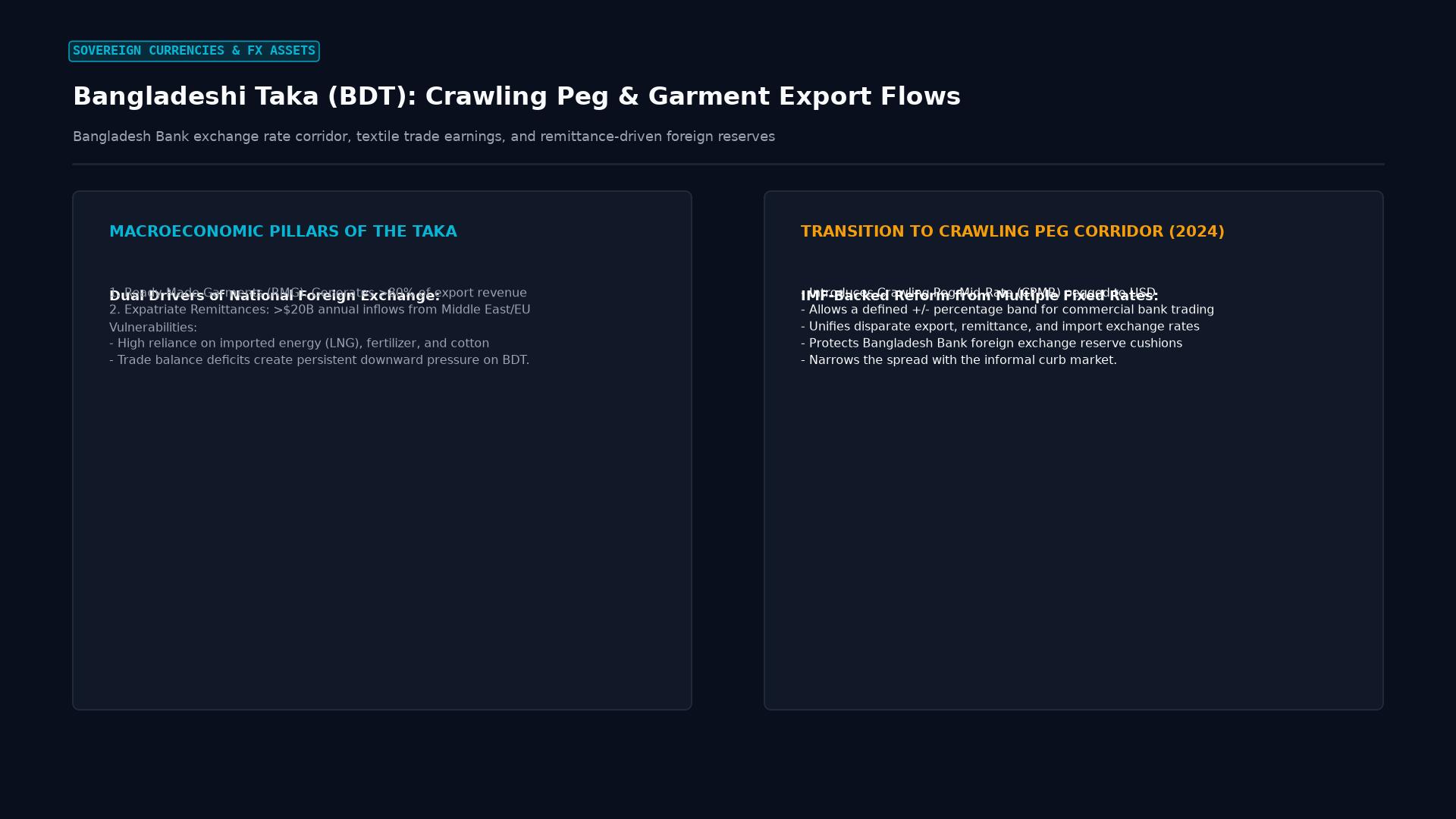 Figure: External trade balance: ready-made garment export earnings and worker remittances supporting Bangladesh Bank’s unified crawling peg corridor.
Exchange Rate Regime: Evolution to Crawling Peg
The exchange rate mechanism of the Bangladeshi Taka has evolved through several structural phases:
- Fixed Basket Peg (1972–2003): The Taka was initially pegged to the British Pound and later linked to a currency basket reflecting major trade partners, with periodic devaluations dictated by central bank decrees.
- Managed Floating Regime (2003–2022): Bangladesh Bank officially transitioned to a managed float, allowing commercial interbank trading while routinely intervening via dollar purchases and sales to prevent sharp swings.
- Multi-Tiered Regulated Rates (2022–2024): Facing rapid foreign reserve depletion following global energy price spikes, Bangladesh Bank introduced a complex system of administered rates (separate rates for export proceeds, worker remittances, and import settlements) set by the Foreign Exchange Dealers’ Association of Bangladesh (BAFEDA) and the Association of Bankers, Bangladesh (ABB).
- Crawling Peg System (May 2024–Present): Under structural reform recommendations tied to a $4.7 billion IMF Extended Credit Facility (ECF) program, Bangladesh Bank introduced a Crawling Peg Corridor (CPC). The central bank establishes a Crawling Peg Mid-Rate (CPMR) pegged to the USD, permitting commercial banks to trade freely within a defined percentage band (typically $\pm 1.0%$) around the benchmark.
+------------------------------------+------------------------------------+
| Managed Rate Architecture          | Market Pressures & Distortions     |
+------------------------------------+------------------------------------+
| Aims to curb sudden currency       | Wide spreads emerge between the    |
| depreciations and protect citizens | official banking rate and the      |
| from imported consumer inflation.  | informal kerb market rate.         |
|                                    |                                    |
| Restricts speculative attacks on   | Incentivizes remittance senders to |
| foreign exchange reserves through  | utilize informal Hundi networks    |
| tight administrative import caps.  | rather than formal bank wires.     |
+------------------------------------+------------------------------------+
The Macroeconomic Twin Engines: RMG and Remittances
The fundamental external balance of the BDT relies on two macroeconomic pillars:
1. Ready-Made Garment (RMG) Exports
Bangladesh is the second-largest exporter of apparel in the world, trailing only China. RMG products (woven garments and knitwear) generate over 80% of total national merchandise export earnings. However, the RMG sector requires massive imports of raw cotton, synthetic yarn, dyes, and specialized spinning machinery. Consequently, net foreign exchange retention is lower than gross export figures suggest, creating a high degree of sensitivity to global cotton prices and European retail demand.
2. Wage-Earner Remittances and the Hundi Challenge
More than 10 million Bangladeshi expatriates work overseas, primarily in the Gulf Cooperation Council (GCC) states (Saudi Arabia, UAE, Qatar, Oman), Malaysia, the United Kingdom, and North America. Remittance inflows historically exceed $20 billion annually, providing vital balance-of-payments support:
$$\text{Current Account Balance} = (\text{Exports} - \text{Imports}) + \text{Net Primary Income} + \text{Remittance Inflows}$$
A persistent challenge to the formal BDT market is the informal money transfer network known as Hundi. When central bank regulations artificially restrict the official banking exchange rate, the kerb market offers a 5% to 15% premium for hard currency. Remittance flows divert into informal channels, depriving the official banking system of liquid dollar reserves. To counteract this, Bangladesh Bank pays a direct cash incentive (typically 2.5%) above the prevailing exchange rate for remittances transferred through legal banking networks.
Balance of Payments Pressures and IMF BPM6 Reserves
Between 2021 and 2024, post-pandemic demand combined with the Russia-Ukraine conflict drove up Bangladesh import bill for liquefied natural gas (LNG), crude oil, fertilizer, and wheat. Gross foreign exchange reserves, which had touched a peak near $48 billion in August 2021, fell sharply.
  Metric                           2021 Peak      2024 Post-Reform Adjustment
  -------------------------------------------------------------------------------
  Gross Reserves (Reported)        ~$48 Billion   ~$25 Billion
  Net Reserves (IMF BPM6 Basis)    ~$41 Billion   ~$13 - $14 Billion
  Import Cover                     ~10 Months     ~3.5 Months
  Official USD/BDT Spot Rate       ~85.00         ~117.00 - 120.00
Under the IMF financial program, Bangladesh Bank adopted the Balance of Payments and International Investment Position Manual (BPM6) accounting standard. BPM6 calculates Net International Reserves (NIR) by stripping out illiquid assets, export development funds (EDF), and bilateral currency swap lines from headline reserves, providing global counterparties with an accurate picture of usable liquid import cover.
Trade Finance, Letter of Credit (LC) Caps, and FX Trading
Trading the Bangladeshi Taka in international wholesale financial markets involves distinct regulatory protocols:
- Letter of Credit (LC) Margins: To preserve foreign exchange, Bangladesh Bank routinely issues regulatory circulars requiring commercial banks to demand 100% cash margins before opening import LCs for luxury goods, vehicles, and non-essential commodities, while exempting life-saving drugs and basic foodstuffs.
- Onshore Forward Contracts: Commercial banks offer forward foreign exchange contracts to exporters and importers, but maturities are strictly regulated and transactions must tie directly to verified trade invoices and bill of lading documents. Pure speculative forward positioning is prohibited.
- Non-Deliverable Forwards (NDFs): International institutional funds hedge Bangladeshi sovereign and corporate debt exposures via offshore USD/BDT Non-Deliverable Forwards traded through financial centers in Singapore and London.
Frequently Asked Questions
Is the Bangladeshi Taka fully convertible on the capital account?
No. The Taka is convertible on the current account (allowing foreign currency transactions for cross-border trade, medical expenses, and travel allowances), but remains non-convertible on the capital account. Bangladeshi residents and domestic corporations cannot freely transfer capital abroad to purchase foreign securities or offshore real estate without special permissions from Bangladesh Bank.
How does Bangladesh Bank manage interbank dollar liquidity?
Bangladesh Bank manages domestic market liquidity through multiple interventions: directly selling USD reserves to state-owned commercial banks to settle sovereign import bills (such as petroleum for Bangladesh Petroleum Corporation), conducting foreign exchange auctions, and issuing repo operations to manage domestic interbank Taka liquidity.
What is the significance of the BDT/INR cross rate for border commerce?
India is Bangladesh’s largest neighbor and a major supplier of raw cotton, yarn, vehicles, and consumer goods. In recent years, Bangladesh Bank and the Reserve Bank of India (RBI) established mechanisms enabling bilateral trade settlement directly in BDT and INR, reducing reliance on USD intermediaries and lowering transaction costs for regional supply chains.
Ready to trade forex?
Open a free demo account with a regulated broker. Practice with virtual funds before risking real money.