Profit Taking
Profit taking is the deliberate execution of closing market or limit orders to liquidate an existing profitable trading position, converting unrealized floating paper gains into realized cash balance while eliminating downside market exposure.
What Is Profit Taking?
In financial market trading and institutional asset management, profit taking refers to the intentional process of closing out an open position that has accumulated significant unrealized (floating) paper profits. By executing an offsetting transaction—selling an existing long position or buying to cover an existing short position—the market participant permanently locks in their gains, releases the margin collateral tied up in the trade, and insulates their capital against future adverse price reversals.
In market microstructure, widespread profit taking often causes sharp, temporary counter-trend pullbacks or consolidation pauses within an ongoing bull or bear market. When large institutional funds, algorithmic CTAs, and discretionary traders simultaneously execute closing orders near key technical milestones, the sudden surge in counter-liquidity temporarily halts the prevailing trend.
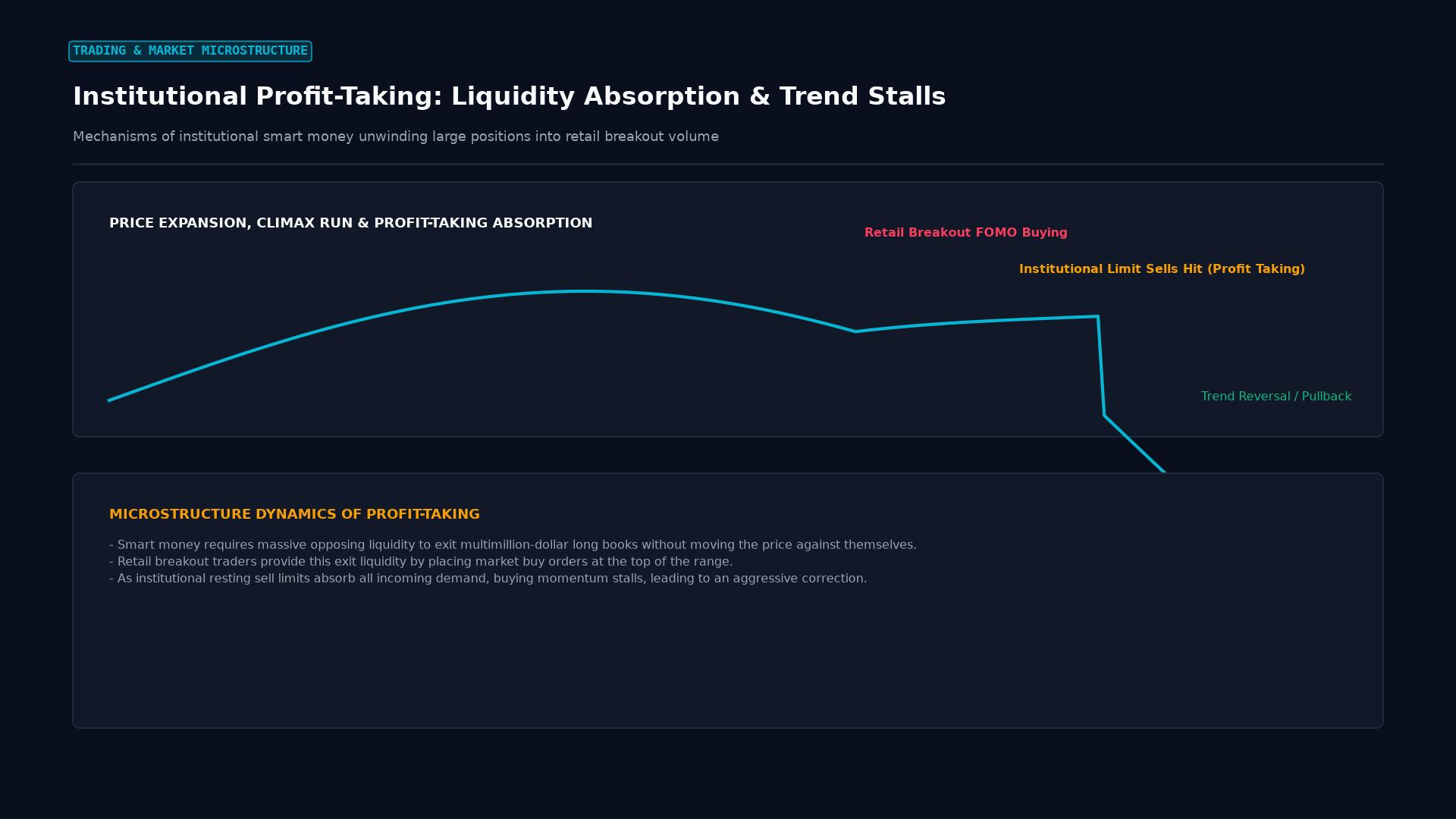 Figure: Order flow dynamics of institutional profit taking: distributing massive long positions into retail breakout buy orders, causing momentum stalls.
Primary Catalysts for Profit Taking
Traders and quantitative portfolio managers initiate profit taking across several systematic and discretionary scenarios:
1. Reaching Pre-Determined Take-Profit (TP) Targets
Professional risk-reward management requires setting clear technical price objectives prior to entering a trade. When price hits a major Fibonacci expansion level (e.g., 161.8%), a multi-month resistance zone, or a psychological round number (e.g., EUR/USD 1.1000), automated limit orders trigger immediate profit realization.
2. De-Risking Ahead of Binary Macroeconomic Releases
When a currency pair or equity index has rallied significantly into a high-impact calendar event—such as a US Federal Reserve FOMC rate decision or Non-Farm Payrolls (NFP) report—institutional desks routinely execute profit taking. Liquidating 50% to 100% of open positions prevents unexpected negative news shocks from wiping out weeks of accumulated paper gains.
3. Month-End and Quarter-End Institutional Rebalancing
Large sovereign wealth funds, pension funds, and multi-asset asset managers operate under statutory asset allocation mandates (e.g., 60% equities / 40% fixed income). If an aggressive equity rally expands the equity weighting to 67% by quarter-end, the fund must systematically engage in profit taking, selling winning stocks and reallocating capital back into bonds or cash to re-establish its baseline allocation.
Strategic Methodologies: All-Out vs. Partial Scaling
Traders deploy two contrasting operational philosophies when taking profits:
| Profit-Taking Strategy | Execution Mechanics | Strategic Advantages | Primary Drawbacks |
|---|---|---|---|
| Complete Exit (All-Out) | Liquidates 100% of position at a single price target. | Completely eliminates market risk; locks in maximum planned monetary gain; frees all margin. | Foregoes potential extended macro trend expansion (“leaving money on the table”). |
| Scaling Out (Partial TP) | Liquidates position in tiered increments (e.g., 50% at TP1, 25% at TP2, 25% trailing). | Locks in cash bank while maintaining an active “runner” with stop-loss at breakeven. | Reduces overall monetary gain on extended trends compared to holding full size. |
| Trailing Stop Liquidation | Allows market to run until trailing stop is triggered on a pullback. | Maximizes participation in monster parabolic trends without predicting market tops. | Inevitably gives back a portion of peak floating profits before the trailing exit executes. |
The “Sell the Fact” Phenomenon in Foreign Exchange
In global currency markets, profit taking is the primary driver of the classic market adage: “Buy the rumor, sell the fact.”
During the weeks preceding an anticipated central bank interest rate hike:
- Macro hedge funds aggressively buy the domestic currency, driving its spot exchange rate higher as the market discounts the rate increase (e.g., EUR/USD rallies 300 pips).
- On the day of the announcement, the central bank delivers the expected 50-basis-point rate hike exactly as forecast.
- Instead of rallying further, the currency suddenly plummets 150 pips within minutes.
- The Explanation: Because the bullish news was already 100% priced into the market, there are no marginal new buyers left to lift offers. Early buyers use the liquidity surge surrounding the news announcement to execute massive profit-taking sell orders, overwhelming the order book.
       "BUY THE RUMOR, SELL THE FACT" PROFIT-TAKING CYCLE

 [Rumor Phase: Weeks Prior]  ---> Speculators Accumulate Long Positions
                                   (Currency Rallies Steadily)
                                               |
                                               v
 [Fact Phase: Central Bank Hikes] -> Event Matches Consensus Perfectly
                                               |
                                               v
 [Profit Taking Unleashed]   ---> Early Bulls Liquidate into High Volume
                                   (Price Drops Sharply Despite Good News!)
Real-World Case Study: USD/JPY Profit Taking at 150.00 (October 2022)
Throughout 2022, the US Dollar staged a historic 3,500-pip rally against the Japanese Yen, climbing from 115.00 to over 151.90 as Federal Reserve rate hikes widened interest rate differentials with the Bank of Japan.
- The Psychological Target: As USD/JPY approached the monumental 150.00–152.00 multi-decade resistance zone in October 2022, speculative retail and institutional long positions reached record extremes on the CFTC Commitments of Traders (COT) report.
- The Profit-Taking Wave: Anticipting that the Japanese Ministry of Finance (MoF) would intervene directly to defend the Yen, macro hedge funds initiated aggressive profit taking, liquidating billions in long dollar contracts to lock in extraordinary 30% annual gains.
- The Cascade: When the MoF executed a surprise $30 billion currency intervention on Friday afternoon, October 21, the market was already fragile. The combination of official intervention and a cascading rush of traders taking remaining profits triggered a violent 700-pip collapse in USD/JPY within hours, eventually driving the pair down to 127.20 over the following ten weeks.
Frequently Asked Questions
Is profit taking a bearish signal?
Not necessarily. In an established bull trend, profit taking is a normal, healthy mechanism that relieves overbought conditions and allows new buyers to enter at favorable discount levels (forming higher lows). However, if profit taking is accompanied by massive institutional volume and breaks major multi-week support levels, it can signal a structural trend reversal.
How does a trailing stop assist in profit taking?
A trailing stop automatically adjusts the stop-loss price higher as the market moves in your favor, maintaining a fixed distance (e.g., 50 pips or 1.5x ATR). It allows you to participate in an indefinite trend while guaranteeing that once price retraces by the trailing distance, the trade is automatically liquidated to protect accumulated profits.
Why do some traders struggle emotionally with taking profits?
Traders often fall victim to the cognitive bias of greed and FOMO (Fear of Missing Out). When a trade is deeply profitable, the emotional desire to extract every last pip prevents them from executing their planned exit. When the market inevitably pulls back, their floating profits vanish, frequently turning winning trades into painful breakeven or losing trades.
Ready to trade forex?
Open a free demo account with a regulated broker. Practice with virtual funds before risking real money.