Offsetting Transaction
An offsetting transaction is a trade or financial operation that takes an equal and opposite position to an existing open market commitment, effectively neutralizing market risk, closing the position, and crystallizing realized profit or loss.
What Is an Offsetting Transaction?
In financial trading, futures exchanges, and foreign exchange markets, an offsetting transaction (frequently referred to as an offsetting trade or closing transaction) is an order executed specifically to eliminate or neutralize an open market position. By executing a trade that matches the exact instrument, size, and counter-direction of an original commitment, the market participant terminates their exposure to future price fluctuations.
For instance:
- A trader who holds an open long position of 100,000 EUR/USD (bought at 1.0820) enters an offsetting transaction by selling 100,000 EUR/USD.
- An option writer who previously sold to open 10 put contracts executes an offsetting transaction by buying to close 10 identical put contracts.
Once the offsetting order fills, the broker or clearinghouse nets the two opposing legs against each other, releasing the initial margin collateral held against the trade and transferring the resulting cash profit or loss directly into the trader’s realized account balance.
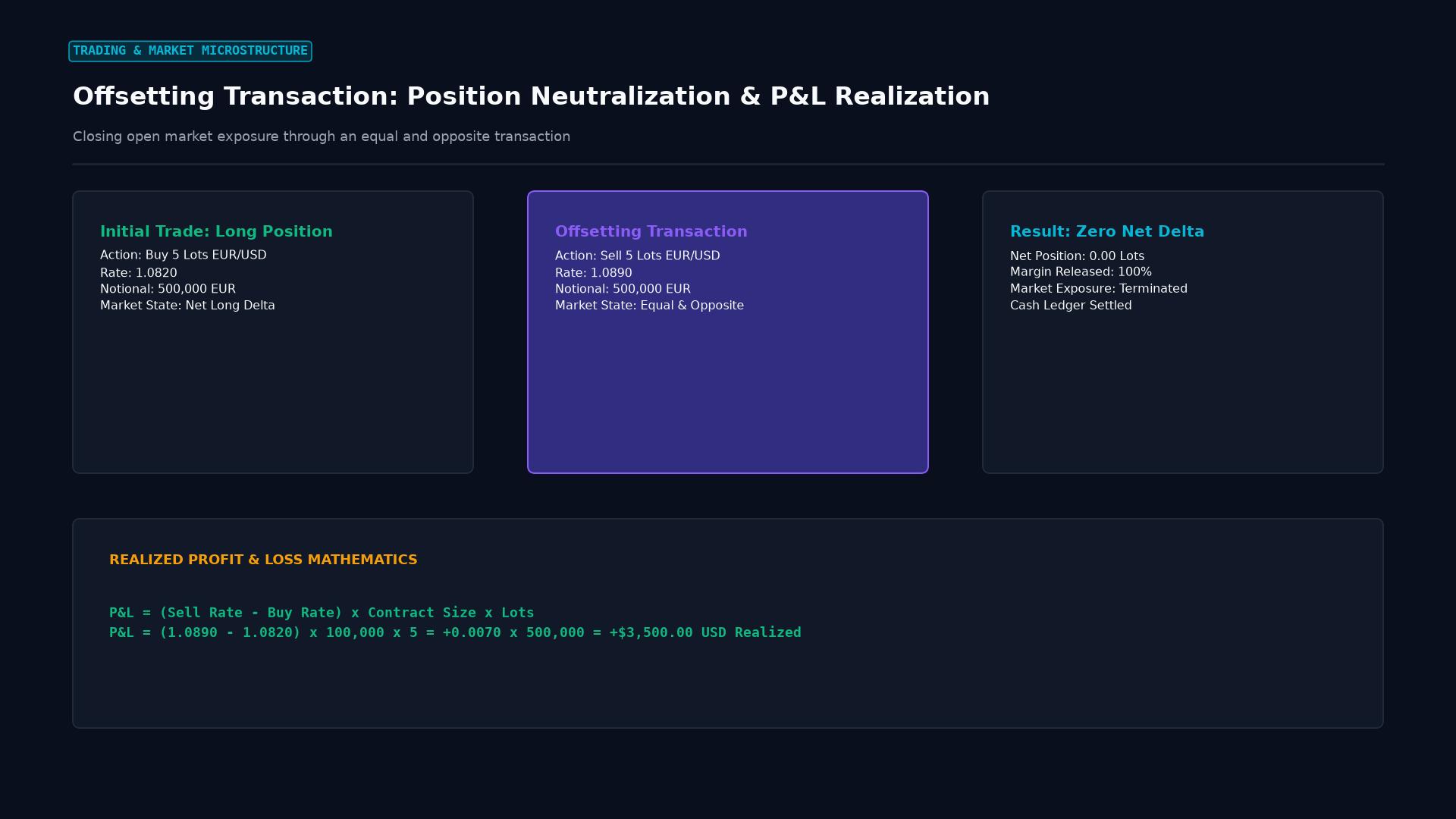 Figure: Position termination workflow: executing an equal and opposite order to eliminate directional delta, release margin, and realize cash P&L.
Offsetting Mechanisms Across Asset Classes
The operational processing of offsetting transactions varies depending on market regulatory structures and accounting conventions:
1. Spot Forex and FIFO Regulations
In the United States, under the National Futures Association (NFA) Compliance Rule 2-43(b), retail forex dealer members (RFEDs) must enforce the First-In, First-Out (FIFO) accounting standard. If a trader holds multiple long positions in the same currency pair purchased at different price levels, an offsetting sell order must automatically close the oldest open lot first. Furthermore, US regulations prohibit holding simultaneous long and short positions in the exact same pair within the same account (anti-hedging rule).
In European and international jurisdictions governed by ESMA or ASIC, brokers often support ticket-based or independent position tracking, allowing traders to select specific open tickets to offset or even maintain simultaneous long and short hedge trades.
2. Futures and Central Clearing Houses
On centralized futures exchanges (such as the Chicago Mercantile Exchange, CME), offsetting is the primary method of contract termination. Because fewer than 2% of futures contracts culminate in physical delivery of commodities or cash settlement at expiration, commercial hedgers and speculative traders routinely offset contracts prior to First Notice Day. The clearinghouse novates the trade, nets the contracts down to zero, and releases performance bond margin.
3. Options Markets: Opening vs. Closing Nomenclature
Options exchanges maintain rigorous order routing tags to differentiate new risk from offsetting transactions:
- Buy to Open (BTO): Establishing a new long call or put.
- Sell to Close (STC): The offsetting transaction that liquidates the long option.
- Sell to Open (STO): Establishing a new short option (writing).
- Buy to Close (BTC): The offsetting transaction that buys back the short option.
Offsetting vs. Hedging: Structural Comparison
Traders frequently confuse executing an offsetting transaction with establishing a hedge:
| Operational Feature | Offsetting Transaction | Hedging Strategy |
|---|---|---|
| Market Exposure | Reduced to Zero (Flat / Square). | Maintained across correlated or synthetic instruments. |
| Margin Requirement | Eliminates margin requirements; releases locked collateral. | Requires margin collateral for both legs (unless broker grants margin netting). |
| Realized P&L | Crystallizes immediate realized profit or loss. | Keeps floating P&L open; defers tax realization. |
| Financing / Swap Costs | Terminates overnight rollover charges (swaps). | Accumulates financing drag (paying the negative carry spread on both sides). |
| Execution Objective | Complete liquidation and trade exit. | Risk mitigation, volatility insulation, or basis capture. |
Real-World Case Study: Futures Delivery Avoidance
Consider an independent commodity trading firm holding an open long position of 20 WTI Crude Oil futures contracts (symbol: CL) on the NYMEX, representing 20,000 physical barrels of oil.
- Initial Position: Bought 20 CL contracts at $74.50 per barrel.
- Expiration Threat: As the contract approaches expiration (three business days prior to the 25th of the calendar month), remaining open long holders become legally obligated to take physical delivery of crude oil at Cushing, Oklahoma pipeline storage facilities.
- The Offsetting Execution: Because the firm possesses no pipeline storage capacity, the risk desk executes an offsetting sell order for 20 CL contracts at $78.20 per barrel.
- Financial Result: $$\text{Realized P&L} = (\text{Exit Price} - \text{Entry Price}) \times \text{Volume}$$ $$\text{Realized P&L} = ($78.20 - $74.50) \times 20{,}000 \ \text{barrels} = +$74{,}000$$
- The CME clearinghouse reconciles the transaction, cancels physical delivery obligations, credits $74,000 cash to the account, and unfreezes $140,000 in maintenance margin.
Frequently Asked Questions
Can I choose which specific position to offset in forex trading?
Under US NFA regulations, no—the FIFO rule dictates that the oldest open trade in that currency pair must be closed first. However, outside the US (e.g., under UK FCA, European CySEC, or Australian ASIC regulations), brokers allow traders to specify individual ticket IDs to offset, enabling non-FIFO tax-lot optimization.
Does an offsetting transaction always realize a tax event?
Yes. In virtually all major tax jurisdictions (including the US Internal Revenue Service under Section 988 or Section 1256, and the UK HMRC), executing an offsetting transaction legally terminates the investment contract, converting an unrealized floating gain or loss into a taxable capital event.
What happens if an offsetting trade is executed for a larger size than the open position?
If a trader is long 1.0 standard lot of EUR/USD and submits a market sell order for 1.5 lots, the transaction first offsets the 1.0 lot long position to flat (realizing P&L), and the remaining 0.5 lot instantly opens a new net short position.
Ready to trade forex?
Open a free demo account with a regulated broker. Practice with virtual funds before risking real money.