Qualified Eligible Participant
A Qualified Eligible Participant (QEP) is an individual or institutional investor meeting high financial sophistication and portfolio thresholds under CFTC Rule 4.7, qualifying them to invest in private commodity pools and managed futures accounts.
What is a Qualified Eligible Participant (QEP)?
In derivatives regulation and alternative investment management, a Qualified Eligible Participant (QEP) is an individual or institutional investor that satisfies rigorous financial net worth, investment experience, and portfolio size requirements established by the Commodity Futures Trading Commission (CFTC).
Codified under CFTC Rule 4.7 (17 CFR § 4.7), the QEP designation serves as a regulatory boundary within the derivatives and managed futures industry. The CFTC recognizes that institutional entities and sophisticated market participants do not require the same paternalistic disclosures, pre-reviewed prospectuses, and operational oversight mandated for retail investors.
When a registered Commodity Pool Operator (CPO) or Commodity Trading Advisor (CTA) restricts its offerings exclusively to investors who qualify as QEPs, the fund manager is granted broad regulatory relief under Rule 4.7. This relief exempts the manager from costly disclosure document filings, mandatory National Futures Association (NFA) pre-reviews, detailed past-performance presentations, and standardized retail reporting requirements.
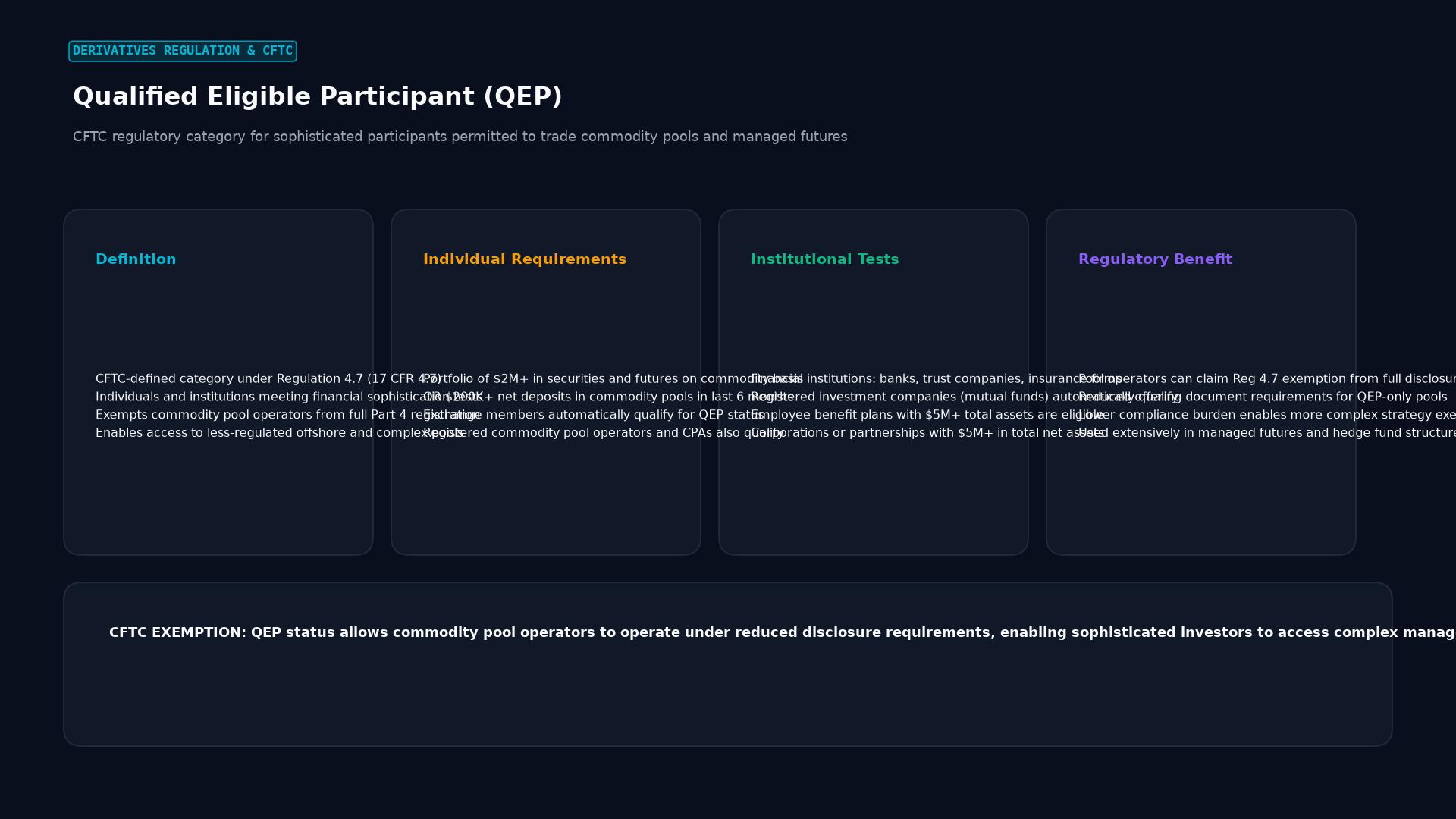 Figure: CFTC regulatory category for sophisticated participants permitted to trade commodity pools and managed futures
The Two Tiers of Qualified Eligible Participants
Under CFTC Rule 4.7, prospective investors fall into two separate operational classifications: those who are automatically deemed QEPs without meeting a portfolio test, and those who must satisfy a mandatory portfolio requirement.
                         CFTC RULE 4.7 ELIGIBILITY PATHWAY

                     Prospective Investor in Commodity Pool
                                       │
                                       ▼
                     Is the investor an "Insider" or Institutional
                     entity under Rule 4.7(a)(2)?
                     - Registered CPO, CTA, or FCM
                     - Broker-Dealer or Registered Investment Adviser
                     - Qualified Purchaser (QP under 1940 Act)
                     - Non-United States Person (Offshore)
                                       │
                         ┌─────────────┴─────────────┐
                        YES                          NO
                         │                           │
                         ▼                           ▼
                  QUALIFIES AS QEP       Must satisfy TWO hurdles:
               (No Portfolio Test needed) 1. Accredited Investor (SEC Rule 501)
                                                       AND
                                          2. The CFTC Portfolio Requirement:
                                             - $2,000,000 in Securities/Assets OR
                                             - $200,000 in Initial Margin/Premiums OR
                                             - A combination (50%/50%)
                                                       │
                                           ┌───────────┴───────────┐
                                          YES                      NO
                                           │                       │
                                           ▼                       ▼
                                    QUALIFIES AS QEP       DISQUALIFIED
                                    (Exempt 4.7 Fund)      (Cannot enter fund)
Category 1: Persons Exempt from the Portfolio Requirement
The first category includes market professionals and large institutional capital allocators whose regulatory status or legal sophistication presumes financial competence. These participants qualify as QEPs without demonstrating specific cash or portfolio balances:
- Registered Derivatives Professionals: Futures Commission Merchants (FCMs), Commodity Pool Operators (CPOs), and Commodity Trading Advisors (CTAs) registered with the CFTC, as well as their associated persons and principals.
- Securities Professionals: SEC-registered broker-dealers and registered investment advisers (RIAs).
- Qualified Purchasers (QPs): Any institutional or high-net-worth investor qualifying as a Qualified Purchaser under Section 2(a)(51)(A) of the Investment Company Act of 1940 (typically owning at least $5,000,000 in investable assets).
- Non-United States Persons: Foreign offshore investors residing outside the United States, as defined under CFTC regulations.
Category 2: Persons Who Must Satisfy the Portfolio Requirement
For standard high-net-worth individuals, family trusts, private corporate entities, and accredited investors, qualifying as a QEP requires passing a two-step cumulative test:
- The Accredited Investor Hurdle: The investor must first qualify as an Accredited Investor under SEC Regulation D (Rule 501) (e.g., individual net worth exceeding $1,000,000 excluding primary residence, or annual personal income exceeding $200,000 / $300,000 for couples).
- The CFTC Portfolio Requirement (Rule 4.7(a)(1)(v)): In addition to accredited status, the investor must satisfy at least one of the following financial thresholds:
- The Securities Portfolio Component: Owns securities of unaffiliated issuers and other investable assets with an aggregate market value of at least $2,000,000; OR
- The Margin Deposit Component: Has on deposit with a registered Futures Commission Merchant (FCM) for the preceding six months at least $200,000 in exchange-specified initial margin and option premiums for futures and options trading; OR
- The Combined Proportional Component: Maintains a combination of the two where the sum of the percentages meets 100% (for example, owning $1,000,000 in securities [50% of test] and holding $100,000 in margin deposits [50% of test]).
(Note: In ongoing regulatory modernizations, the CFTC has proposed inflation-adjusting these thresholds upward to reflect modern capital levels, such as increasing the portfolio test to $4,000,000 and margin requirements to $400,000).
Regulatory Hierarchy: Where QEP Fits
Financial regulations establish multiple tiers of investor accreditation. Each tier unlocks access to private alternative funds and exempts managers from different statutory constraints.
+------------------------------------------------------------------------------------+
|                         INVESTOR SOPHISTICATION HIERARCHY                          |
+---------------------+-------------------+---------------------+--------------------+
| REGULATORY STATUS   | REGULATORY REGIME | CORE THRESHOLD      | VEHICLES UNLOCKED  |
+---------------------+-------------------+---------------------+--------------------+
| Retail Investor     | SEC / FINRA / NFA | None                | Public Mutual Funds|
|                     | Full Oversight    | (Public Markets)    | ETFs, Public Pools |
+---------------------+-------------------+---------------------+--------------------+
| Accredited Investor | SEC Regulation D  | $1M Net Worth or    | Standard Private   |
| (Rule 501)          | (Securities Act)  | $200k/300k Income   | Placements, Reg D  |
+---------------------+-------------------+---------------------+--------------------+
| Qualified Client    | SEC Rule 205-3    | $1.1M AUM or        | Registered Funds   |
|                     | (Advisers Act)    | $2.2M Net Worth     | Charging Perf. Fees|
+---------------------+-------------------+---------------------+--------------------+
| Qualified Eligible  | CFTC Rule 4.7     | Accredited + $2M    | Exempt Commodity   |
| Participant (QEP)   | (CEA Framework)   | Portfolio / $200k   | Pools & Managed    |
|                     |                   | Margin Requirement  | Futures CTAs       |
+---------------------+-------------------+---------------------+--------------------+
| Qualified Purchaser | SEC Section       | $5,000,000 in       | Section 3(c)(7)    |
| (QP)                | 2(a)(51) (ICA)    | Investable Assets   | Elite Hedge Funds  |
+---------------------+-------------------+---------------------+--------------------+
Regulatory Relief Granted to CPOs and CTAs Under Rule 4.7
When a fund manager verifies that 100% of the pool’s participants meet QEP standards, the manager files a simple electronic notice with the NFA and receives immediate exemptions from administrative burdens:
+------------------------------------------------------------------------------------+
|                         RULE 4.7 REGULATORY RELIEF OVERVIEW                        |
+-------------------+----------------------------------------------------------------+
| REGULATORY DOMAIN | NATURE OF EXEMPTION & RELIEF                                   |
+-------------------+----------------------------------------------------------------+
| Disclosure Doc    | Exempt from submitting disclosure documents to the NFA for     |
| Pre-Review        | formal review and approval prior to taking investor capital.   |
+-------------------+----------------------------------------------------------------+
| Past Performance  | Relieved from rigid NFA past-performance presentation tables;  |
| Presentation      | managers can display performance using proprietary institutional|
|                   | metrics, provided data is factual and not misleading.          |
+-------------------+----------------------------------------------------------------+
| Periodic Account  | Permits quarterly account statements rather than monthly       |
| Statements        | reporting cycles required for retail commodity pools.          |
+-------------------+----------------------------------------------------------------+
| Annual Certified  | Annual financial reports do not require full GAAP certification|
| Audits            | in standard retail format, provided certified financials meet  |
|                   | standard institutional accounting guidelines.                  |
+-------------------+----------------------------------------------------------------+
The Mandatory Rule 4.7 Legend
Even under exempt status, consumer protection laws mandate transparency. Every private offering memorandum, subscription agreement, and account statement issued under Rule 4.7 must display a prominent, capitalized disclosure legend on its front cover:
"PURSUANT TO AN EXEMPTION FROM THE COMMODITY FUTURES TRADING COMMISSION
IN CONNECTION WITH ACCOUNTS OF QUALIFIED ELIGIBLE PERSONS, THIS BROCHURE
OR ACCOUNT DOCUMENT IS NOT REQUIRED TO BE, AND HAS NOT BEEN, FILED WITH
THE COMMISSION. THE COMMODITY FUTURES TRADING COMMISSION DOES NOT PASS
UPON THE MERITS OF PARTICIPATING IN A TRADING PROGRAM OR UPON THE ADEQUACY
OR ACCURACY OF COMMODITY TRADING ADVISOR DISCLOSURE."
Institutional Due Diligence for QEP Compliance
Maintaining QEP compliance is an ongoing legal obligation for fund managers. If a commodity pool operator inadvertently admits an unaccredited or non-QEP investor into a Rule 4.7 fund:
- The entire fund loses its exempt status under Rule 4.7.
- The CPO becomes retroactively liable for failing to provide full retail NFA disclosure documents.
- Investors may obtain statutory rescission rights, enabling them to demand the return of their capital and forcing the liquidation of trading positions.
To avoid these risks, institutional administrators execute thorough subscription audits:
- Asset Verification: Reviewing third-party brokerage statements, audited financials, or custodian letters dated within the prior 90 days confirming the $2,000,000 investment asset threshold.
- Margin Verification: Confirming active futures clearing accounts with authorized FCMs demonstrating the required $200,000 initial margin balance.
- Representation Letters: Requiring signed investor certifications verifying that invested capital belongs to the participant and was not pooled from non-QEP third parties to circumvent regulatory minimums.
Key Takeaways
- CFTC Derivatives Boundary: A Qualified Eligible Participant (QEP) is an investor recognized under CFTC Rule 4.7 as possessing the net worth and sophistication required to trade managed futures and private commodity pools without retail protections.
- Rule 4.7 Regulatory Relief: Restricting fund access exclusively to QEPs frees Commodity Pool Operators (CPOs) and Commodity Trading Advisors (CTAs) from mandatory NFA disclosure pre-reviews and monthly reporting cycles.
- The Two-Category Taxonomy: Institutional insiders (CPOs, CTAs, registered advisers, and Qualified Purchasers) qualify automatically, while individual investors must meet both Accredited Investor standards and the CFTC Portfolio Requirement.
- The Portfolio Requirement: High-net-worth individuals must demonstrate ownership of at least $2,000,000 in investable securities or $200,000 in futures initial margin deposits.
- Distinct from SEC Classifications: QEP is a specific CFTC derivatives designation, sitting above SEC Accredited Investor status and below Section 3(c)(7) Qualified Purchaser status.
- Strict Compliance Liabilities: Admitting a single non-QEP participant into a Rule 4.7 pool jeopardizes the fund’s regulatory exemption, exposing the manager to NFA enforcement actions and investor rescission demands.
Frequently Asked Questions (FAQ)
What is the primary difference between an Accredited Investor and a Qualified Eligible Participant (QEP)?
An Accredited Investor is an SEC designation under Regulation D (requiring $1,000,000 in net worth excluding a primary residence, or $200,000 in annual income) that permits participation in private equity, venture capital, and standard private securities placements. A Qualified Eligible Participant (QEP) is a stricter CFTC designation under Rule 4.7 for commodity pools, futures funds, and managed derivatives. To qualify as a natural person QEP, an investor must be an Accredited Investor and satisfy the CFTC Portfolio Requirement (owning at least $2,000,000 in securities or having $200,000 on deposit with an FCM for initial futures margin).
Can an exempt Rule 4.7 commodity pool accept any non-QEP investors?
Under strict CFTC rules, an exempt Rule 4.7 pool cannot accept non-QEP investors from the general public. However, Rule 4.7 contains narrow exceptions for “knowledgeable employees”, such as the fund’s portfolio managers, executives, and key trading personnel who participate in the fund’s operational activities. These individuals are permitted to invest alongside QEPs despite not meeting the personal portfolio test, aligning insider capital with institutional client interests.
What is a Commodity Pool Operator (CPO) and how does QEP status help them?
A Commodity Pool Operator (CPO) is an individual or firm that combines funds from multiple investors to trade commodity futures, options on futures, foreign exchange contracts, or retail commodity swaps. In a normal retail commodity pool, the CPO must draft a comprehensive disclosure document, submit it to the National Futures Association (NFA) for a prolonged review process, provide monthly account statements, and adhere to strict disclosure templates. If the CPO limits the pool to QEPs, it can launch the fund immediately without NFA pre-approval, significantly reducing operational, legal, and compliance expenses.
Ready to trade forex?
Open a free demo account with a regulated broker. Practice with virtual funds before risking real money.