Rate
In global finance and macroeconomics, rate is a foundational mathematical ratio expressing the relative price, cost, or return between two financial variables—most prominently designating either an Exchange Rate (the value of one currency in terms of another) or an Interest Rate (the cost of capital).
What Is a Rate in Financial Markets?
In international economics, banking, and investment management, the term rate represents a standardized proportion, ratio, or percentage that defines the contractual terms of trade, borrowing, or investment. While colloquial market commentary often uses “rate” as a shorthand term, institutional finance structures the concept across two monumental macroeconomic pillars:
- Foreign Exchange Rate (FX Rate): The relative price ratio at which one sovereign national currency can be converted into another (e.g., an exchange rate of EUR/USD = 1.0850 indicates that 1 Euro commands 1.0850 US Dollars).
- Interest Rate: The annualized percentage fee charged by a lender to a borrower for the use of capital, or the yield earned by an investor on cash deposits or debt securities (e.g., a 5.25% Federal Funds Rate).
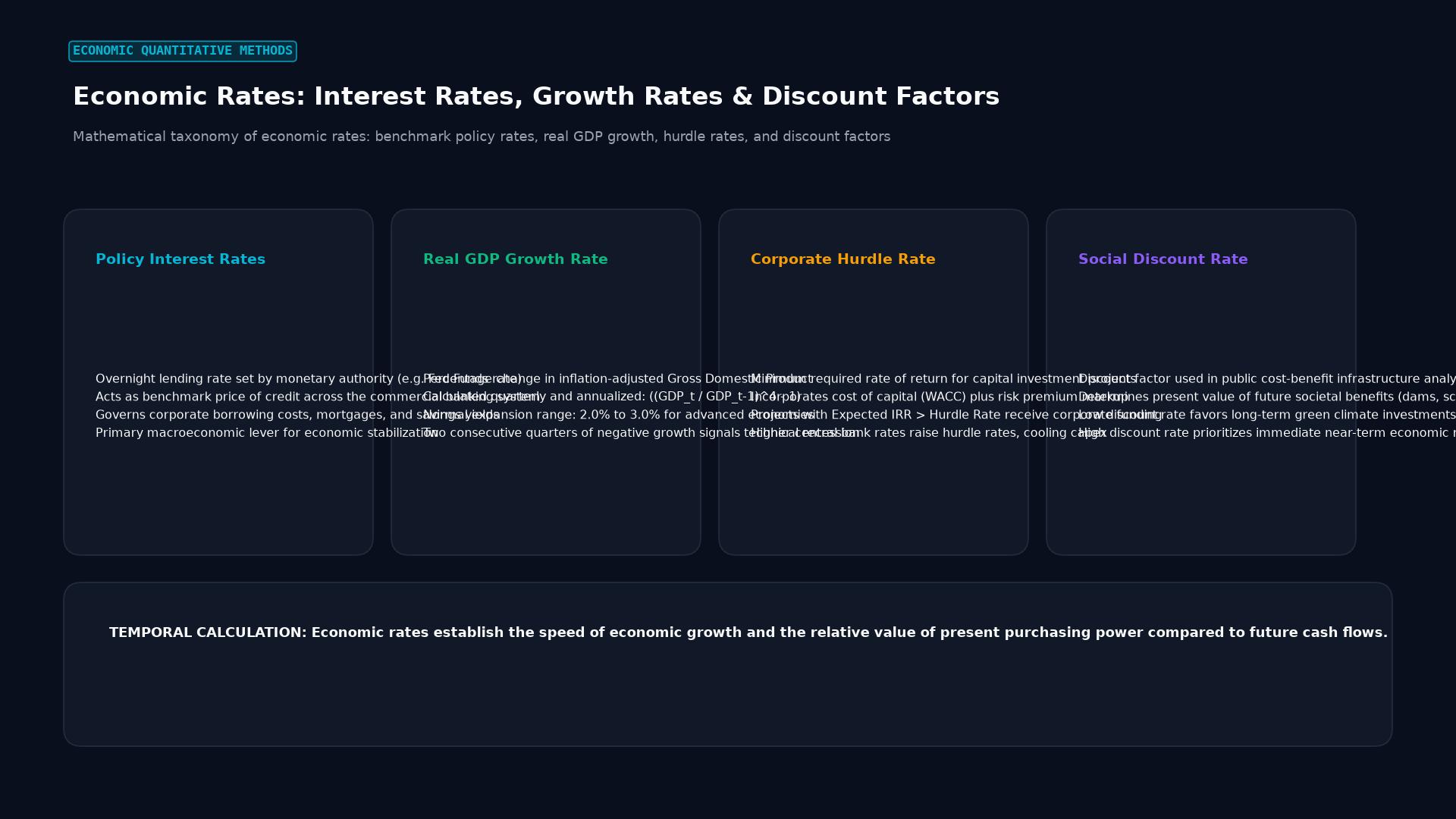 Figure: Mathematical taxonomy of economic rates: benchmark policy rates, real GDP growth, hurdle rates, and discount factors
1. Foreign Exchange Rates: Quoting Conventions and Regimes
An exchange rate is an economic price tag on national sovereignty. It dictates terms of international trade, capital flows, and purchasing power:
Quoting Hierarchy: Base vs. Quote Currency
Every foreign exchange rate is expressed as a fractional pair: $$\text{Exchange Rate} = \frac{\text{Base Currency}}{\text{Quote Currency}}$$
- The Base Currency is the unit of reference (always equals 1).
- The Quote (Counter) Currency is the variable amount required to purchase one unit of the base currency.
Sovereign Exchange Rate Regimes
Nations structure their currency rates under three broad frameworks:
- Free-Floating Rate: Market forces of global supply and demand determine the exchange rate without government intervention (e.g., USD, EUR, JPY, GBP).
- Pegged / Fixed Rate: The national central bank fixes its currency rate to a major anchor currency (e.g., the Hong Kong Dollar pegged at 7.75–7.85 HKD per USD), requiring continuous central bank reserve intervention.
- Crawling Peg / Managed Float: The exchange rate is permitted to fluctuate within a prescribed target band, adjusted periodically for inflation differentials.
2. Interest Rates: The Price of Time and Risk
Interest rates represent the foundational cost of money across an economy:
$$\text{Nominal Interest Rate} = \text{Real Interest Rate} + \text{Expected Inflation Rate} \quad \text{(Fisher Effect)}$$
Primary Categories of Interest Rates:
- Policy / Benchmark Rates: Set directly by sovereign central banks (such as the Federal Open Market Committee, ECB Governing Council, or Bank of Japan) to achieve price stability and maximum sustainable employment.
- Interbank Overnight Rates: The rate at which commercial banks lend uncollateralized or collateralized reserves to one another (e.g., SOFR, €STR, SONIA).
- Lending & Commercial Rates: Rates charged to corporate and retail borrowers (e.g., Prime Rate, mortgage rates, corporate bond yields).
The Critical Interconnection: Rates Drive Currency Rates
The two dimensions of “rate” are inextricably linked. Under the economic doctrine of Covered Interest Parity (CIP) and global capital mobility, capital naturally flows toward jurisdictions offering higher risk-adjusted interest yields:
$$\text{Higher Domestic Interest Rates} \implies \text{Inflow of Foreign Capital} \implies \text{Appreciation of Domestic FX Rate}$$
| Economic Catalyst | Interest Rate Impact | Exchange Rate Impact (Domestic Currency) |
|---|---|---|
| Central Bank Hikes Rates | Short-term bond yields and money market returns rise. | Appreciates: Foreign capital enters to capture higher yield. |
| Central Bank Cuts Rates | Borrowing costs fall; money supply expands. | Depreciates: Capital departs seeking higher returns abroad. |
| Inflation Surges Above Target | Central bank is compelled to tighten policy rates. | Mixed: Strong if central bank is credible; weak if real rates turn negative. |
| Severe Financial Crisis | Emergency liquidity injections; rates slashed to 0%. | Flight to Safety: Safe-haven currencies (USD, CHF) surge regardless of rate cuts. |
Real-World Case Study: The 2022 US Dollar “King Dollar” Rate Shock
In 2022, as global inflation exploded post-pandemic, central banks responded with vastly divergent interest rate policies:
- The Rate Divergence:
- The US Federal Reserve launched an aggressive rate-hiking cycle, raising the Fed Funds rate by 425 basis points from 0.00% to 4.25% in nine months.
- The Bank of Japan (BoJ) maintained its ultra-loose Yield Curve Control (YCC) policy, pinning short-term Japanese interest rates at -0.10% and 10-year yields at 0.00%.
- The Exchange Rate Impact: The monumental expansion in the US-Japan interest rate differential triggered an extraordinary global capital rotation. Institutional carry traders borrowed Yen at zero interest to invest in US Treasuries yielding 4.5%.
- The Currency Plunge: USD/JPY exploded from 115.00 in January 2022 to over 151.90 by October 2022—a historic 32% devaluation of the Yen in ten months, perfectly illustrating how interest rates govern foreign exchange rates.
Frequently Asked Questions
What is the difference between a nominal rate and an effective rate?
A nominal interest rate is the stated headline annual interest rate without taking into account the effects of intra-year compounding. The effective interest rate (Annual Percentage Yield - APY) incorporates compounding frequency (e.g., monthly or daily), reflecting the true economic return or borrowing cost: $$\text{Effective Rate} = \left(1 + \frac{r}{n}\right)^n - 1$$
What is the “Real Exchange Rate”?
While the nominal exchange rate is the observable market price ratio between currencies, the Real Exchange Rate (RER) adjusts the nominal rate for the relative price levels (inflation) in the two nations: $$\text{RER} = \text{Nominal Rate} \times \left(\frac{P_{\text{foreign}}}{P_{\text{domestic}}}\right)$$ It measures the true international competitiveness of a nation’s goods and services.
Who determines the exchange rate on a Sunday evening?
The foreign exchange market is continuous and decentralized. On Sunday evening at 5:00 PM EST, commercial banks, liquidity aggregators, and institutional dealing desks in Wellington (New Zealand) and Sydney (Australia) begin quoting two-way bid/ask prices based on accumulated weekend fundamental news, establishing the opening exchange rates for the global week.
Ready to trade forex?
Open a free demo account with a regulated broker. Practice with virtual funds before risking real money.