Rate Differential
The rate differential (more formally, the Interest Rate Differential or IRD) is the mathematical difference between the benchmark sovereign interest rates of two national currencies, serving as the primary fundamental driver of foreign exchange forward points, carry trade profitability, and global capital flows.
What Is a Rate Differential?
In international macroeconomics, sovereign debt trading, and foreign exchange markets, the rate differential—universally known as the Interest Rate Differential (IRD)—measures the numerical spread between the benchmark interest rates of two sovereign jurisdictions:
$$\text{Interest Rate Differential (IRD)} = r_{\text{base}} - r_{\text{quote}}$$
Where:
- $r_{\text{base}}$ = The benchmark policy or sovereign bond yield of the base currency nation.
- $r_{\text{quote}}$ = The benchmark policy or sovereign bond yield of the quote currency nation.
The interest rate differential represents the ultimate gravitational force in global foreign exchange. Because trillions of dollars in liquid institutional capital (managed by sovereign wealth funds, multinational corporations, and global asset managers) continuously seek maximum risk-adjusted yield, capital systematically flows from low-yielding currencies into high-yielding currencies, dictating multi-year exchange rate trends.
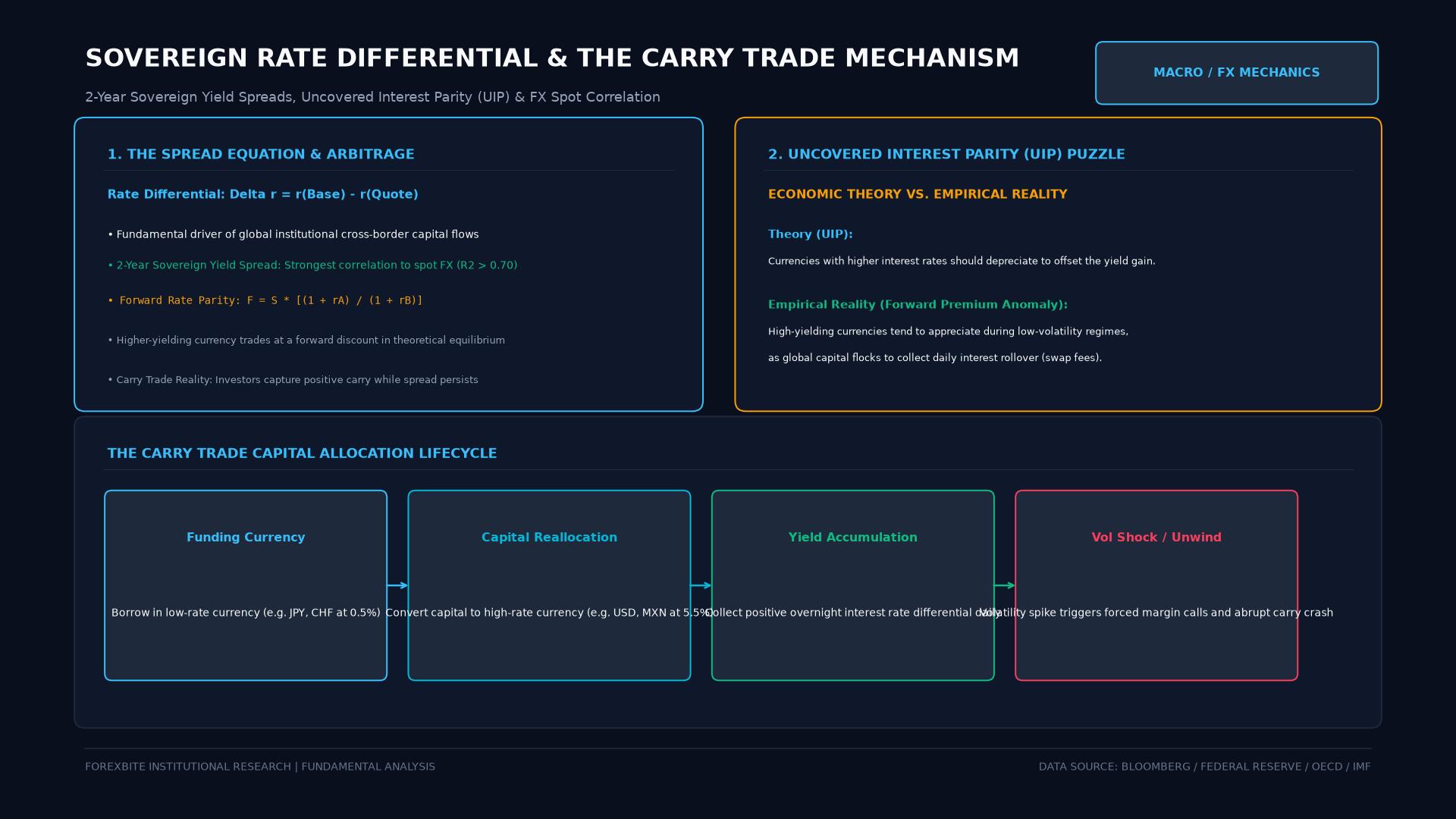 Figure: Macroeconomic mechanics of sovereign interest rate differentials, contrasting Uncovered Interest Parity (UIP) theory with empirical Carry Trade lifecycle dynamics and sudden volatility-induced unwinds.
The Role of Rate Differentials Across Financial Markets
The rate differential governs three fundamental market mechanisms:
1. The FX Carry Trade
In an FX Carry Trade, an investor borrows in a currency with a low interest rate (the funding currency, such as JPY or CHF) and invests the proceeds in a currency with a high interest rate (the target currency, such as USD, MXN, or BRL). The investor captures the positive rate differential as ongoing daily rollover yield (swap), provided the exchange rate does not depreciate enough to erase the interest income.
2. Pricing Foreign Exchange Forwards (Covered Interest Parity)
The rate differential mathematically dictates the forward points applied to forward contracts under Covered Interest Parity (CIP):
$$\text{Forward Rate} \approx \text{Spot Rate} \times \left[1 + (r_{\text{quote}} - r_{\text{base}}) \times \frac{\text{Days}}{360}\right]$$
- If $r_{\text{base}} > r_{\text{quote}}$, the base currency trades at a forward discount (forward rate is lower than spot).
- If $r_{\text{base}} < r_{\text{quote}}$, the base currency trades at a forward premium (forward rate is higher than spot).
3. Yield Curve Spreads and Sovereign Debt
Macro fixed-income traders track the rate differential between 2-year government bond yields across countries (e.g., US 2-Year Treasury yield minus German 2-Year Bund yield). Because 2-year yields reflect market expectations of central bank policy over the next 24 months, shifts in the 2-year yield spread exhibit an extraordinarily high statistical correlation with spot EUR/USD movements.
2-Year Yield Differential vs. Spot Exchange Rates
The table below illustrates how shifts in short-term government bond yield spreads drive currency valuations:
| Yield Spread Shift | Base Currency Bond Yield | Quote Currency Bond Yield | Net Impact on Currency Pair |
|---|---|---|---|
| Spread Widens in Favor of Base | Rises faster than quote (or quote falls). | Yield advantage expands toward base. | Bullish: Capital flows into base currency; spot rate rallies. |
| Spread Narrows (Compresses) | Base yield falls faster than quote. | Yield advantage of base diminishes. | Bearish: Carry unwind; base currency depreciates. |
| Yield Curve Inversion Differential | Base curve inverts deeper than quote. | Signals impending domestic recession. | Complex: High current carry vs. future recession devaluation. |
                  2-YEAR SOVEREIGN YIELD SPREAD CORRELATION

   2Y US - DE Spread (%)                                Spot EUR/USD
          ^                                                    ^
    +2.5% |                   *                                | 1.15
    +2.0% |               *       *                            | 1.10
    +1.5% |           *               *                        | 1.05
    +1.0% | *                                 *                | 1.00
          +------------------------------------> Time          +--------------------> Time
             (As US Yield Advantage Expands, Spot EUR/USD Depreciates Toward Parity)
Real vs. Nominal Rate Differentials
Professional macro funds never evaluate headline nominal interest rates in isolation; they calculate the Real Interest Rate Differential (RIRD), subtracting inflation expectations from nominal rates:
$$\text{Real Rate} = \text{Nominal Interest Rate} - \text{Inflation Rate} \quad (r_{\text{real}} = r_{\text{nom}} - \pi)$$
$$\text{RIRD} = (r_{\text{base}} - \pi_{\text{base}}) - (r_{\text{quote}} - \pi_{\text{quote}})$$
A country can offer a high nominal interest rate of 12%, but if domestic inflation is running at 15%, its real interest rate is -3%. Institutional capital will avoid such a currency because the purchasing power of the capital is eroding in real terms. Currencies appreciate most reliably when their real interest rate differential is positive and expanding.
Real-World Case Study: The 2022–2023 US-German Yield Spread and EUR/USD
Between January 2021 and September 2022, the interest rate landscape between the United States and the Eurozone diverged dramatically:
- The Setup: In early 2021, the US 2-Year Treasury yield yielded 0.15%, while the German 2-Year Bund yield was -0.70% (a spread of +85 basis points in favor of USD). EUR/USD traded near 1.2200.
- The Fed’s Acceleration: In 2022, the Federal Reserve initiated aggressive 75-basis-point rate hikes, pushing the US 2-Year yield to 4.30%.
- The ECB’s Delay: The European Central Bank delayed tightening due to sovereign debt fragmentation fears and the Russian gas crisis, keeping German 2-Year yields near 1.50%.
- The Spread Expansion: The US-German 2-year yield differential widened from +85 bps to over +280 bps.
- The Exchange Rate Collapse: Tracking the yield differential with nearly 90% correlation, EUR/USD plunged from 1.2200 down to 0.9535 (breaking through 1:1 parity) by September 2022.
Frequently Asked Questions
Why does a widening rate differential not always cause a currency to rally?
If the widening interest rate differential is accompanied by surging domestic political instability, ballooning sovereign debt deficits, or runaway inflation that turns real interest rates negative, the currency may crash despite higher nominal interest rates (as experienced in Turkey and Argentina).
What is the “Carry Trade Unwind”?
A carry trade unwind occurs when market volatility spikes, an unexpected geopolitical shock occurs, or the low-yielding funding currency’s central bank raises rates unexpectedly. Carry traders rapidly close out positions by buying back the funding currency, causing violent counter-trend appreciations in the funding currency (e.g., massive rapid rallies in the Japanese Yen).
How do retail forex traders see the rate differential in their platforms?
Retail traders see the interest rate differential directly reflected in their broker’s Daily Swap Rates (Rollover Charges). When trading a currency pair with a positive rate differential in your favor, your account is credited with a positive swap cash payment at 5:00 PM EST each day the position is held open.
Ready to trade forex?
Open a free demo account with a regulated broker. Practice with virtual funds before risking real money.