Reciprocal Currency
In foreign exchange market quotation conventions, a reciprocal currency refers to: (1) the counter or quote currency appearing on the right side of a currency pair; or (2) an exchange rate expressed as the mathematical inverse (1 / Rate) of standard market quotation conventions.
What Is a Reciprocal Currency?
In international banking and foreign exchange market microstructure, the term reciprocal currency is used across two related operational concepts:
- Quotation Structure (The Counter / Quote Currency): In any standardized two-currency quotation pair ($\text{Base / Quote}$), the reciprocal currency is the currency on the right-hand side of the fraction. It represents the unit of measurement used to price one single unit of the base currency.
- Mathematical Inversion (Reciprocal Exchange Rate): The mathematical inverse ($1 / X$) of an established currency quotation. For example, while interbank markets quote the Euro against the US Dollar conventionally as EUR/USD = 1.0850, the reciprocal quotation is USD/EUR = 0.9216 ($1 / 1.0850$), which indicates how many Euros are required to purchase one US Dollar.
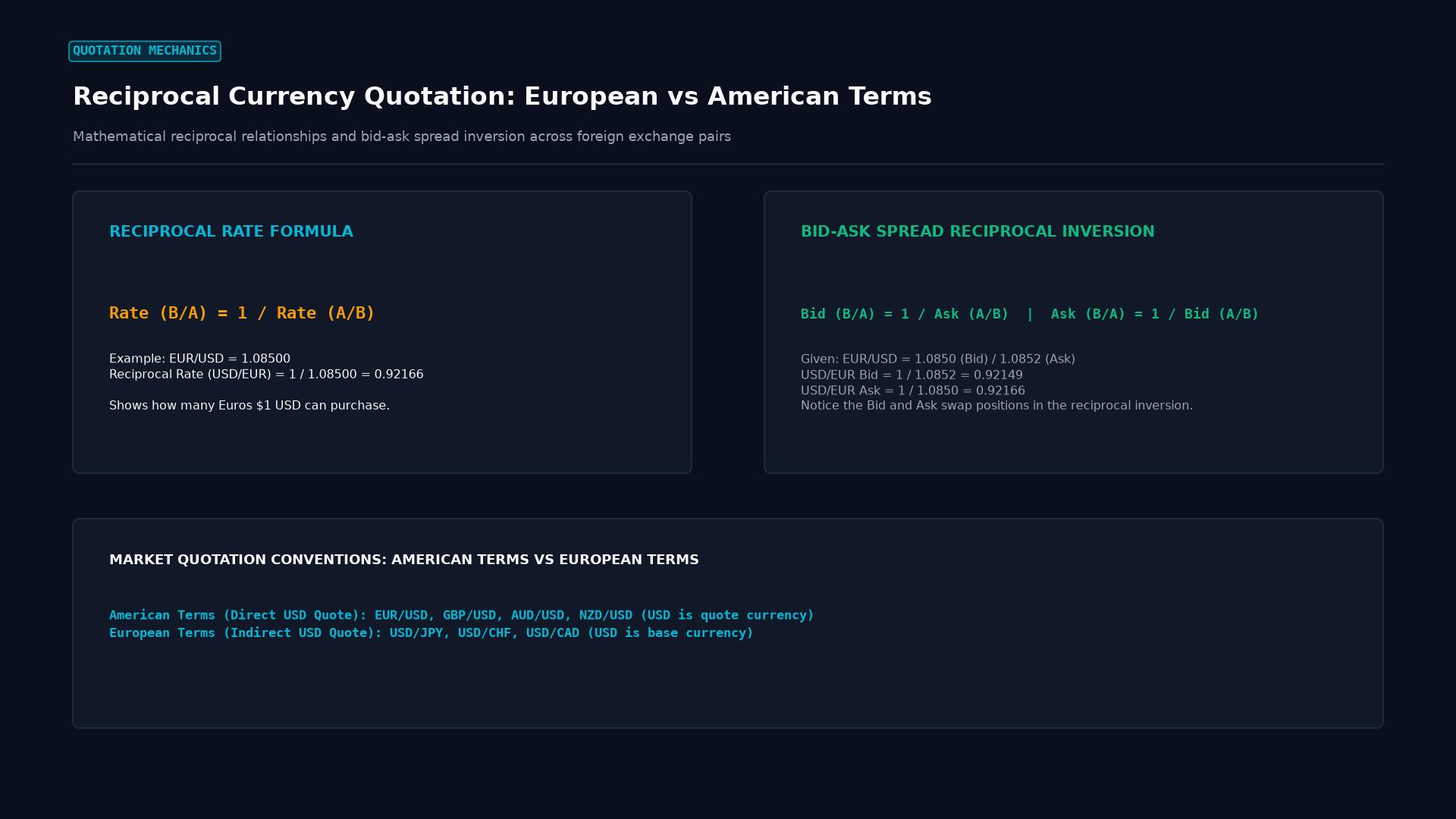 Figure: Mathematical reciprocal relationships and bid-ask spread inversion across foreign exchange pairs
Market Quotation Conventions and the US Dollar Anchor
Historically, the global foreign exchange market organized quoting conventions around the US Dollar (USD) following the 1944 Bretton Woods Agreement:
- European Terms (Indirect Quotes for US Residents): Most currencies are conventionally quoted with the US Dollar as the Base Currency on the left (e.g., USD/JPY, USD/CHF, USD/CAD). The foreign currency acts as the reciprocal currency.
- American Terms (Direct Quotes for US Residents): A select group of historically dominant sovereign currencies are conventionally quoted with the foreign currency as the Base Currency on the left, making the US Dollar the reciprocal currency:
- EUR/USD (Euro)
- GBP/USD (British Pound / Cable)
- AUD/USD (Australian Dollar)
- NZD/USD (New Zealand Dollar)
Converting Bid and Ask Prices in Reciprocal Quotations
A common mathematical pitfall among financial analysts and corporate treasurers is the inversion of two-way bid-ask quotes. Inverting a quote is not as simple as dividing each price by one, because the roles of the buyer and seller invert:
$$\text{Bid}{\text{Reciprocal}} = \frac{1}{\text{Ask}{\text{Original}}}$$
$$\text{Ask}{\text{Reciprocal}} = \frac{1}{\text{Bid}{\text{Original}}}$$
                   INVERSION OF TWO-WAY BID-ASK SPREADS

  Original Interbank Quote (EUR/USD):
  Bid = 1.08500  /  Ask = 1.08520
               \      /
                \    /  (Cross-Inversion Math)
                 v  v
  Reciprocal Quote (USD/EUR):
  Bid = 1 / 1.08520 = 0.92149  /  Ask = 1 / 1.08500 = 0.92166
If a bank client wants to sell US Dollars to buy Euros (buying EUR at the reciprocal quote), they must buy at the higher Ask ($0.92166$), which corresponds mathematically to selling Euros at the original lower Bid ($1.08500$). The cross-inversion guarantees that the dealer’s bid-ask spread margin is preserved.
Cross-Currency Rate Construction via Reciprocal Triangulation
In interbank foreign exchange dealing, currency pairs that do not trade directly against each other with deep liquidity (e.g., the Australian Dollar against the Swiss Franc, AUD/CHF) are priced synthetically using triangular arbitrage and reciprocal equations:
$$\text{AUD/CHF} = \text{AUD/USD} \times \text{USD/CHF}$$
$$\text{EUR/GBP} = \text{EUR/USD} \times \text{USD/GBP} = \frac{\text{EUR/USD}}{\text{GBP/USD}} \quad \left(\text{using reciprocal USD/GBP} = \frac{1}{\text{GBP/USD}}\right)$$
| Cross Pair Needed | Standard Market Quotes Available | Triangular Reciprocal Equation |
|---|---|---|
| EUR/GBP | EUR/USD ($1.0850$) & GBP/USD ($1.2700$) | $\text{EUR/GBP} = \frac{1.0850}{1.2700} = \mathbf{0.8543}$ |
| GBP/JPY | GBP/USD ($1.2700$) & USD/JPY ($150.00$) | $\text{GBP/JPY} = 1.2700 \times 150.00 = \mathbf{190.50}$ |
| EUR/CAD | EUR/USD ($1.0850$) & USD/CAD ($1.3600$) | $\text{EUR/CAD} = 1.0850 \times 1.3600 = \mathbf{1.4756}$ |
Real-World Case Study: Corporate Balance Sheet Reporting and Reciprocal Inversion
In early 2023, a German industrial conglomerate with extensive US manufacturing facilities compiled its consolidated financial statements in Euros (EUR) under International Financial Reporting Standards (IFRS):
- The Problem: The US subsidiary generated $150,000,000 USD in revenue. Financial media and bank FX screens displayed the headline rate as EUR/USD = 1.0800.
- The Accounting Conversion: Under European accounting rules, the corporate controller needed to state foreign assets in terms of the functional domestic currency (EUR).
- The Reciprocal Calculation: $$\text{USD/EUR Reciprocal Rate} = \frac{1}{1.0800} \approx \mathbf{0.9259 \ \text{EUR per USD}}$$ $$\text{Consolidated Euro Revenue} = $150{,}000{,}000 \times 0.9259 = \mathbf{€138{,}888{,}889 \ \text{EUR}}$$
- The Takeaway: While trading platforms quote EUR/USD to facilitate currency trading, corporate treasuries across Europe continuously convert quotes into their reciprocal counterparts to comply with financial reporting standards.
Frequently Asked Questions
Why isn’t USD/EUR quoted as the standard market convention instead of EUR/USD?
When the Euro was officially launched in 1999, the European Central Bank and international foreign exchange standards committees established that the Euro would always serve as the base currency against all other global currencies (including the US Dollar, Japanese Yen, and British Pound), preserving quoting uniformity worldwide.
What happens to a reciprocal rate when the base currency appreciates?
When the base currency appreciates, the standard quote increases, while the reciprocal quote decreases. For example, if EUR/USD rises from 1.0500 to 1.1000 (Euro strengthening), the reciprocal USD/EUR rate drops from 0.9524 to 0.9091 (meaning each US Dollar buys fewer Euros).
How does triangular arbitrage enforce reciprocal currency pricing?
If an interbank dealer quotes a direct cross rate (e.g., EUR/GBP) that deviates from the mathematical product of the two USD-based pairs ($\text{EUR/USD} / \text{GBP/USD}$), algorithmic triangular arbitrageurs instantly execute simultaneous three-way trades across London and New York, extracting riskless profit and driving the rates back into exact reciprocal equilibrium within milliseconds.
Ready to trade forex?
Open a free demo account with a regulated broker. Practice with virtual funds before risking real money.