Counter Currency
A counter currency (also known as the quote or term currency) is the second currency listed in an FX pair, indicating the amount required to buy one unit of the base currency.
What Is a Counter Currency?
In the foreign exchange market, currencies are strictly quoted and traded in standardized pairs. The counter currency—also universally known as the quote currency or term currency—is the second currency listed in a currency pair quotation. It serves as the reference denomination that establishes the price or value of the base currency (the first currency listed).
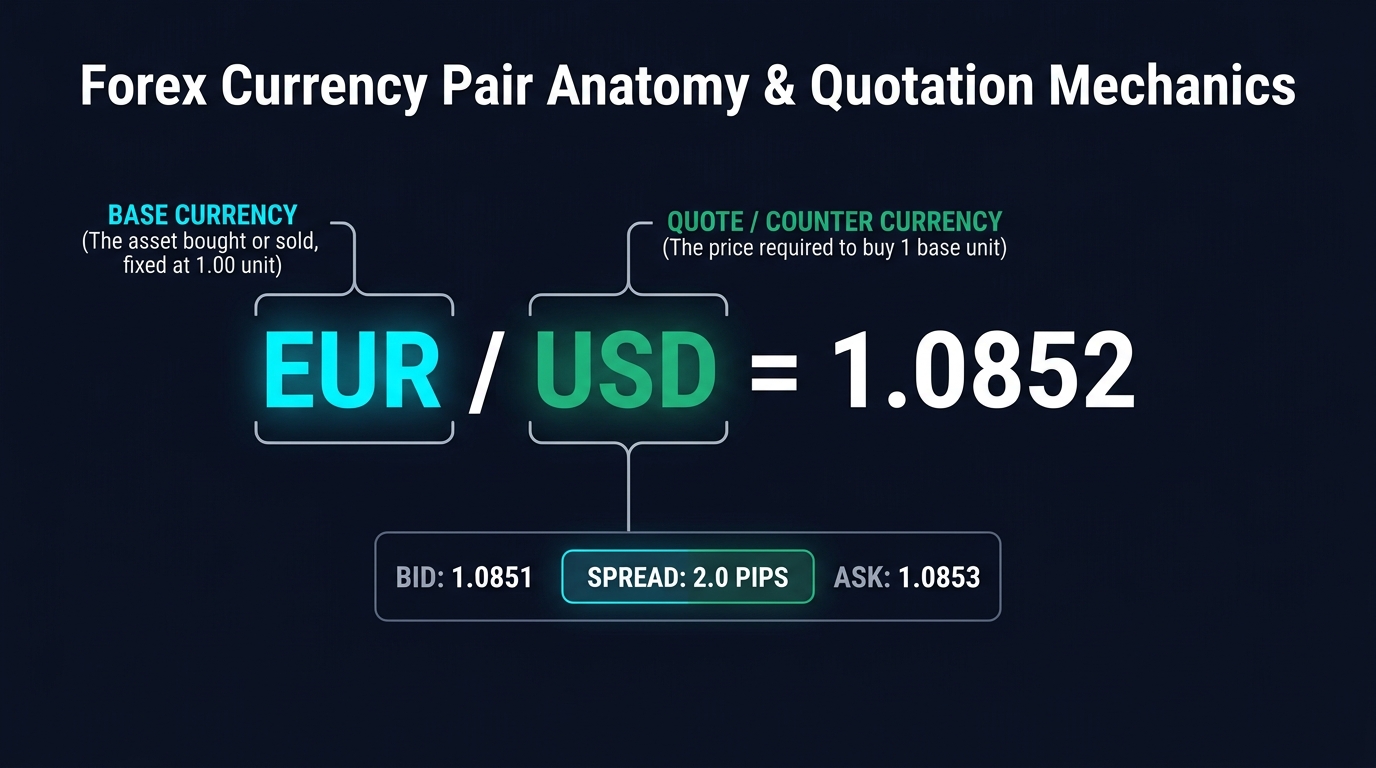
For example, in the quotation EUR/USD = 1.0850:
- EUR is the Base Currency (standardized as exactly 1.00 unit).
- USD is the Counter Currency (stating that 1.00 Euro is worth 1.0850 US Dollars).
When a trader initiates a long (buy) order on a currency pair, they are fundamentally purchasing the base currency while simultaneously selling the counter currency to fund the transaction. Conversely, opening a short (sell) order sells the base currency to acquire the counter currency.
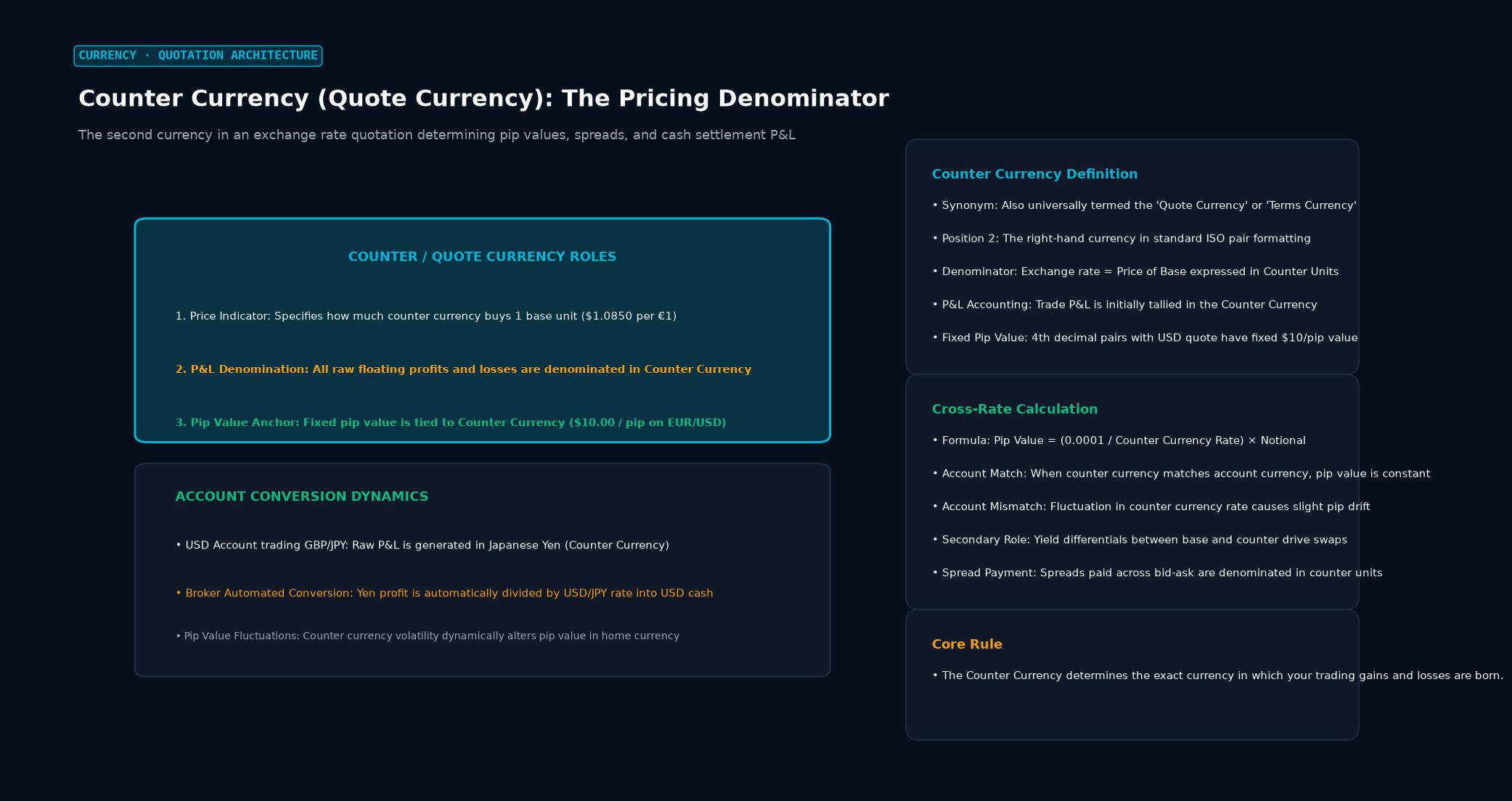 Figure: The second currency in an exchange rate quotation determining pip values, spreads, and cash settlement P&L
Key Takeaways
- Price Determination Role: The counter currency dictates the unit of account for the exchange rate; changes in the quotation represent fluctuations in the counter currency’s purchasing power relative to the base currency.
- Pip Value Determination: In retail and institutional forex, the counter currency establishes the monetary value of a pip ($0.0001$ for most pairs; $0.01$ for Yen pairs). If the counter currency is USD, 1 standard lot always yields an exact $10.00 USD pip value.
- Floating Profit/Loss Denomination: All floating profits, losses, and transaction spreads are initially calculated in the counter currency before being automatically converted back into the trader’s account base currency.
- Direct vs. Indirect Quotations: A quotation is direct when the domestic currency serves as the counter currency (e.g., EUR/USD from an American investor’s perspective).
How the Counter Currency Dictates Pip Values
Because market movements are quantified in pips, understanding the role of the counter currency is critical for accurate position sizing and risk management.
Case 1: Pairs Where USD Is the Counter Currency (EUR/USD, GBP/USD, AUD/USD, NZD/USD)
When the counter currency is the U.S. Dollar, the pip value is fixed regardless of exchange rate fluctuations: $$\text{Pip Value} = \text{Contract Size} \times 0.0001$$
- Standard Lot (100,000 units): $100,000 \times 0.0001 = $10.00 \text{ USD per pip}$
- Mini Lot (10,000 units): $10,000 \times 0.0001 = $1.00 \text{ USD per pip}$
- Micro Lot (1,000 units): $1,000 \times 0.0001 = $0.10 \text{ USD per pip}$
Case 2: Pairs Where Non-USD Currencies Are the Counter Currency (Cross Pairs & USD Majors)
When the counter currency is not USD, the pip value is denominated in that foreign currency and must be dynamically converted to USD at the prevailing spot rate:
$$\text{Pip Value in Account USD} = \frac{\text{Contract Size} \times \text{Pip Increment}}{\text{USD / Counter Currency Exchange Rate}}$$
| Currency Pair | Base Currency | Counter Currency | Pip Unit | Standard Lot Pip Value (Counter) | Pip Value in USD (at Example Rate) |
|---|---|---|---|---|---|
| EUR/USD | EUR | USD | 0.0001 | $10.00 USD | $10.00 (Fixed) |
| USD/JPY | USD | JPY | 0.01 | ¥1,000 JPY | $6.45 (at USD/JPY 155.00) |
| USD/CAD | USD | CAD | 0.0001 | C$10.00 CAD | $7.35 (at USD/CAD 1.3600) |
| EUR/GBP | EUR | GBP | 0.0001 | £10.00 GBP | $12.75 (at GBP/USD 1.2750) |
| USD/CHF | USD | CHF | 0.0001 | CHF 10.00 | $11.11 (at USD/CHF 0.9000) |
Profit and Loss Calculation Lifecycle
Consider the mechanics of a trade on EUR/GBP (Euro base, British Pound counter):
- Trade Entry: A trader buys 2 standard lots (€200,000 notional) of EUR/GBP at
0.8500. - Trade Exit: The market rallies to
0.8550, and the trader closes the position for a 50-pip profit. - P&L in Counter Currency: $$\text{Profit} = 50 \text{ pips} \times (£10.00 \text{ per pip per lot}) \times 2 \text{ lots} = £1,000 \text{ GBP}$$
- Conversion to Trader’s USD Account: The broker’s clearing engine instantly queries the live GBP/USD spot rate (e.g., 1.2800) to credit the USD account: $$\text{Final Account Credit} = £1,000 \text{ GBP} \times 1.2800 = $1,280 \text{ USD}$$
Strategic Insight: If the counter currency depreciates sharply against your account funding currency while you are holding an open winner, your converted net profit can shrink even if the pair itself moved favorably in pips.
Direct vs. Indirect Quotations in Institutional FX
Depending on the perspective of the domestic market, the placement of the counter currency changes the classification of the quote:
From the Perspective of a United States Trader:
Direct Quotation:   EUR/USD = 1.0850 (Counter currency is domestic USD)
Indirect Quotation: USD/JPY = 155.00 (Counter currency is foreign JPY)- Direct Quotation (American Terms): Expresses the number of domestic units needed to buy one unit of foreign currency. A rising quote means the domestic currency is depreciating.
- Indirect Quotation (European Terms): Expresses the number of foreign units received for one domestic unit. A rising quote means the domestic currency is appreciating.
Frequently Asked Questions
Why isn’t USD always the counter currency?
International market conventions established by the foreign exchange interbank market rank currencies by global hierarchy. The standard naming priority order is: EUR > GBP > AUD > NZD > USD > CAD > CHF > JPY. This is why the Euro and British Pound almost always serve as the base currency when paired with the U.S. Dollar (EUR/USD, GBP/USD).
Does the counter currency affect the spread cost?
Yes. Spreads are quoted in pips of the counter currency. For a pair with an expensive counter currency like EUR/GBP (where 1 pip equals £10 GBP $\approx$ $12.75 USD), a 1.5-pip spread costs approximately $19.12 per standard lot, compared to just $15.00 on EUR/USD.
What happens to the counter currency when a trader goes short?
When shorting a currency pair (e.g., selling AUD/USD), the trader is borrowing and selling the base currency (AUD) while buying and holding the counter currency (USD). Any overnight rollover swap rate will be determined by the interest rate differential between lending USD and borrowing AUD.
Ready to trade forex?
Open a free demo account with a regulated broker. Practice with virtual funds before risking real money.