Regulated Market
A regulated market (RM) is an officially authorized and supervised multilateral trading venue—such as a registered national stock or futures exchange—subject to statutory governmental regulatory oversight that enforces transparent trading rules, stringent listing requirements, and comprehensive investor protections.
What Is a Regulated Market?
In financial market law, European Union financial services directives (such as MiFID II), and international securities regulation, a regulated market (RM) is a formal legal designation for a multilateral system operated or managed by a recognized market operator. It brings together multiple third-party buying and selling interests in financial instruments—in accordance with its non-discretionary rules—in a way that results in legally binding contracts.
Unlike over-the-counter (OTC) dealing networks, unregulated dark pools, or decentralized cryptocurrency platforms, a regulated market functions under the direct, continuous supervision of a national competent authority—such as the Securities and Exchange Commission (SEC) in the United States, the Financial Conduct Authority (FCA) in the United Kingdom, or the European Securities and Markets Authority (ESMA) across the European Union.
Examples of premier global regulated markets include the New York Stock Exchange (NYSE), the Nasdaq Stock Market, the London Stock Exchange (LSE), the Deutsche Börse (Xetra), and the Chicago Mercantile Exchange (CME).
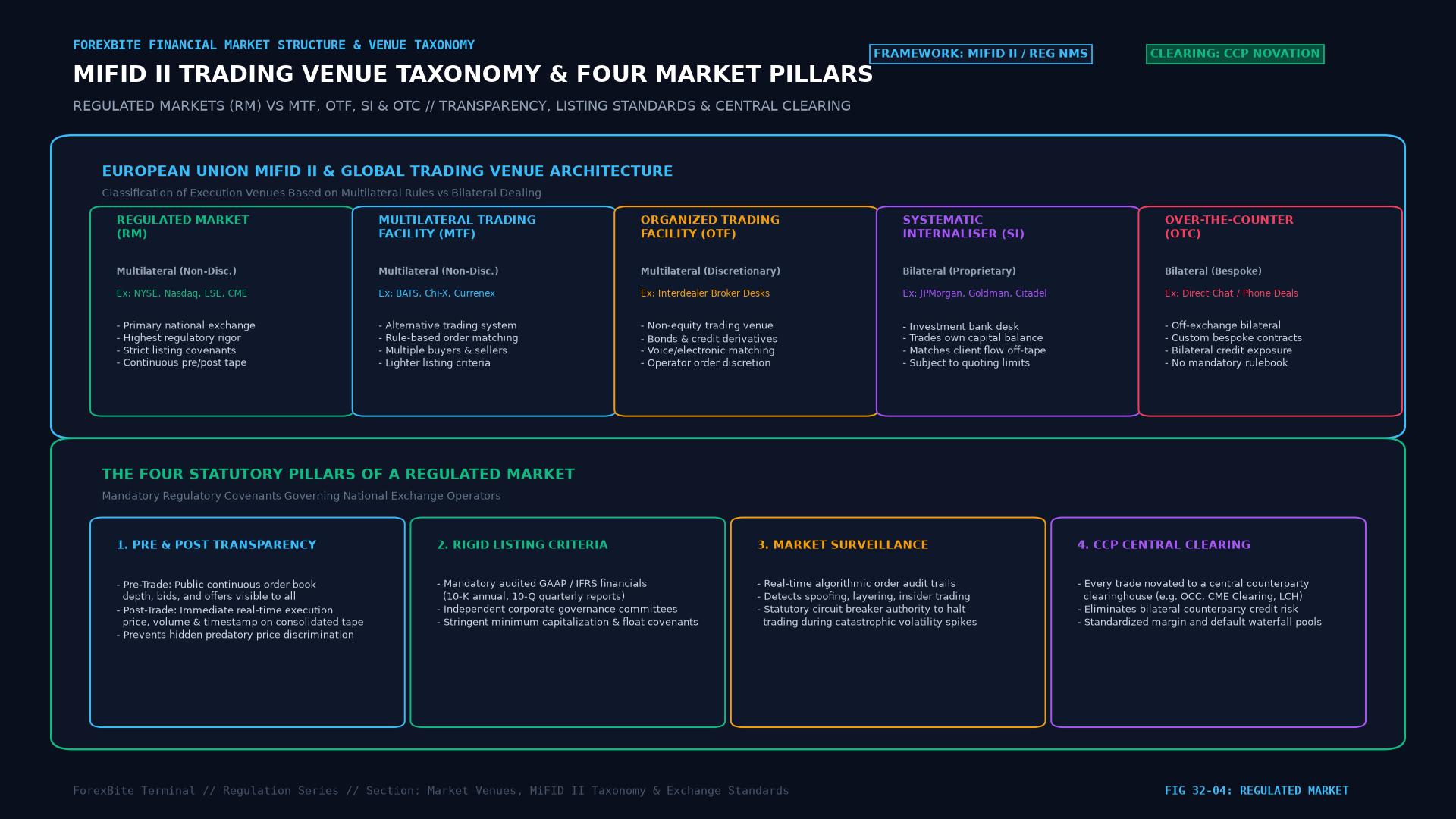 Figure: The MiFID II trading venue taxonomy (Regulated Markets, MTFs, OTFs, Systematic Internalisers, and OTC) and the four statutory pillars governing regulated exchange operators.
The Four Pillars of a Regulated Market
To maintain its statutory charter as a regulated market, a trading venue must operate in compliance with four core regulatory pillars:
1. Pre-Trade and Post-Trade Transparency
A regulated market must publish actionable bids, offers, and order book depth to the general public continuously during trading hours (pre-trade transparency). Immediately following execution, the venue must publicly report the transaction price, volume, and execution timestamp across the consolidated tape (post-trade transparency).
2. Rigorous Issuer Listing Standards
Companies seeking to list their securities on a regulated market must submit to extensive vetting. This includes filing audited annual and quarterly financial reports (10-K and 10-Q under US GAAP or IFRS), maintaining independent board committees, and providing immediate disclosure of material corporate developments.
3. Market Abuse and Surveillance Covenants
Regulated markets operate sophisticated real-time algorithmic surveillance systems designed to detect and prevent insider trading, spoofing, wash-trading, and quote stuffing. Venues maintain statutory authority to halt trading (circuit breakers) during extreme volatility.
4. Central Counterparty (CCP) Clearing and Settlement
All transactions executed on a regulated market are novated and cleared through a registered central counterparty clearinghouse (such as the Options Clearing Corporation - OCC, or CME Clearing). This eliminates bilateral counterparty credit risk and guarantees performance through standardized margin funds.
Trading Venue Comparison: RM vs. MTF vs. OTF vs. OTC
Under modern regulatory frameworks, market participants choose between distinct venue tiers based on liquidity, asset class, and oversight:
| Venue Classification | Operator Discretion | Eligible Financial Instruments | Transparency Mandate | Examples |
|---|---|---|---|---|
| Regulated Market (RM) | Zero Discretion: Matches strictly by automated price/time priority. | Listed equities, sovereign bonds, exchange-traded futures & options. | Highest: Comprehensive public pre- and post-trade transparency. | NYSE, Nasdaq, LSE, CME, Eurex. |
| Multilateral Trading Facility (MTF) | Zero Discretion: Electronic matching rules identical to an RM. | Equities, fixed income, retail bonds, ETFs (often secondary listings). | High: Similar to RM, but with more flexible issuer listing rules. | Tradeweb, MarketAxess, BATS Chi-X. |
| Organized Trading Facility (OTF) | Discretionary: Operator can exercise discretion in order routing. | Strictly non-equity instruments (corporate bonds, structured derivatives, emissions). | Moderate: Tailored for complex over-the-counter wholesale derivatives. | ICAP, BGC Partners, TP ICAP. |
| Systematic Internaliser (SI) | Bilateral: Bank trades against clients from its own proprietary book. | Equities, currency forwards, corporate debt. | Firm Quoting Mandate: Must publish quotes up to standard market size. | Goldman Sachs, JPMorgan dealing desks. |
The Regulated Market in Foreign Exchange
A critical nuance for foreign exchange traders is that spot forex is primarily an over-the-counter (OTC) market, not a regulated market in the strict legal sense of an exchange.
However, currency traders access regulated markets through two primary channels:
- Currency Futures and Options: Traded on regulated futures exchanges (such as CME FX Futures), offering standardized contracts, centralized order books, and CCP clearing.
- Regulated Brokerage Frameworks: While spot forex trades OTC, the brokers themselves operate under statutory supervision (e.g., CFTC/NFA registered Retail Foreign Exchange Dealers in the US, or FCA-authorized firms in the UK), enforcing leverage caps, client capital segregation, and negative balance protection.
Real-World Case Study: The Flash Crash of May 6, 2010
On May 6, 2010, the US equity market experienced the infamous “Flash Crash”, where the Dow Jones Industrial Average plunged nearly 1,000 points (9%) in minutes before staging an equally rapid recovery:
- The Cause: A mutual fund sold a massive block of 75,000 E-mini S&P 500 futures contracts on the CME using an automated algorithmic execution program without price or time limits.
- The Contagion: Algorithmic high-frequency market makers rapidly pulled their resting bids from the book to avoid absorbing catastrophic losses, creating an execution vacuum across lit regulated markets and dark pools.
- The Regulatory Response: The SEC and CFTC conducted an extensive joint investigation. Recognizing that unregulated fragmentation exacerbated the crash, regulators instituted mandatory Limit-Up/Limit-Down (LULD) Circuit Breakers across all US regulated markets.
- The Outcome: Under modern rules, trading in any individual stock or future is automatically halted for 5 minutes if its price moves outside a defined percentage band (typically 5% or 10%) from its average price over the prior five minutes, ensuring regulated markets maintain orderly price discovery during panics.
Frequently Asked Questions
What is the primary difference between a regulated market and an unregulated market?
A regulated market operates under statutory government licenses, enforces strict public transparency, guarantees investor protection through segregated central clearing, and holds issuers to audited legal standards. An unregulated market (such as offshore crypto exchanges or peer-to-peer bulletin boards) lacks government supervision, exposes participants to direct counterparty default risk, and offers zero legal restitution in cases of fraud.
Are all stock exchanges classified as regulated markets?
In the European Union, an exchange is an official “Regulated Market” only if it appears on the official register maintained by ESMA. Certain junior growth markets (such as the London Stock Exchange’s AIM market) are classified as Multilateral Trading Facilities (MTFs) rather than full Regulated Markets because they offer simplified regulatory and listing requirements for smaller emerging enterprises.
Why do institutional asset managers prefer trading on regulated markets?
Institutional fiduciaries (pension funds, insurance companies, and mutual funds) are bound by legal mandates and ERISA laws to ensure Best Execution and eliminate counterparty insolvency risk. Regulated markets provide guaranteed clearinghouse novation, public pricing transparency, and audit trails that protect fund fiduciaries from legal liability.
Ready to trade forex?
Open a free demo account with a regulated broker. Practice with virtual funds before risking real money.