Price Transparency
Price transparency is the degree to which all market participants have equal, reliable, and real-time access to actionable trading information, encompassing both pre-trade transparency (visible bids, offers, and order book depth) and post-trade transparency (timely publication of executed transaction prices and volumes).
What Is Price Transparency?
In financial market microstructure and regulatory economics, price transparency refers to the accessibility and timeliness of critical market pricing data available to buyers, sellers, and intermediaries. A highly transparent market ensures that participants can readily observe fair market valuations, evaluate prevailing liquidity conditions, and execute trades without informational disadvantage.
Price transparency is divided into two foundational structural phases:
- Pre-Trade Transparency: The visibility of resting quotes before an order is executed. This includes publicly displayed firm bids, offers, order sizes, and the multi-tiered Depth of Book (Level 2 data) available within the electronic limit order book (CLOB).
- Post-Trade Transparency: The public dissemination of executed transaction details immediately following trade completion. This includes the exact execution price, transaction volume, timestamp, and executing venue, reported across consolidated public data tapes.
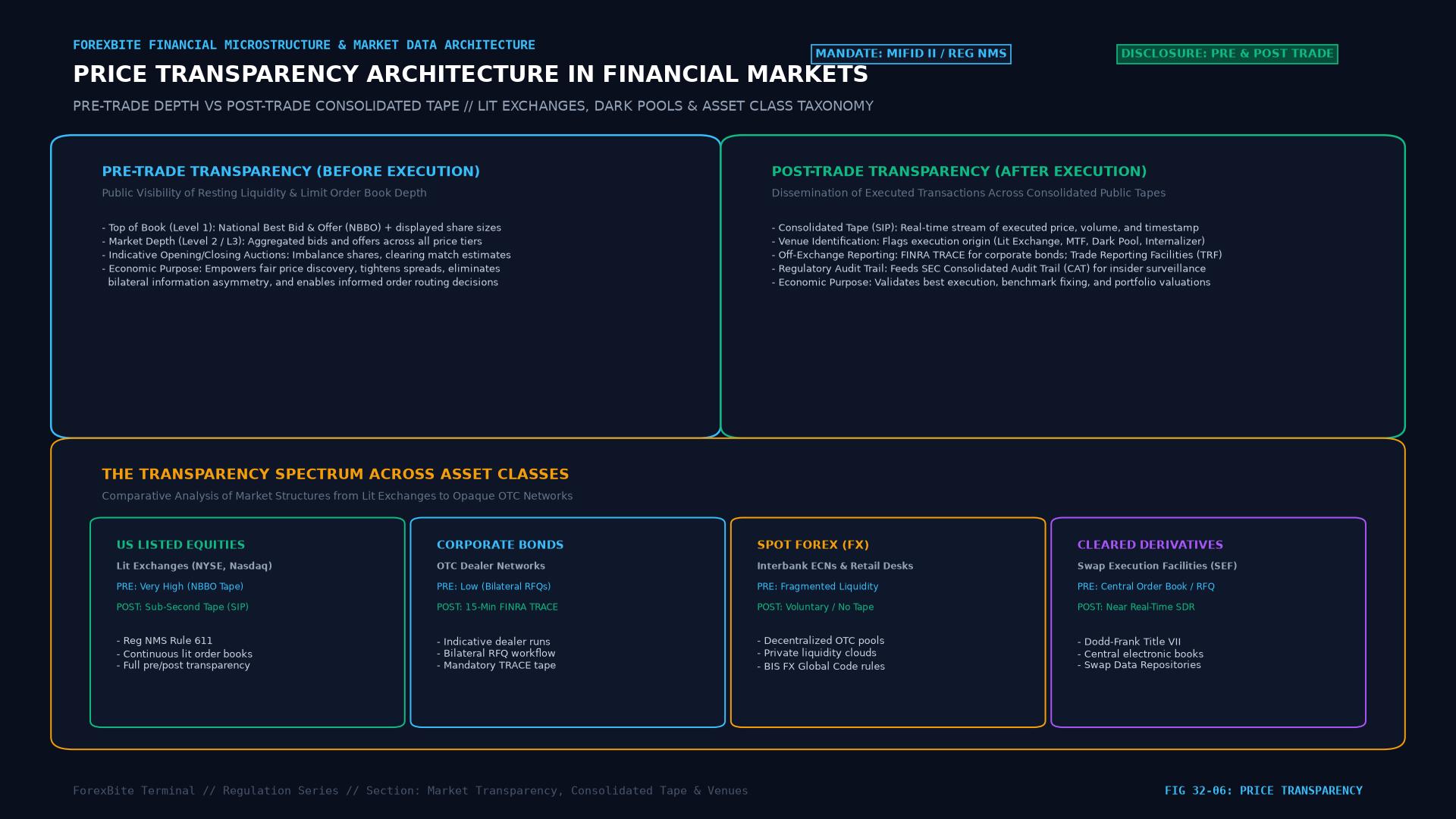 Figure: Pre-trade market depth versus post-trade consolidated tape reporting across equities, fixed income, OTC foreign exchange, and cleared derivatives.
The Transparency Spectrum Across Asset Classes
Financial markets exhibit varying degrees of price transparency, ranging from fully lit public exchanges to opaque over-the-counter (OTC) dealing networks:
| Market Sector | Primary Trading Venues | Pre-Trade Transparency | Post-Trade Transparency | Regulatory Drivers |
|---|---|---|---|---|
| US Listed Equities | Public Exchanges (NYSE, Nasdaq, Cboe) | Very High (Lit): Protected quotes published via the Consolidated Tape Association (SIP). | Immediate: Sub-second tape reporting across all lit and dark transactions. | Regulation NMS (Rule 611 Order Protection Rule). |
| Corporate Bonds | Over-the-Counter (OTC) Dealer Networks | Low to Moderate: Bilateral RFQ (Request-for-Quote); indicative dealer runs. | High (Delayed): Mandatory reporting within 15 minutes of execution. | FINRA TRACE (Trade Reporting and Compliance Engine). |
| Spot Foreign Exchange | Interbank ECNs (EBS, Refinitiv), Retail Aggregators | Fragmented: Transparent within private liquidity pools; zero single consolidated tape. | Low to Moderate: Voluntarily reported; no universal post-trade tape. | FX Global Code of Conduct (Principles-based). |
| Cleared Swaps / Derivatives | Swap Execution Facilities (SEFs) | Moderate to High: Centralized electronic order books and RFQ systems. | High (Near Real-Time): Public reporting via Swap Data Repositories (SDR). | Dodd-Frank Title VII / EMIR Article 9. |
Lit Markets vs. Dark Pools: The Transparency Debate
Modern market design features a persistent structural tension between public transparency and execution efficiency:
1. “Lit” Exchanges
On lit exchanges (such as the primary books of the London Stock Exchange or Nasdaq), all resting limit orders are displayed openly to the public.
- Advantage: Maximizes competitive price discovery, narrows bid-ask spreads, and prevents unfair information advantages.
- Disadvantage for Institutions: Displaying a massive institutional order (e.g., buying 500,000 shares or €100M EUR/USD) signals market intention, enabling high-frequency trading (HFT) algorithms to front-run the trade, driving prices higher before execution.
2. “Dark” Liquidity (Dark Pools & Internalizers)
Dark pools are private crossing networks and alternative trading systems (ATS) that operate with zero pre-trade transparency.
- Advantage: Institutional asset managers can match large block orders at the midpoint of the NBBO without moving the market price.
- Disadvantage for the Public: If too much trading volume migrates into dark pools (unlit trading), public lit markets suffer liquidity drain, widening public bid-ask spreads and degrading broad economic price discovery.
       LIT EXCHANGES VS. DARK POOLS: TRADEOFF ARCHITECTURE

  [LIT EXCHANGE: High Pre-Trade Visibility]
  Resting Order Visible ---> HFT Detects Large Size ---> Price Slips Upward
  * Full Transparency; Higher Market Impact for Institutional Blocks

  [DARK POOL: Zero Pre-Trade Visibility]
  Resting Order Hidden  ---> Matched at Midpoint    ---> Zero Market Impact
  * No Pre-Trade Transparency; Protects Blocks; Diverts Public Volume
Regulatory Mandates for Transparency
Global securities regulators have established statutory reporting frameworks to eliminate opaque dealer pricing:
- MiFID II (Europe): The Markets in Financial Instruments Directive II introduced stringent pre- and post-trade transparency mandates across non-equity instruments (fixed income, structured finance, and derivatives). It established the “Double Volume Cap” (DVC) to limit the percentage of equity trading executed in dark pools.
- FINRA TRACE (United States): Implemented in 2002, the Trade Reporting and Compliance Engine transformed the opaque US corporate bond market by requiring broker-dealers to publicly report transaction prices and volumes for secondary debt trades within 15 minutes of execution.
- Consolidated Audit Trail (CAT): An advanced SEC regulatory monitoring system tracking every order, quote, cancellation, and execution across US equity and options markets to detect spoofing, layering, and algorithmic manipulation.
Real-World Case Study: How FINRA TRACE Lowered Corporate Bond Trading Costs
Prior to July 2002, the US corporate bond market was entirely opaque. Individual investors and institutional portfolio managers traded over-the-counter through telephone dealer networks without knowing what other market participants had paid for identical bonds hours earlier. Dealers exploited this informational asymmetry by charging bid-ask spreads exceeding 150 to 250 basis points.
- The Transparency Reform: In 2002, FINRA phased in mandatory public post-trade reporting via TRACE. For the first time, bond transaction prices were disseminated publicly within minutes of execution.
- Academic & Empirical Findings: Landmark studies by financial economists (including Bessembinder, Maxwell, and Venkataraman) revealed that post-trade price transparency caused:
- An immediate 50% reduction in bid-ask spreads on investment-grade corporate bonds.
- Savings of over $1 billion annually in transaction costs for bond investors.
- The Takeaway: Price transparency directly strips monopolistic informational rent from market intermediaries and transfers economic surplus back to capital allocators.
Frequently Asked Questions
Why is the spot forex market less transparent than the stock market?
Spot foreign exchange is a decentralized, over-the-counter (OTC) market without a single central clearinghouse or government-mandated consolidated tape. Trading occurs across multiple independent electronic networks (EBS, Refinitiv, Bloomberg, Currenex) and bilateral bank dealing desks, meaning complete global trade data cannot be aggregated into a single public feed.
What is the Consolidated Tape in US equities?
The Consolidated Tape is an electronic infrastructure system mandated by the SEC that combines real-time price, volume, and quotation data from all major US stock exchanges and alternative trading systems into a unified public stream (the SIP - Securities Information Processor), guaranteeing that investors see the National Best Bid and Offer (NBBO).
Does high price transparency always benefit financial markets?
While post-trade transparency is universally acknowledged to improve market fairness, excessive pre-trade transparency can harm liquidity providers by exposing their inventory risk to predatory algorithmic traders, potentially causing market makers to widen spreads or withdraw liquidity during volatile crises.
Ready to trade forex?
Open a free demo account with a regulated broker. Practice with virtual funds before risking real money.