Revaluation
A revaluation is the calculated, official upward adjustment of a nation's official exchange rate relative to a chosen baseline—such as another foreign currency or gold—enacted deliberately by a central bank or monetary authority.
In international economics and currency markets, a revaluation is a sovereign policy decision in which a government or central bank officially raises the pegged exchange rate of its domestic currency. Occurring exclusively within fixed exchange rate or pegged regimes, a revaluation makes foreign currencies cheaper to purchase domestically and makes domestic goods more expensive for foreign buyers.
While the term is also used in financial accounting to describe the daily “mark-to-market” recalculation of open trading positions at current closing rates, its primary macroeconomic significance lies in how nations adjust their fixed parities to manage balance-of-payments imbalances.
Revaluation vs. Appreciation: Understanding the Core Difference
Financial commentators often use “revaluation” and “appreciation” interchangeably, but in technical finance they represent fundamentally different economic mechanisms:
| Dimension | Currency Revaluation | Currency Appreciation |
|---|---|---|
| Exchange Rate Regime | Fixed, pegged, or crawling peg regimes | Pure floating or managed float regimes |
| Driver of Movement | Official government or central bank decree | Free-market supply and demand dynamics |
| Timing & Speed | Discontinuous; occurs instantly at the time of policy announcement | Continuous; occurs tick-by-tick across 24-hour trading sessions |
| Opposite Concept | Devaluation (official downward adjustment) | Depreciation (market-driven downward drift) |
For example, when market demand pushes EUR/USD higher over weeks of trading, the euro appreciates. Conversely, when the People’s Bank of China officially adjusted the fixed peg of the renminbi from 8.28 down to 8.11 per USD in July 2005, the Chinese government enacted an official revaluation.
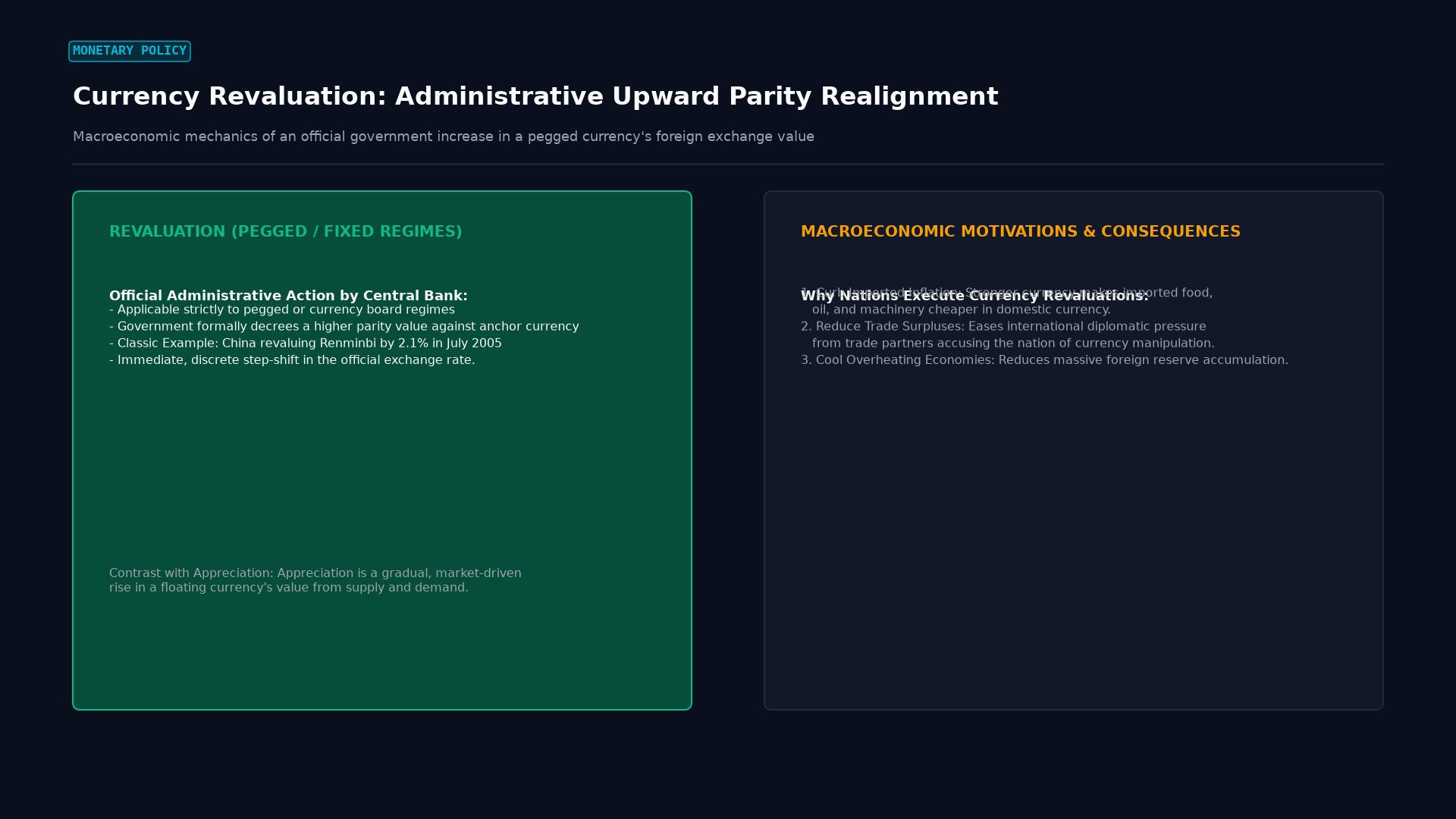 Figure: Macroeconomic mechanics of an official government increase in a pegged currency’s foreign exchange value
Economic Catalysts for a Currency Revaluation
Central banks do not enact revaluations lightly, as a stronger currency hurts domestic export competitiveness. However, specific macroeconomic conditions compel authorities to revalue:
- Combating Imported Inflation: When global commodity and energy prices surge, an artificially weak pegged currency forces domestic citizens to pay exorbitant prices for food, fuel, and raw materials. Revaluing the currency immediately reduces the domestic cost of imported essentials.
- Chronic Current Account Surpluses: If an export-heavy nation runs massive trade surpluses for years, major trading partners (such as the United States or European Union) may threaten retaliatory tariffs or label the country a currency manipulator. Revaluing the currency levels the playing field.
- Surging Foreign Exchange Reserves: When international capital continuously rushes into a nation, the central bank must print massive amounts of domestic money to buy those incoming foreign dollars, risking domestic inflation and asset bubbles. Revaluation removes the need for excessive intervention.
The Accounting Dimension: Mark-to-Market Revaluation
Outside macroeconomics, revaluation refers to the daily operational process within brokerage platforms and trading desks known as mark-to-market (MTM):
- Daily Portfolio Revaluation: At the close of each trading day (typically 5:00 PM New York time), a broker recalculates the unrealized profit and loss of all open positions based on the daily settlement price.
- Currency Conversion: If a trader holds a GBP/JPY position in a USD-denominated trading account, the broker’s risk engine performs an automated revaluation, converting the floating yen profits or losses into U.S. dollars at current spot rates.
Practical Example: China’s Landmark Yuan Revaluation (2005)
The most influential modern currency revaluation occurred on July 21, 2005:
- The Context: For a decade following the 1997 Asian Financial Crisis, China had maintained a strict peg of approximately 8.28 RMB per U.S. dollar.
- The Pressure: As China emerged as the “world’s factory,” its trade surplus expanded dramatically. U.S. lawmakers strongly criticized the 8.28 peg as an artificial subsidy that distorted global manufacturing.
- The Decree: The People’s Bank of China announced an immediate 2.1% revaluation, resetting the parity to 8.11 RMB per USD, and declared a shift toward a managed floating basket peg.
- Market Impact: Over the subsequent three years, managed appreciation carried the yuan from 8.11 to roughly 6.80 per USD (a cumulative 20% strengthening), boosting purchasing power for Chinese consumers while demonstrating how a managed revaluation unfolds.
Key Takeaways
- Official Policy Move: Revaluation is a deliberate administrative action by a government or central bank to raise the value of its pegged currency.
- Distinct from Appreciation: Appreciation is driven by market forces in floating regimes; revaluation is an official decree in fixed regimes.
- Inflation Defense: Revaluations are commonly enacted to curb domestic inflation by lowering the cost of imported goods and commodities.
- Export Trade-Off: While revaluing strengthens domestic consumer buying power, it increases foreign prices for exports, challenging domestic manufacturers.
- Trading Implications: Positions held in currencies approaching an inevitable revaluation offer asymmetrical upside, though capital control restrictions often limit speculative access.
Frequently Asked Questions
Does a revaluation make a country’s exports more competitive?
No. A revaluation makes a country’s exports more expensive for foreign buyers, reducing export competitiveness. However, it benefits the domestic economy by making foreign imports, energy, and overseas debt servicing substantially cheaper.
Can a retail forex trader profit from a currency revaluation?
Trading a revaluation directly in the spot market is difficult because pegged currencies usually operate under strict capital controls. However, institutional and sophisticated retail traders sometimes position for revaluations using non-deliverable forwards (NDFs) or options that price in future adjustment probabilities.
What is the opposite of a currency revaluation?
The exact opposite of a revaluation is a devaluation—the deliberate downward adjustment of a pegged currency’s official exchange rate, typically undertaken to stimulate exports or halt the depletion of central bank foreign reserves.
Ready to trade forex?
Open a free demo account with a regulated broker. Practice with virtual funds before risking real money.