Currency Peg
A currency peg is a monetary policy regime in which a nation's central bank fixes or anchors its exchange rate to the value of another foreign currency, a basket of currencies, or a precious metal to promote trade stability and control inflation.
A currency peg—often referred to as a fixed exchange rate regime—is an institutional monetary framework in which a government or central bank stabilizes its domestic currency by anchoring its value to that of a dominant international partner (most commonly the U.S. dollar or euro) or a trade-weighted basket of foreign currencies.
Countries adopt currency pegs to foster international trade certainty, prevent exchange rate volatility, attract foreign direct investment, and eliminate hyperinflation by “importing” the monetary credibility of a stable foreign central bank. However, defending a peg requires substantial foreign exchange reserves and forces the nation to surrender independent control over its domestic interest rates.
Types of Currency Peg Regimes
Currency pegs exist across a spectrum ranging from rigid legal commitments to flexible managed arrangements:
| Peg Structure | Operational Mechanism | Historical / Current Examples | Flexibility |
|---|---|---|---|
| Currency Board (Hard Peg) | 100% of domestic monetary base backed by foreign reserves; strict legal mandate | Hong Kong Dollar (HKD) linked to USD within a narrow band (7.75–7.85) | Ultra-Rigid; zero monetary autonomy |
| Conventional Fixed Peg | Central bank commits to maintain an exact parity, intervening via open market operations | Saudi Riyal (SAR) fixed at 3.75 per USD; UAE Dirham (AED) at 3.6725 | Rigid; interest rates closely mirror the Federal Reserve |
| Crawling Peg | Parity is adjusted periodically in pre-announced, incremental steps | Used by developing economies to offset high domestic inflation | Moderately flexible; predictable drift |
| Basket Peg | Exchange rate anchored to a trade-weighted basket of multiple major currencies | Singapore Dollar (SGD) managed within an undisclosed policy band (S$NEER) | Dynamic; balances multi-country trade flows |
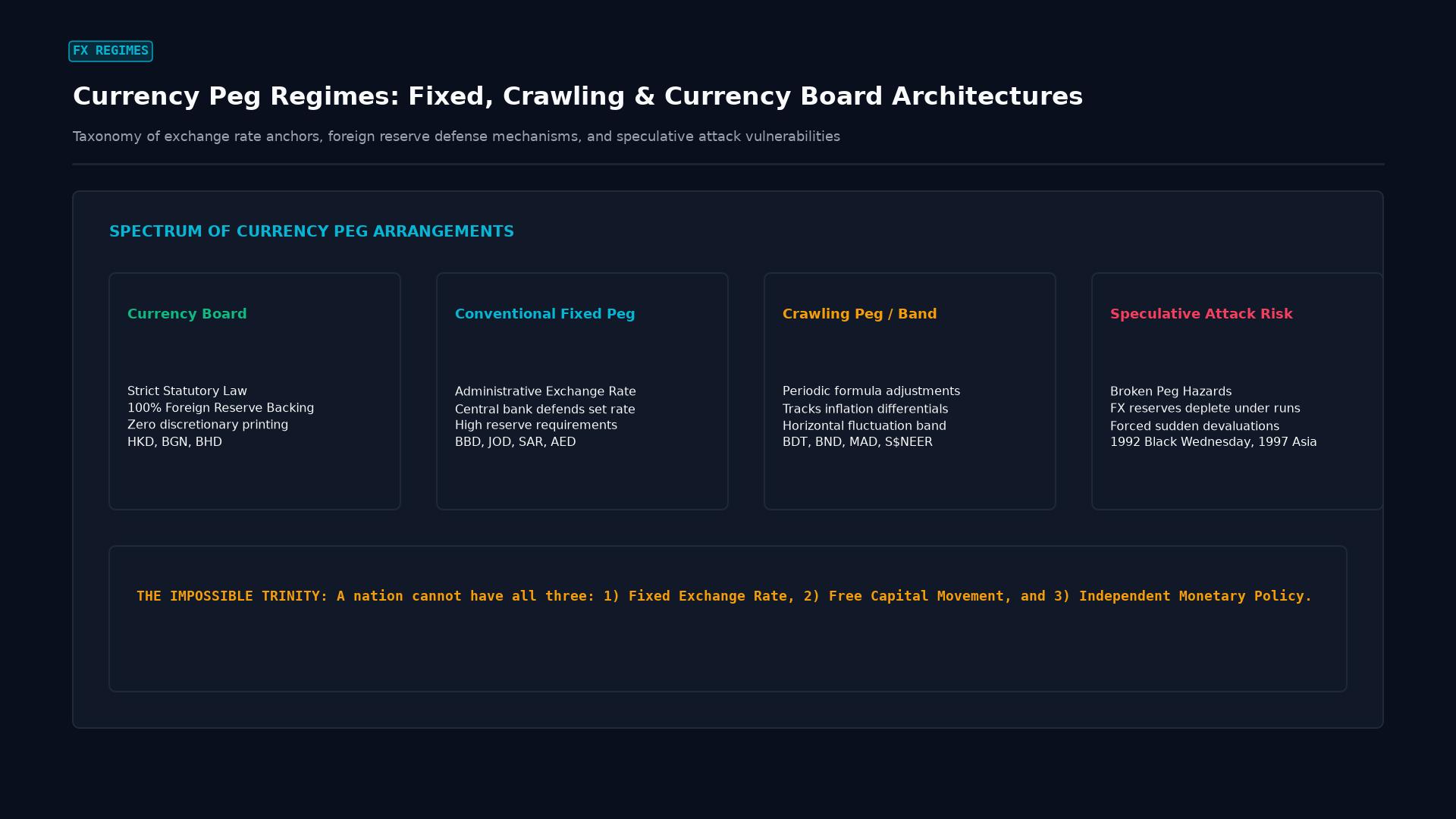 Figure: Taxonomy of exchange rate anchors, foreign reserve defense mechanisms, and speculative attack vulnerabilities
The Mechanics of Defending a Currency Peg
Maintaining an exchange rate that diverges from free-market supply and demand requires constant central bank intervention:
- When Domestic Currency Faces Downward Pressure (Depreciation Threat): If investors sell the pegged currency, the central bank must step in as the buyer of last resort. It uses its foreign exchange reserves (such as U.S. dollar treasuries) to buy back domestic currency, reducing supply to maintain parity. If foreign reserves are exhausted, the peg collapses into a sharp devaluation.
- When Domestic Currency Faces Upward Pressure (Appreciation Threat): If strong capital inflows push the currency higher, the central bank prints domestic currency to buy incoming foreign assets, expanding its foreign exchange reserves.
The Impossible Trinity (Mundell-Fleming Trilemma)
Central banks managing a currency peg are bound by the classic macroeconomic Trilemma: a country cannot simultaneously maintain all three of the following conditions:
- A Fixed Exchange Rate (the peg)
- Free Capital Mobility (open cross-border capital flows)
- An Independent Monetary Policy (setting interest rates according to domestic economic cycles)
Because countries with pegged currencies allow international capital to flow freely, they must forfeit domestic monetary independence. If the U.S. Federal Reserve hikes interest rates, the Hong Kong Monetary Authority (HKMA) and Saudi Central Bank (SAMA) must immediately hike their own interest rates in lockstep, even if their domestic real estate or labor markets are experiencing an economic slowdown.
Famous Peg Breakdowns: The Lessons of Black Thursday
While currency pegs appear stable for years, economic imbalances or speculative capital attacks can break them with catastrophic consequences:
1. The Swiss Franc Floor Abandonment (January 15, 2015)
In September 2011, the Swiss National Bank (SNB) established a minimum exchange rate floor of 1.20 EUR/CHF to protect Swiss exporters against a surging safe-haven franc. To defend this artificial floor, the SNB printed hundreds of billions of francs to purchase euros.
By early 2015, with the European Central Bank preparing to launch massive Quantitative Easing, the cost of defending the floor became untenable. On January 15, 2015, the SNB abruptly announced it was abandoning the 1.20 floor. Within minutes, EUR/CHF plummeted from 1.2000 to below 0.8500—an unprecedented 3,000-pip flash crash that bankrupted multiple retail brokerages and wiped out highly leveraged traders.
2. Black Wednesday: The British Pound ERM Crisis (1992)
The United Kingdom pegged the pound sterling to the German Deutsche Mark under the European Exchange Rate Mechanism (ERM). Facing deep recession, the UK could not justify keeping high interest rates to match Germany. Speculators led by George Soros shorted billions in sterling. Despite the Bank of England hiking rates to 15% in a single day and burning billions in reserves, the UK was forced to exit the ERM, devaluing the pound and costing British taxpayers billions.
Practical Considerations for Forex Traders
- Avoid Over-Leveraging Pegged Pairs: While pegged pairs exhibit minimal volatility during peacetime, black swan peg breaks cause instantaneous gaps without liquidity, bypassing traditional stop-loss orders and creating catastrophic slippage.
- Trading the Bands: In systems like the Hong Kong Dollar (7.75–7.85), mean-reversion traders buy when HKD touches 7.8450 and sell when it reaches 7.7550, relying on the central bank’s guaranteed intervention at the boundary walls.
- Monitor Foreign Reserve Burn Rates: When a pegged nation faces persistent balance-of-payments deficits, tracking the monthly decline of its foreign currency reserves provides early warning of an impending devaluation.
Key Takeaways
- Anchored Value: A currency peg fixes a domestic currency’s exchange rate to a major foreign currency (like the USD or EUR) or a currency basket.
- Economic Trade-Off: Pegs foster trade certainty and curb domestic inflation, but require countries to forfeit independent interest rate policy under the Impossible Trinity.
- Reserve Exhaustion Threat: Defending a peg against persistent depreciation requires selling foreign exchange reserves; when reserves dry up, a forced devaluation occurs.
- Black Swan Vulnerability: Peg abandonments (such as the 2015 Swiss Franc shock) trigger violent liquidity voids, extreme slippage, and massive volatility.
- Interest Rate Lockstep: Pegged economies must mirror the interest rate decisions of the anchor currency’s central bank.
Frequently Asked Questions
Why does Saudi Arabia peg the Riyal to the U.S. Dollar?
Saudi Arabia’s primary export is crude oil, which is priced and settled internationally in U.S. dollars. Pegging the Riyal to the dollar at 3.75 SAR/USD eliminates exchange rate risk for the kingdom’s primary revenue source and provides fiscal predictability.
What is the difference between a hard peg and a soft peg?
A hard peg is legally mandated and requires 100% foreign reserve backing (such as a currency board like Hong Kong). A soft peg (or conventional peg) is an administrative policy target where the central bank intervenes in the market to maintain a target level, but retains legal discretion to devalue or float if economic conditions deteriorate.
Can a retail trader make money trading pegged currencies?
Yes, but the dynamics differ from free-floating pairs. Some traders scalp small oscillations within narrow allowable bands (such as the HKD peg). Others position for macro breakups or devaluations in emerging market pegs using forward contracts or options, where asymmetrical payoffs exist if the peg collapses.
Ready to trade forex?
Open a free demo account with a regulated broker. Practice with virtual funds before risking real money.