Risk Capital
Risk capital is the dedicated portion of an individual's or institution's liquid net worth specifically allocated to speculative, high-volatility financial instruments—such as leveraged foreign exchange, options, futures, and early-stage venture equity—the complete loss of which would not impair basic living standards, core solvency, or operational continuity.
What Is Risk Capital?
In personal wealth management, institutional trading, and regulatory compliance, risk capital (often termed venture capital or speculative capital) refers strictly to discretionary funds that can be completely lost in speculative financial markets without causing material hardship, bankruptcy, or disruption to an individual’s lifestyle or an institution’s core balance sheet.
In financial jurisprudence and regulatory disclosures mandated by bodies like the Commodity Futures Trading Commission (CFTC) and the National Futures Association (NFA), the concept of risk capital is legally codified:
$$\text{CFTC Rule 4.41 Mandate: } \text{“Only risk capital should be used for trading, and only those with sufficient risk capital should consider trading.”}$$
If an investor uses borrowed funds, emergency living reserves, home equity, or retirement savings to engage in leveraged forex or options trading, they are violating the foundational principle of risk capital. Trading with non-risk capital introduces psychological desperation—widely known as trading with “scared money”—which almost invariably culminates in catastrophic trading errors and total account ruin.
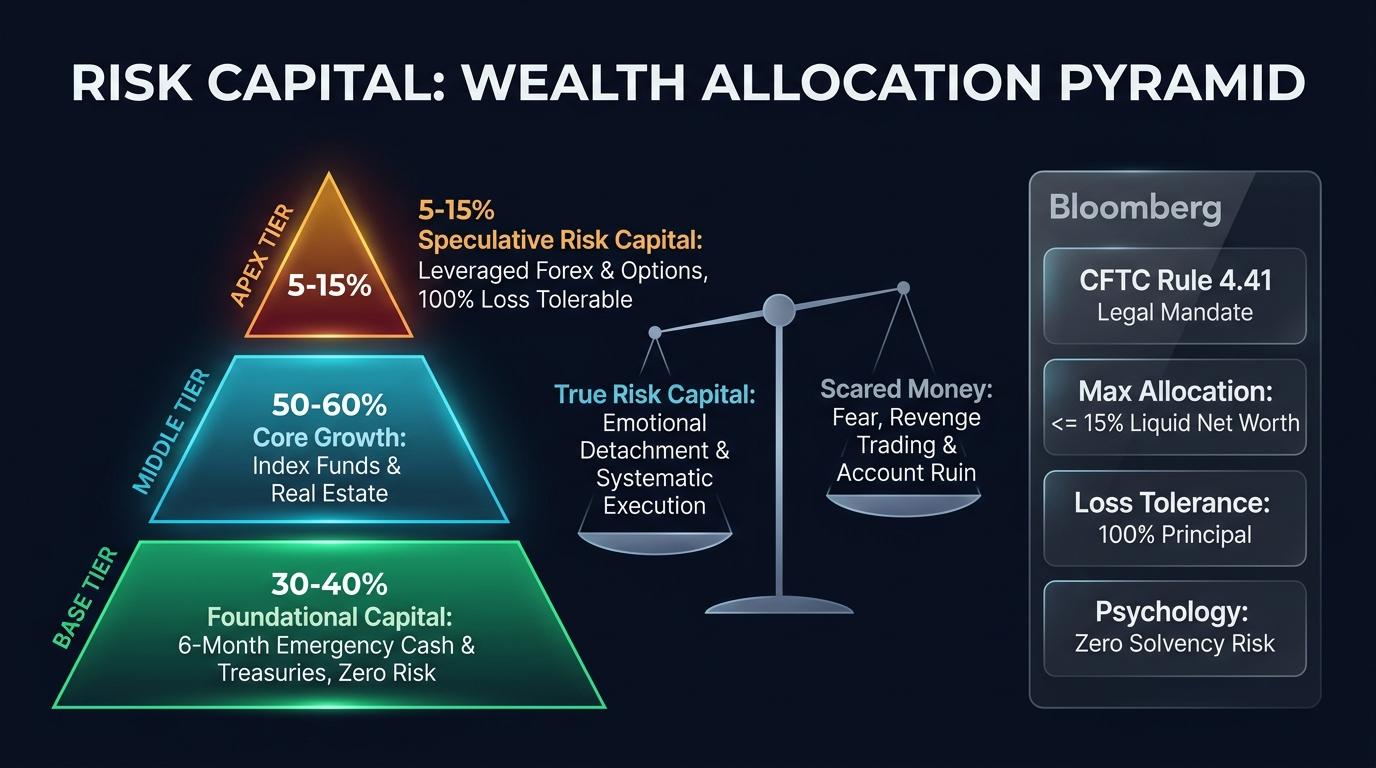
                    PERSONAL WEALTH ALLOCATION PYRAMID

                     /\
                    /  \  [RISK CAPITAL: 5% - 15%]
                   /    \ - Leveraged Forex, Futures & Options
                  / SPEC \- Crypto, Early-Stage Angel Equity
                 /--------\- High Risk; Potential 100% Capital Loss
                /  GROWTH  \
               /  CAPITAL   \ [CORE WEALTH: 50% - 60%]
              /--------------\- Broad Index Funds, ETFs, Equities, Real Estate
             /   PRESERVATION \
            /    & EMERGENCY   \ [FOUNDATIONAL CAPITAL: 30% - 40%]
           /--------------------\ - 6-Month Cash Buffer, High-Yield Savings, Treasuries
          +----------------------+ - Strictly Protected; ZERO Speculative Exposure!
Core Capital vs. Risk Capital: The Structural Divide
Prudent financial planning draws an impenetrable wall between an investor’s baseline wealth and their speculative trading book:
| Dimension | Foundational / Core Capital | True Risk Capital |
|---|---|---|
| Primary Financial Objective | Capital Preservation and guaranteed solvency. | Aggressive Capital Growth and alpha extraction. |
| Permissible Loss Tolerance | 0%: Cannot tolerate principal loss. | Up to 100%: Can be wiped out without systemic damage. |
| Typical Assets Held | Sovereign Treasuries, FDIC-insured cash, primary real estate. | Leveraged Spot FX, Futures, Long/Short Equities, Options. |
| Time Horizon | Long-term (Decades to lifetime retirement). | Short-to-medium term (Intraday, swing, multi-month). |
| Psychological Impact | Anxiety-inducing if put at risk (“Scared Money”). | Emotionally Detached: Losses are accepted as a business expense. |
| Regulatory Classification | Essential household net worth. | Discretionary speculative liquid net worth. |
The Psychology of Trading: True Risk Capital vs. “Scared Money”
The most significant operational advantage of trading exclusively with true risk capital is psychological:
$$\text{Scared Money Cannot Win} \implies \text{Trading with essential funds leads to emotional paralysis}$$
- The “Scared Money” Syndrome: When an individual trades using money needed for rent, child education, or debt servicing, their emotional brain (the amygdala) treats every negative pip fluctuation as an existential survival threat. They panic-exit winning trades after 5 pips to secure small cash, but refuse to cut losing trades, desperately hoping the market returns to breakeven until a forced margin call liquidates their account.
- The True Risk Capital Mindset: An institutional trader or disciplined retail investor deploying genuine risk capital views losses objectively. Every loss is simply the cost of doing business, analogous to an airline paying for jet fuel. The trader executes their trading plan with robotic detachment.
Strategic Allocation: The Barbell Portfolio Strategy
Popularized by mathematical statistician and former derivatives trader Nassim Nicholas Taleb, the Barbell Strategy is an institutional asset allocation model engineered to exploit risk capital while eliminating ruin risk:
                      THE TALEB BARBELL ASSET ALLOCATION

         EXTREME SAFETY                                  MAXIMUM CONVEXITY
      [85% to 90% of Total Wealth]                     [10% to 15% of Total Wealth]
                   |                                                |
                   v                                                v
      - US Short-Term T-Bills                          - Leveraged Options Puts/Calls
      - Sovereign Inflation-Protected Bonds            - High-Beta Currency Breakouts
      - High-Yield Cash Equivalents                    - Venture Capital Investments
                   |                                                |
                   +================================================+
                                           |
                                           v
         Result: Immune to catastrophic hyper-crashes (90% safe),
                 while retaining massive explosive upside from Risk Capital!
By concentrating 90% of wealth in ultra-safe instruments and allocating only 10% to aggressive risk capital, the investor eliminates the risk of financial ruin while preserving explosive convexity on market tail events.
Position Sizing Within the Risk Capital Pool
Deploying risk capital does not mean gambling the entire speculative pool on a single trade. Professional risk management mandates the Fixed Fractional Risk Model:
$$\text{Maximum Dollar Risk per Trade} = \text{Total Risk Capital} \times \text{Risk Percentage (1% to 2%) }$$
$$\text{Allowed Position Size (Lots)} = \frac{\text{Maximum Dollar Risk}}{\text{Stop-Loss Distance (pips)} \times \text{Pip Value}}$$
If a trader dedicates $20,000 in true risk capital and adheres to a 1.5% maximum risk rule:
- Maximum loss allowed on any single trade = $$20{,}000 \times 0.015 = \mathbf{$300 \ \text{USD}}$.
- If the stop-loss on a GBP/USD setup is 40 pips ($400 per standard lot): $$\text{Position Size} = \frac{$300}{40 \times $10.00} = \mathbf{0.75 \ \text{Lots}}$$
- The trader would need to suffer 67 consecutive maximum losses before their risk capital was depleted, guaranteeing long-term survivability through statistical drawdowns.
Real-World Case Study: The 2015 Swiss Franc Flash Crash and Non-Risk Capital Ruin
On January 15, 2015, the Swiss National Bank (SNB) unexpectedly unpegged the Swiss Franc from the Euro (EUR/CHF 1.2000 peg), causing EUR/CHF to collapse by 2,000 pips in minutes:
- The Retail Tragedy: Thousands of retail accounts across Europe and Asia were trading EUR/CHF with 1:100 to 1:400 leverage, buying dips near 1.2000 under the assumption that the SNB would defend the peg forever.
- The Non-Risk Capital Violation: Many retail traders had deposited life savings, home improvement funds, or business operating capital into their retail brokerage accounts.
- The Negative Balance Disaster: Because interbank liquidity evaporated completely, broker stop-loss orders could not execute until rates dropped past 0.9500. Traders not only lost 100% of their deposited balances within seconds, but many received margin deficit collection notices from brokers for tens of thousands of dollars in debt beyond their deposits.
- The Regulatory Fallout: The catastrophe prompted global regulators (FCA, ESMA, ASIC) to impose mandatory leverage restrictions (capping retail forex leverage at 1:30) and mandate statutory Negative Balance Protection, reinforcing that leveraged derivatives must be funded strictly with risk capital.
Frequently Asked Questions
How much of my net worth should be allocated to risk capital?
For individual investors, general financial planning conventions recommend allocating no more than 5% to 15% of total liquid net worth to high-risk speculative trading (forex, futures, single-stock options). The remaining 85% to 95% should reside in core diversified index funds, real estate, and safe fixed-income assets.
Is borrowed money ever considered risk capital?
No. Borrowed money (credit card advances, personal loans, home equity loans) can never be classified as risk capital. Because debt carries a legal obligation of repayment regardless of trading performance, risking borrowed money creates existential financial and legal ruin risk.
What is the “Appropriateness Test” in retail brokerage onboarding?
Under financial regulations such as MiFID II in Europe and Dodd-Frank in the US, brokers are legally required to administer an Appropriateness and Suitability Questionnaire before opening leveraged accounts. The questionnaire verifies that the applicant possesses sufficient investment knowledge, understands leverage risk, and has verified that their trading funds consist solely of disposable risk capital.
Ready to trade forex?
Open a free demo account with a regulated broker. Practice with virtual funds before risking real money.