Risk
In financial economics and trading, risk is the quantifiable probability and magnitude of capital loss, or the potential for actual investment returns to deviate adversely from expected outcomes due to market, credit, liquidity, or operational factors.
What Is Financial Risk?
In modern portfolio theory, capital markets, and quantitative trading, risk is the fundamental condition of uncertainty surrounding future financial returns. While colloquial language equates risk purely with “loss,” financial economics defines risk as volatility and dispersion: the mathematical probability that an investment’s actual realized return will differ adversely from its expected return.
The foundational principle underpinning all modern finance is the Risk-Return Tradeoff: $$\text{Expected Return} \propto \text{Systematic Risk}$$ Capital allocators demand higher expected yields, returns, or risk premia to compensate them for bearing higher levels of uncertainty.
Without risk, financial markets cannot generate economic profit (alpha); however, unmanaged or unhedged risk inevitably leads to catastrophic capital depletion, forced margin liquidations, and institutional insolvency.
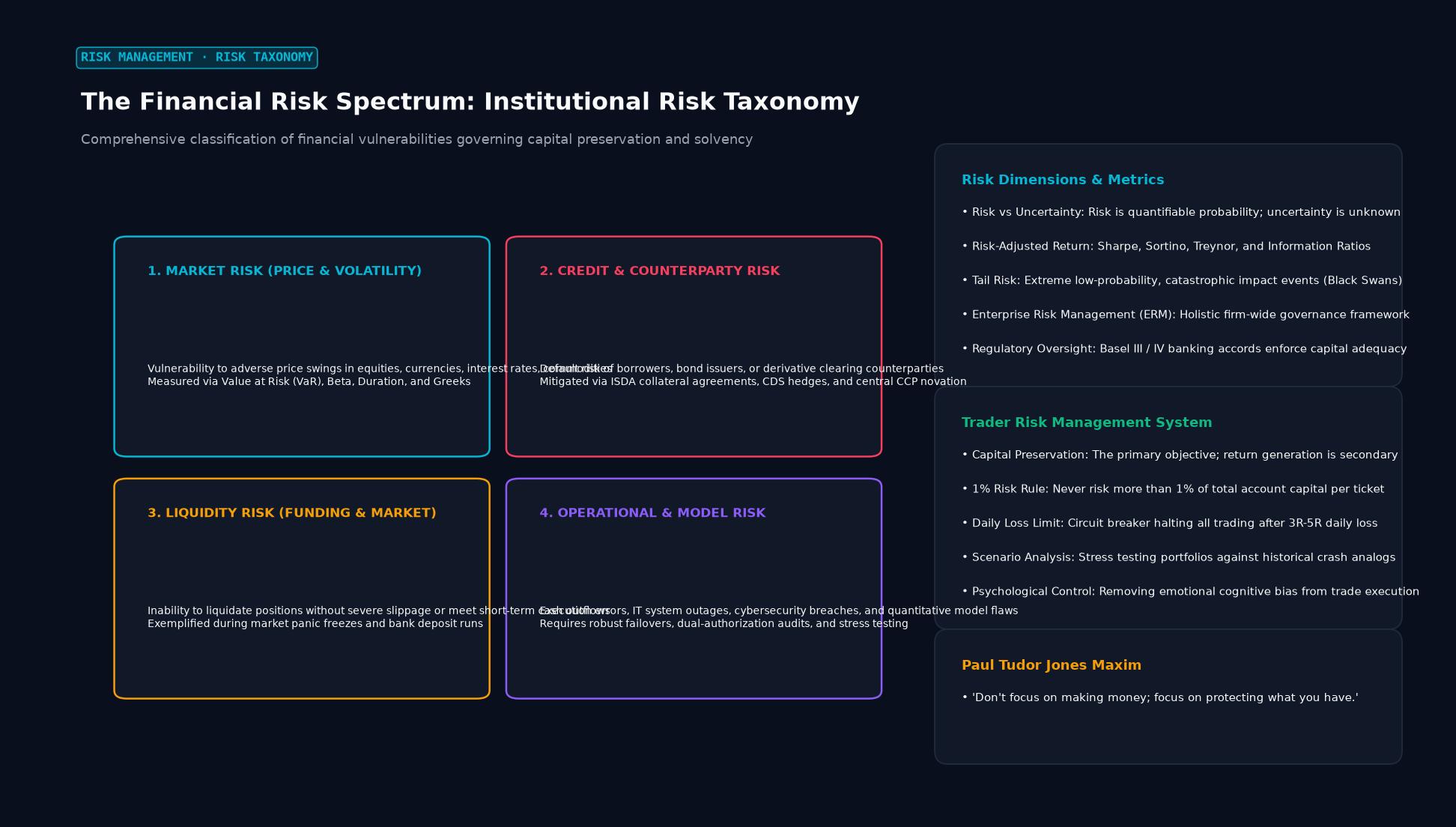 Figure: Comprehensive classification of financial vulnerabilities governing capital preservation and solvency
The Four Primary Pillars of Financial Risk
Financial institutions, investment banks, and hedge funds categorize risk across four distinct operational domains:
1. Market Risk
The risk of losses arising from adverse movements in market prices and rates across four primary asset classes:
- Equity Risk: Fluctuation in share prices and stock indices.
- Interest Rate Risk: Changes in benchmark sovereign yields that impact bond valuations.
- Currency (FX) Risk: Fluctuations in exchange rates affecting cross-border assets and revenues.
- Commodity Risk: Volatility in physical energy, metals, and agricultural goods.
2. Credit and Counterparty Risk
The risk that a borrower, bond issuer, or trading counterparty will default on their contractual obligations:
- Default Risk: The failure of a corporate or sovereign entity to repay bond principal or interest coupons.
- Counterparty Risk: The risk that an OTC derivative partner (e.g., in an interest rate swap) enters bankruptcy before fulfilling settlement obligations.
- Settlement (Herstatt) Risk: The danger that one party delivers cash in a cross-border trade, but the other party defaults before sending the reciprocal currency.
3. Liquidity Risk
Divided into two distinct market failures:
- Asset (Market) Liquidity Risk: The inability to buy or sell a large position quickly without causing massive price slippage due to thin order book depth.
- Funding Liquidity Risk: The inability of an institution to satisfy immediate cash margin calls, collateral pledges, or debt rollovers, forcing emergency fire-sales of illiquid assets.
4. Operational and Model Risk
Internal failures resulting from inadequate processes, technology breakdowns, human error, or quantitative flaws:
- Model Risk: Flawed mathematical assumptions (such as assuming normal Gaussian bell-curve distributions instead of fat-tailed distributions) that cause risk models to underestimate crash probabilities.
- Execution & Cyber Risk: Exchange connectivity outages, broker server crashes, and algorithmic execution bugs (e.g., the 2012 Knight Capital glitch).
Quantitative Metrics for Measuring Risk
Quantitative risk officers and portfolio managers measure and manage risk through standardized mathematical indicators:
| Risk Metric | Mathematical Definition | Practical Application |
|---|---|---|
| Standard Deviation ($\sigma$) | $\sigma = \sqrt{\frac{1}{N-1} \sum (R_i - \mu)^2}$ | Measures the dispersion and historical volatility of asset returns around the mean. |
| Value at Risk (VaR) | $\text{VaR}_\alpha = \inf { l \in \mathbb{R} : P(L > l) \le 1 - \alpha }$ | Quantifies the maximum expected capital loss over a specified time horizon at a given confidence level (e.g., 99% 1-day VaR). |
| Expected Shortfall (CVaR) | $\text{ES}\alpha = \mathbb{E}[L \mid L \ge \text{VaR}\alpha]$ | Measures the average loss incurred beyond the VaR threshold; captures tail risk and black-swan crashes. |
| Beta ($\beta$) | $\beta = \frac{\text{Cov}(R_i, R_m)}{\text{Var}(R_m)}$ | Evaluates the sensitivity of an asset’s returns relative to the broad market index (systematic risk). |
| Maximum Drawdown (MDD) | $\text{MDD} = \frac{\text{Peak Value} - \text{Trough Value}}{\text{Peak Value}}$ | Measures the maximum percentage peak-to-trough capital decline experienced by a portfolio. |
Systematic Risk vs. Unsystematic Risk
Modern Portfolio Theory (formulated by Harry Markowitz in 1952) proves that total investment risk consists of two distinct components:
$$\text{Total Risk} = \text{Systematic (Market) Risk} + \text{Unsystematic (Idiosyncratic) Risk}$$
                   THE DIVERSIFICATION EFFECT ON RISK

    Portfolio Risk (σ)
        ^
        |   \
        |    \  UNSYSTEMATIC RISK (Idiosyncratic)
        |     \ - Company-specific scandals, CEO turnover, product failure
        |      \ - CAN BE DIVERSIFIED AWAY by holding 25-30+ assets!
        |       *-------------------------------------------
        |         SYSTEMATIC RISK (Market Risk: Beta)
        |         - Recessions, war, interest rate hikes, pandemics
        |         - CANNOT BE ELIMINATED through diversification!
+----------------------------------------------------> Number of Assets (n)- Unsystematic Risk (Diversifiable): Company-specific or sector-specific risks (e.g., an airline experiencing a pilot strike). By diversifying a portfolio across 25 to 30 uncorrelated assets, unsystematic risk is mathematically eliminated to near-zero.
- Systematic Risk (Non-Diversifiable): Macroeconomic events that affect the entire financial system simultaneously (e.g., sudden central bank rate hikes, global recessions, geopolitical conflicts). Investors can only hedge systematic risk using derivatives (futures, options) or reducing gross exposure.
Real-World Case Study: Long-Term Capital Management (LTCM) Model Risk (1998)
In the late 1990s, Long-Term Capital Management (LTCM) was an elite quantitative hedge fund led by Wall Street bond traders and Nobel Prize-winning economists Myron Scholes and Robert Merton:
- The Strategy: High-volume statistical arbitrage across global fixed-income spreads, utilizing extreme leverage exceeding 25:1 to 30:1 (holding over $125 billion in assets on $4.7 billion in equity, with $1.25 trillion in gross derivative notional).
- The Model Risk Assumption: LTCM’s quantitative risk models assumed that financial markets followed normal distributions with stable historical correlations, calculating that a catastrophic loss was a “10-standard-deviation event” (statistically impossible).
- The Black Swan: In August 1998, the Russian government unexpectedly devalued the Ruble and defaulted on its domestic sovereign debt (GKO bonds).
- The Contagion: Global financial liquidity vanished instantly. Sovereign debt spreads that LTCM’s models assumed were uncorrelated widened dramatically in tandem.
- The Collapse: Because of extreme leverage, LTCM lost $4.6 billion in four months, threatening a systemic cascade of defaults across Wall Street prime brokers.
- The Bailout: On September 23, 1998, the Federal Reserve Bank of New York orchestrated an emergency $3.6 billion private consortium bailout by 14 major investment banks to prevent a global financial meltdown.
Frequently Asked Questions
What is the difference between risk and uncertainty?
First formulated by economist Frank Knight in 1921:
- Risk refers to situations where the potential outcomes and their mathematical probabilities are known or can be statistically estimated (e.g., rolling dice or modeling historical bond yields).
- Uncertainty (Knightian Uncertainty) refers to events where the possible outcomes or their probability distributions are completely unknown and cannot be modeled mathematically (e.g., an unprecedented geopolitical conflict or black-swan technological disruption).
What is the “1% Rule” in retail trading risk management?
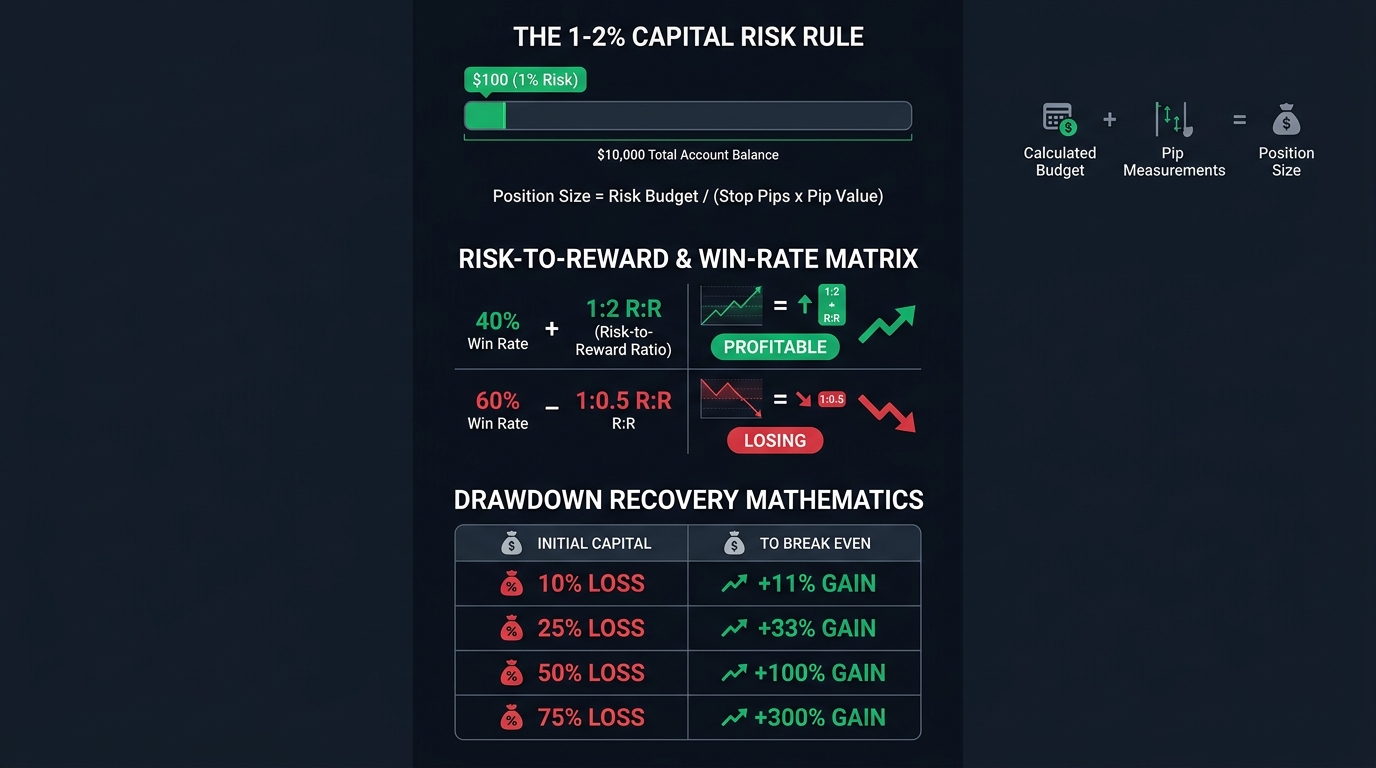
The 1% Rule is a foundational risk management discipline where a trader never risks losing more than 1.0% of their total account equity on any single trade. By calculating position size based on the distance between their entry price and stop-loss price, a trader guarantees that a sequence of consecutive losses will not wipe out their trading capital.
How does leverage amplify financial risk?
Leverage allows a trader to control a large notional position using a small margin deposit. While leverage magnifies percentage profits on favorable moves, it equally magnifies percentage losses relative to deposited capital. A 1% adverse move on a position leveraged at 1:100 will cause a 100% loss of the deposited margin, triggering an instant stop-out liquidation.
Ready to trade forex?
Open a free demo account with a regulated broker. Practice with virtual funds before risking real money.