Rollover Rate
The net interest rate differential between two currencies in a foreign exchange pair, expressed as swap points or cash values applied to open positions held past the daily 5:00 PM EST market cutoff.
What Is a Rollover Rate?
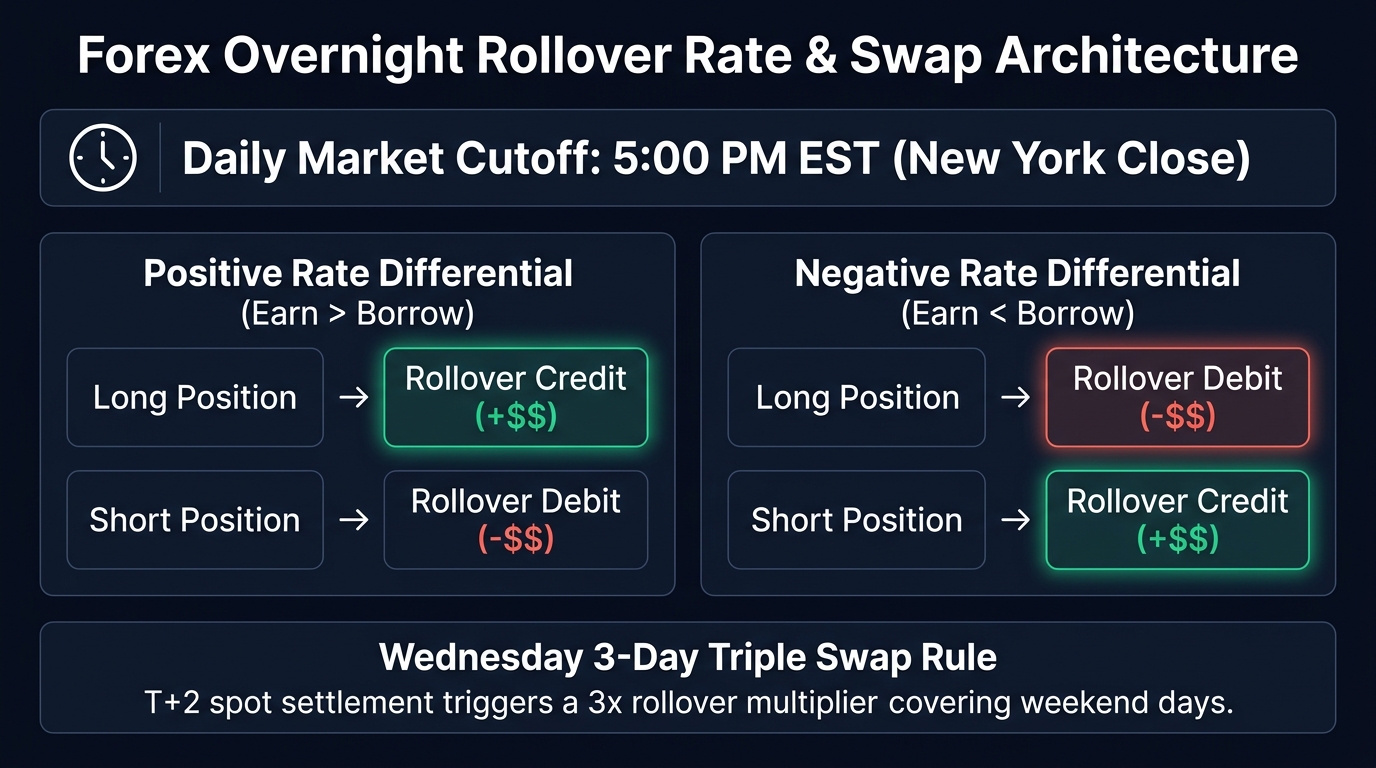
A rollover rate—commonly referred to as an overnight swap rate or financing rate—is the net interest rate applied to an open foreign exchange position held past the close of the global trading day (5:00 PM Eastern Standard Time / New York close). Because spot foreign exchange trading operates on a two-day settlement cycle ($T+2$), open speculative trades must be synthetically rolled forward every twenty-four hours to avert physical cash delivery.
When an investor executes a foreign exchange trade, they simultaneously borrow one sovereign currency at its national interbank lending rate to purchase another currency that earns an overnight deposit rate. The rollover rate represents the net difference between these two interbank rates, modified by counterparty credit spreads, liquidity conditions, and broker financing markups. Depending on whether the purchased currency’s yield is greater or less than the borrowed currency’s yield, the rollover rate generates either a rollover credit (positive carry) or a rollover debit (negative carry).
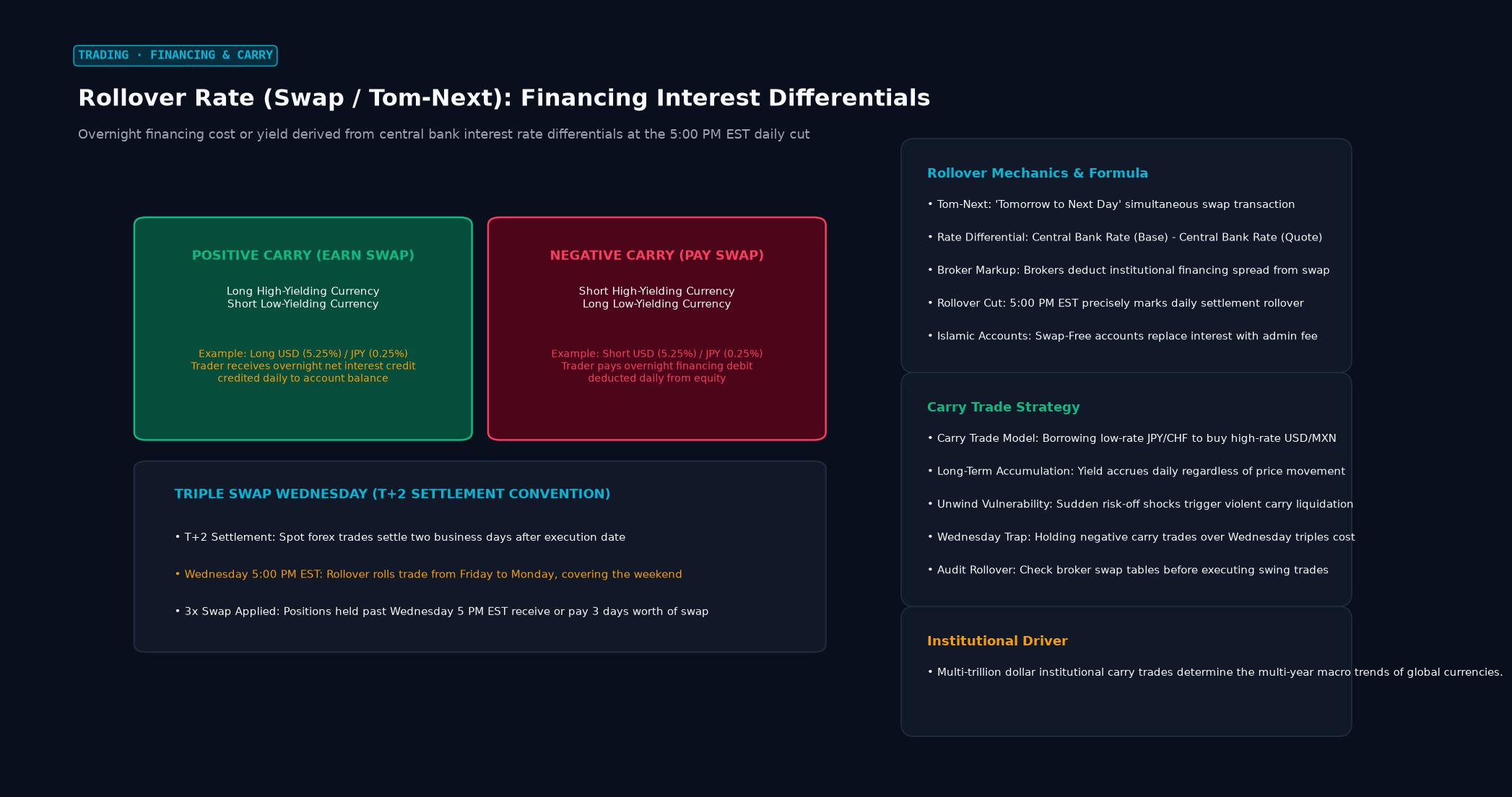 Figure: Overnight financing cost or yield derived from central bank interest rate differentials at the 5:00 PM EST daily cut
The Mathematical Derivation of Rollover Rates
In wholesale money markets, rollover rates are derived directly from the principle of Covered Interest Parity (CIP). Under CIP, the relationship between spot exchange rates, forward exchange rates, and sovereign interest rate differentials dictates the fair pricing of overnight swaps.
The theoretical forward points for an overnight Tom-Next swap are determined by:
$$\text{Forward Points} = S \times \left[ \frac{1 + \left(r_{\text{quote}} \times \frac{d}{360}\right)}{1 + \left(r_{\text{base}} \times \frac{d}{360}\right)} - 1 \right]$$
Where:
- $S$ = Current spot exchange rate.
- $r_{\text{quote}}$ = Benchmark overnight deposit/lending rate of the quote currency.
- $r_{\text{base}}$ = Benchmark overnight deposit/lending rate of the base currency.
- $d$ = Number of rollover days (typically 1 day for standard weekdays, 3 days on Wednesday).
- Day-count convention: Usually 360 days (or 365 days for British Pound, Australian Dollar, Canadian Dollar, and New Zealand Dollar).
From Interbank Forward Points to Broker Pip Adjustments
Institutional liquidity providers (Tier-1 banks such as JPMorgan, Deutsche Bank, and Citi) quote Tom-Next swap rates in fractional points (pipettes). Retail brokers convert these points into cash debits or credits per lot:
$$\text{Cash Rollover} = \text{Contract Size} \times \text{Pip Value} \times \text{Rollover Points}$$
For instance, consider a 1.00 standard lot ($100,000) long position in AUD/USD:
- Spot Rate: 0.6500
- Reserve Bank of Australia (RBA) Cash Rate: 4.35%
- U.S. Federal Reserve Funds Rate: 5.25%
- Net Rate Spread: $4.35% - 5.25% = -0.90%$
- After adding an institutional financing markup of $0.50%$, the effective rollover rate stands at $-1.40%$ annualized.
- The resulting overnight adjustment extracts approximately $-$2.53$ per standard lot nightly.
Rollover Rate vs. Spot Rate vs. Forward Rate
Understanding how rollover rates interact with broader currency pricing requires distinguishing between the three core quotation mechanisms:
| Market Metric | Primary Definition | Time Horizon | Key Determinants |
|---|---|---|---|
| Spot Rate | Immediate transaction price for two-day physical or cash delivery | $T+2$ (or $T+1$ for USD/CAD) | Supply and demand, macroeconomic data releases, capital flows |
| Rollover Rate | Daily adjustment applied to prevent physical delivery by pushing value date out one day | 24 hours (overnight Tom-Next) | Central bank policy rates, overnight SOFR/ESTR spreads, bank credit risk |
| Forward Rate | Predetermined exchange rate agreed upon today for settlement at a specified future date | 1 week to 5+ years | Spot rate plus cumulative interest rate differentials (forward swap points) |
Real-World Case Study: The USD/JPY Historic Rollover Surge (2022–2024)
Following the 2020 pandemic recovery, the global macroeconomic environment experienced severe monetary policy divergence. While the U.S. Federal Reserve aggressively raised interest rates from 0.25% to 5.50% to combat multi-decade high inflation, the Bank of Japan (BOJ) maintained its negative interest rate policy (-0.10%) and Yield Curve Control (YCC) framework.
       HISTORIC POLICY RATE DIVERGENCE (2022–2024)

 6.00% ──┐
         │                                    US Fed Funds (5.50%)
 4.00% ──┼────────────────────────────────────────────────────────
         │
 2.00% ──┼────────────────────────────────────────────────────────
         │
 0.00% ──┼────────────────────────────────────────────────────────
         │                                    BOJ Policy Rate (-0.10%)
-0.20% ──┴────────────────────────────────────────────────────────
         Net Annual Interest Rate Differential: ~5.60%
This unprecedented yield gap created the most lucrative carry trade environment of the 21st century:
- Daily Rollover Yield: Holding a long USD/JPY position generated approximately $$35.00$ to $$42.00$ per standard lot in positive rollover credits every night.
- Weekly Rollover Yield: On Wednesdays (with the 3x triple rollover accounting for the weekend), a single standard lot produced over $$120.00$ in cash credits.
- Market Consequences: Global hedge funds and Japanese domestic retail investors (“Mrs. Watanabe”) piled into long USD/JPY trades. The influx of carry trade capital drove USD/JPY from roughly 115.00 in early 2022 to above 160.00 in mid-2024.
- The Unwind Risk: In August 2024, when the BOJ unexpectedly raised its benchmark rate to 0.25% and U.S. labor data weakened, aggressive carry-unwinding collapsed USD/JPY from 161.95 to 141.68 in three weeks. While rollover rates provide predictable yield, the risk of rapid capital depreciation during rate repricing cycles remains substantial.
Why Broker Rollover Rates Differ from Interbank Benchmarks
Retail traders frequently observe that the rollover credits and debits posted on their platform do not precisely match official central bank rate differentials. Several institutional layers introduce asymmetrical spreads:
                  THE ASYMMETRICAL ROLLOVER PRICING PYRAMID

           [ Central Bank Benchmark Yields: Fed 5.25% vs ECB 3.75% ]
                                     │
                                     ▼
        [ Interbank Tier-1 Market: SOFR vs ESTR Tom-Next Spread ]
                                     │
                                     ▼
        [ Prime Broker / Liquidity Provider Markup: ± 0.25% - 0.50% ]
                                     │
                                     ▼
        [ Retail Forex Broker Retail Spread: ± 1.00% - 2.50% ]
                                     │
                                     ▼
Long Swap: Lower Credit / Short Swap: Higher Debit (Widened Spread)- Liquidity Provider Haircuts: Prime brokers and aggregators adjust overnight quotes based on their balance-sheet liquidity constraints under Basel III regulations.
- Asymmetric Retail Spreads: A broker may deduct 2.50% on a short position while crediting only 0.75% on the corresponding long position, retaining the 1.75% spread as riskless financing revenue.
- Weekend Settlement Risk: Over bank holidays or periods of acute geopolitical crisis, interbank dealers widen Tom-Next spreads to insulate against gap openings.
Frequently Asked Questions
What is the exact difference between a rollover rate and a swap rate?
In foreign exchange terminology, “rollover rate” and “swap rate” are functionally interchangeable. Both describe the cost or yield of rolling an open spot FX position overnight via a Tomorrow-Next swap. “Swap rate” is more commonly used in institutional and platform terminology (such as MetaTrader’s swap column), while “rollover rate” is the preferred economic and regulatory phrasing.
Why do rollover rates fluctuate even when central banks have not changed rates?
While benchmark central bank policy rates change only a few times per year, market rollover rates fluctuate daily. They are driven by short-term interbank money market conditions, such as commercial bank liquidity, cross-currency basis swaps, repo market dynamics, and sovereign Treasury bill supply.
How can swing traders prevent rollover rates from eroding long-term profits?
Long-term position traders can mitigate rollover erosion by aligning their trades in the direction of positive carry (buying the higher-yielding currency), closing positions before 5:00 PM EST, utilizing futures contracts (where financing costs are embedded transparently in the basis), or opening designated swap-free accounts where overnight fees are replaced with flat administrative commissions.
Ready to trade forex?
Open a free demo account with a regulated broker. Practice with virtual funds before risking real money.