Rollover Debit
A net financing charge deducted from a trading account when an open foreign exchange position is rolled over past the daily market close, occurring when the purchased currency carries a lower benchmark interest rate than the sold currency.
What Is a Rollover Debit?
In foreign exchange trading, spot transactions technically settle two business days after execution ($T+2$). Because retail and institutional speculators trade currencies to capture exchange rate fluctuations rather than take physical delivery of banknotes, open positions must be continuously extended—or rolled over—into the next settlement date.
A rollover debit (frequently termed a negative swap charge or financing debit) occurs when maintaining an open spot FX position past the daily market close (typically 5:00 PM Eastern Standard Time / New York close) incurs an interest deficit. In every currency pair, an investor buys the base currency while simultaneously borrowing and selling the quote currency (or vice versa). If the interest rate paid on the borrowed currency exceeds the interest rate earned on the purchased currency, the trader incurs a net negative interest rate differential that is debited from their cash account.
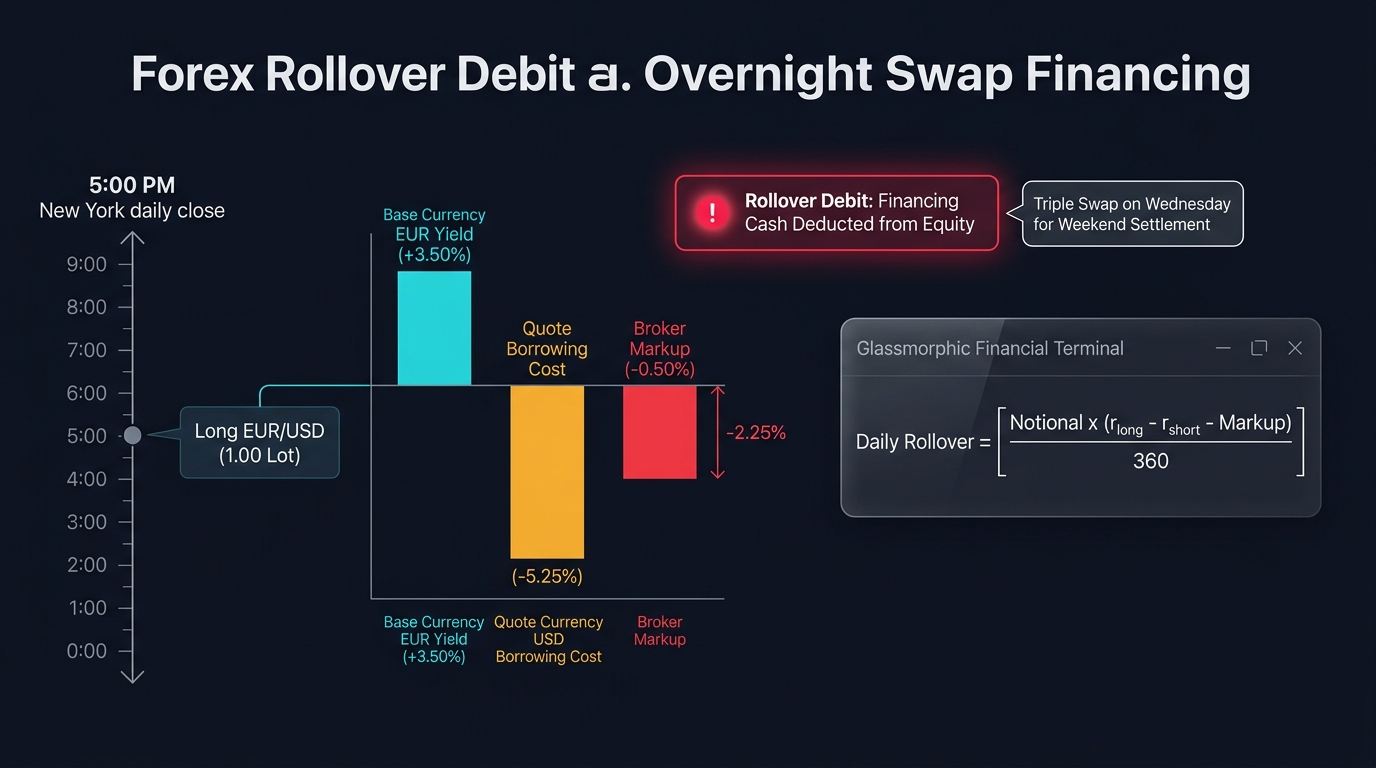
                  DAILY OVERNIGHT FINANCING FLOW (5:00 PM EST)

  [Open Long Base / Short Quote Position]
                    │
                    ▼
     Compare Overnight Interbank Rates
                    │
    ┌───────────────┴───────────────┐
    ▼                               ▼
Earn Yield on Base Currency     Pay Interest on Quote Currency
(e.g., EUR at 3.50%)            (e.g., USD at 5.25%)
    │                               │
    └───────────────┬───────────────┘
                    ▼
       Net Rate = 3.50% - 5.25% - Broker Markup = -2.25% (Net Negative)
                    │
                    ▼
          [ ROLLOVER DEBIT APPLIED ] ──► Cash Deducted from Equity
Institutional dealers execute this rollover through an overnight financial transaction known as a Tomorrow-Next (Tom-Next) swap. The broker simultaneously closes the spot position at the current value date and re-opens it for the subsequent value date at a price adjusted by “swap points.” When market interest differentials and broker administration fees tilt negative, this adjustment results in a direct rollover debit.
Mechanics and Calculation of Overnight Rollover Debits
The calculation of a rollover debit incorporates three variables: the nominal notional value of the position, the interest rate differential between the two central banks, and the counterparty or broker administrative spread.
The mathematical formula to determine the daily rollover charge in base currency terms is:
$$\text{Daily Rollover Debit} = \left[ \frac{\text{Notional Value} \times (r_{\text{long}} - r_{\text{short}} - \text{Markup})}{360 \text{ or } 365} \right] \times \text{Spot Rate}$$
Where:
- $\text{Notional Value}$: Standard contract size (e.g., $100,000 per standard lot).
- $r_{\text{long}}$: Overnight lending rate of the currency being purchased.
- $r_{\text{short}}$: Overnight borrowing rate of the currency being sold.
- $\text{Markup}$: The retail liquidity provider or broker financing spread (typically 0.25% to 1.50%).
- Day-count convention: 360 days for USD, EUR, and CHF money markets; 365 days for GBP, AUD, NZD, and CAD.
Practical Pip-Point Calculation
In retail platforms such as MetaTrader or cTrader, rollovers are quoted directly in points or pips per lot.
Assume a trader is short USD/JPY with 2 standard lots ($200,000). The Federal Reserve funds rate is 5.25%, and the Bank of Japan policy rate is 0.10%. Because the trader is short USD (borrowing high-yielding USD) and long JPY (holding low-yielding JPY), the position generates a heavy rollover debit:
-
Base currency interest spread: $0.10% - 5.25% = -5.15%$.
-
Adding an institutional broker financing markup of $0.50%$, the annual net negative yield becomes $-5.65%$.
-
Daily cost:
$$\text{Daily Rollover} = \frac{$200,000 \times -0.0565}{360} = -$31.39 \text{ per night}$$
If the trader holds this short position for 30 calendar days, the cumulative rollover debit extracts $$941.70$ in financing costs regardless of whether USD/JPY drifts upward or downward.
Rollover Debit vs. Rollover Credit
Every spot currency pair involves a two-way transaction where one currency is bought and the other is sold. Therefore, overnight carry dynamics are inherently directional:
| Parameter | Rollover Debit (Negative Carry) | Rollover Credit (Positive Carry) |
|---|---|---|
| Underlying Driver | Long currency yields less than short currency | Long currency yields more than short currency |
| Account Impact | Daily cash deduction from account balance | Daily cash credit added to account balance |
| Broker Markup Impact | Expands the debit, making financing more expensive | Compresses the credit, reducing net interest earned |
| Strategic Stance | Natural headwind against long-term swing positions | Tailwinds favored by carry trade strategies |
| Typical Pair Examples | Long EUR/USD (when Fed > ECB), Short USD/JPY | Long USD/JPY, Long AUD/JPY (traditional carry) |
| Market Volatility Risk | High carrying cost compounds unrealized drawdown | Risk of sudden carry unwind during market panic |
The Wednesday Triple Rollover Phenomenon
Because foreign exchange settlements follow the standard $T+2$ banking cycle, weekend rollover financing must be settled during the regular trading week. Global financial institutions do not settle transactions on Saturdays or Sundays.
                  WEDNESDAY "TRIPLE ROLLOVER" CALENDAR MECHANICS

 Trade Day:       Wednesday 5:00 PM EST
 Execution:       Positions rolled from Thursday (T+1) to Friday (T+2)
 Weekend Gap:     Position held over Saturday & Sunday rolls into Monday (T+3, T+4, T+5)
 Settlement:      Wednesday 5:00 PM EST assesses 3 FULL DAYS of Rollover Debit
When a position is rolled over on Wednesday at 5:00 PM EST, the spot value date moves from Friday to Monday. To account for the 48 hours of credit risk and capital commitment over the weekend, brokers charge three days of rollover debits (3x swap) in a single transaction. A position with a $$25.00$ nightly debit will incur a $-$75.00$ deduction on Wednesday evening. Conversely, pairs that settle on a $T+1$ basis (such as USD/CAD) usually execute their triple rollover on Thursday evening.
Real-World Case Study: EUR/USD Negative Carry Drain (2022–2023)
Between July 2022 and mid-2023, the U.S. Federal Reserve enacted one of the most aggressive monetary tightening cycles in modern financial history, lifting the upper bound of the Federal Funds rate to 5.50%. Concurrently, the European Central Bank (ECB) raised its deposit facility rate more cautiously, peaking at 4.00%.
Fed Funds Rate: 5.50%  ──┐
                         ├─► Rate Differential: -1.50% (Base EUR vs Quote USD)
ECB Deposit:    4.00%  ──┘
                         └─► Broker Retail Markup: -1.00% ──► Total Net Carry: -2.50%
A swing trader maintaining a 10-lot long EUR/USD position ($1,000,000 notional) over a 9-month consolidation period experienced severe rollover attrition:
- Daily Overnight Cost: With a net negative yield of $-2.50%$ annually, the nightly debit totaled approximately $-$69.44$.
- Weekly Cost (incorporating 3x Wednesday): $-$486.08$ per week.
- Total Attrition Over 270 Days: The cumulative rollover debit extracted over $$18,750$ directly from the trader’s account balance.
Even though spot EUR/USD eventually staged an upward correction, the structural rollover debit eliminated nearly 190 pips of trading profit. Institutional macro funds actively account for this drag, frequently switching from spot instruments to currency futures or synthetic FX forward boxes to neutralize negative carry.
Strategic Risk Management for Traders Facing Rollover Debits
Experienced market participants utilize targeted operational rules to avoid or minimize destructive rollover debits:
- Intraday Liquidation: Day traders avoid overnight financing altogether by closing all speculative exposure before 4:59 PM EST, re-entering after 5:01 PM EST if desired.
- Swap-Free (Islamic) Accounts: For religious reasons prohibiting riba (usury), certified swap-free trading accounts replace daily rollover debits with fixed administrative or holding commissions, though brokers often widen spreads to compensate.
- Carry-Conscious Hedging: Rather than holding long-term directional exposure against a wide interest differential, institutional managers execute FX forwards where the forward point premium is locked in at inception, eliminating unpredictable floating swap markups.
- Trading Higher-Yielding Crosses: When seeking bullish exposure against the US Dollar, traders frequently select currencies with benchmark yields closer to or above the USD rate rather than holding heavily penalized low-rate currencies like the Swiss Franc (CHF) or Japanese Yen (JPY).
Frequently Asked Questions
Can a rollover debit turn a winning trade into a net loss?
Yes. If an investor holds a winning trade with an unrealized profit of 50 pips over several months while accumulating 65 pips in rollover debits, the net cash settlement upon closing will produce a realized capital loss. Every multi-week or multi-month swing strategy must factor projected swap debits into its risk-reward ratio.
Why do some brokers charge rollover debits on both long and short positions?
In an ideal interbank market, one side earns a credit while the opposite side pays a debit. However, retail brokers apply a financing spread (markup) to both sides of the trade. If the underlying interest rate differential is narrow (e.g., 0.25%), the broker’s 1.00% markup can push both the long swap and short swap into negative territory, creating rollover debits regardless of trade direction.
At what exact time is the rollover debit applied?
The universal settlement cutoff for foreign exchange is 5:00 PM Eastern Standard Time (EST/EDT) in New York. Any position open at precisely 5:00:01 PM EST incurs the daily rollover debit or credit, regardless of whether the order was opened six hours earlier or six seconds earlier. Positions closed at 4:59:59 PM EST are exempt from rollover fees.
Ready to trade forex?
Open a free demo account with a regulated broker. Practice with virtual funds before risking real money.