Rollover Credit
A rollover credit (positive swap) is an interest payment credited directly to a trader's account balance when an open spot foreign exchange position is held past the daily 5:00 PM EST market close, occurring when the currency purchased carries a higher benchmark interest rate than the currency sold.
What Is a Rollover Credit?
In foreign exchange trading and retail CFD brokerages, a rollover credit (commonly referred to as a positive swap or positive carry) is cash interest paid directly into an investor’s trading account when a leveraged currency position is held overnight past the daily market clearing cutoff—standardized globally at 5:00 PM Eastern Standard Time (EST) / New York close.
The credit arises from the fundamental mechanics of spot foreign exchange, where every trade involves simultaneously buying one sovereign currency while borrowing another:
- When you open a position in a currency pair, you earn interest on the currency you buy (go long).
- Simultaneously, you must pay interest on the currency you sell (borrow / go short).
If the sovereign benchmark interest rate of the purchased currency exceeds the interest rate of the borrowed currency—and that positive differential exceeds the broker’s administrative financing markup—the trader receives a net rollover credit for every night the trade remains open.
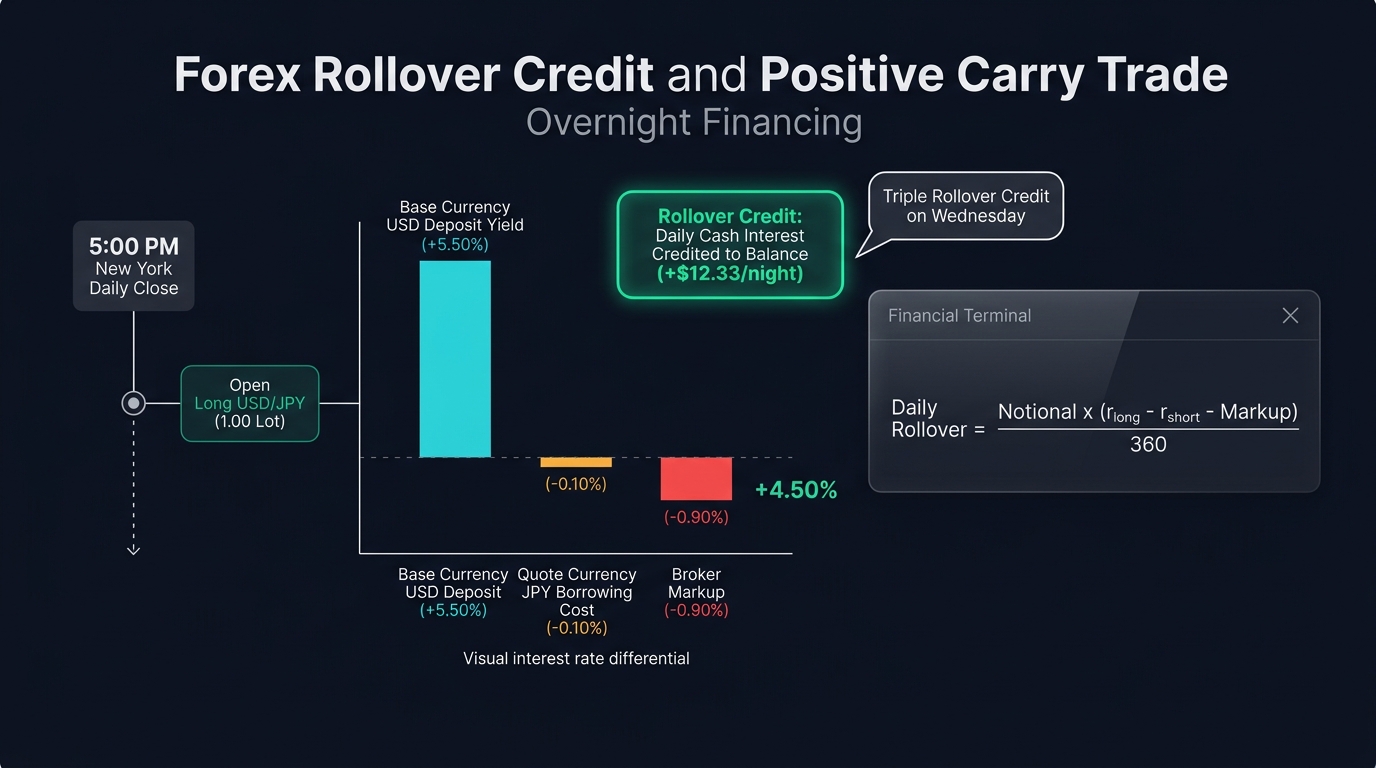
                    ROLLOVER CREDIT (POSITIVE CARRY) FLOW

   BUY 1.0 Lot USD/JPY @ 150.00 (Long USD, Short JPY)
   - Earning USD Interest Rate:  +5.50% Annual
   - Paying JPY Interest Rate:   -0.10% Annual
   - Broker Administrative Fee:  -0.90% Annual
   ------------------------------------------------------------
   NET ANNUAL CARRY YIELD:       +4.50% (Positive Differential)
                                    |
                                    v (Held past 5:00 PM EST)
   DAILY CASH ROLLOVER CREDIT CREDITED TO BALANCE: +$12.33 / night
Mathematical Calculation of a Daily Rollover Credit
Institutional dealing desks and retail STP/ECN brokers calculate the daily rollover credit using the Tomorrow-Next (Tom-Next) swap rate:
$$\text{Daily Rollover Credit} = \left[\frac{\text{Contract Notional Size} \times (r_{\text{long}} - r_{\text{short}} - \text{Broker Markup})}{360 \text{ (or 365)}}\right] \times \text{Spot Exchange Rate}$$
Where:
- $\text{Contract Notional Size}$ = Units of base currency (e.g., 100,000 for 1.0 standard lot).
- $r_{\text{long}}$ = Sovereign deposit rate of the currency being held long.
- $r_{\text{short}}$ = Sovereign borrowing rate of the currency being borrowed short.
- $\text{Broker Markup}$ = The financing haircut retained by the liquidity provider and retail broker (typically 50 to 100 basis points).
Numerical Calculation Example:
- Long 1.0 standard lot ($100,000) of USD/CHF.
- US Dollar deposit yield: 5.25%.
- Swiss Franc borrowing rate: 1.25%.
- Broker administrative spread: 0.75%.
- Net positive rate spread: $5.25% - 1.25% - 0.75% = \mathbf{+3.25%}$.
- Daily Rollover Credit: $$\text{Daily Credit} = \frac{$100{,}000 \times 0.0325}{360} \approx \mathbf{+$9.03 \ \text{USD per night}}$$
If held for 30 consecutive days, the trader accumulates +$270.90 USD in passive cash yield, regardless of whether the spot exchange rate moves up or down.
The Wednesday Triple Rollover Credit
A major calendar feature of holding positive-carry trades is the Wednesday Triple Credit:
- In the spot forex market, standard trade settlement occurs on a $T+2$ business-day basis.
- Positions held overnight on Wednesday at 5:00 PM EST roll settlement from Friday to Monday, spanning the weekend when commercial bank clearing systems are closed.
- To account for Saturday and Sunday, brokers credit three full days of rollover interest on Wednesday evening: $$\text{Wednesday Credit} = \text{Standard Daily Rollover Credit} \times 3$$ For the USD/CHF position above, the trader receives +$27.09 USD on Wednesday night alone.
       WEEKLY ROLLOVER CREDIT ACCRUAL SCHEDULE

  Rollover Timestamp:        Days Credited:      Cash Credit ($9.03/day):
  ------------------------------------------------------------------------
  Monday 5:00 PM EST   --->  1 Day               +$9.03
  Tuesday 5:00 PM EST  --->  1 Day               +$9.03
  Wednesday 5:00 PM EST ---> 3 Days (Weekend!)   +$27.09 (TRIPLE SWAP!)
  Thursday 5:00 PM EST --->  1 Day               +$9.03
  Friday 5:00 PM EST   --->  1 Day               +$9.03
  ------------------------------------------------------------------------
  TOTAL WEEKLY CASH INCOME ACCRUED:              +$63.21 USD
Tactical Applications: The Institutional Carry Trade
Institutional hedge funds and macro asset managers allocate hundreds of billions of dollars to systematic Carry Trade Strategies designed specifically to harvest rollover credits:
- Basket Diversification: Allocators do not hold a single currency pair; they construct a diversified portfolio buying multiple high-yielding currencies (e.g., USD, MXN, BRL, HUF) financed by shorting low-yielding funding currencies (e.g., JPY, CHF).
- Volatility Filtering: Carry trades perform best during regimes of low global financial volatility (low VIX). When market volatility is subdued, currencies trade in tight ranges, allowing investors to compound daily rollover credits without capital loss.
Real-World Case Study: The 2023 USD/JPY Carry Trade Boom
Throughout 2023, the Federal Reserve held its policy rate at 5.50%, while the Bank of Japan anchored short-term rates at -0.10%:
- The Trade: A macro trader held a long position of 5.0 standard lots ($500,000 notional) of USD/JPY from January 3, 2023, to December 20, 2023 (350 days).
- The Rollover Economics:
- Average daily rollover credit: +$58.50 per day ($175.50 on Wednesdays).
- Total cumulative rollover credit earned: $$\text{Total Swap Income} = 350 \ \text{days} \times $58.50 \approx \mathbf{+$20{,}475 \ \text{USD}}$$
- The Capital Appreciation: Simultaneously, spot USD/JPY rallied from 130.00 to 142.00 (+1,200 pips), generating an additional +$42,000 in capital gains.
- Total Return: The combination of capital appreciation ($42,000) and accumulated rollover credit ($20,475) generated a massive total return of +$62,475, with rollover credits contributing nearly 33% of total profitability.
Frequently Asked Questions
Can a rollover credit turn into a debit?
Yes. If the central bank of the currency you are holding long cuts interest rates, or the central bank of the currency you are short hikes interest rates, the interest rate differential can invert. Furthermore, if a broker widens its financing markup, a small positive credit can flip into a negative rollover debit.
Are rollover credits taxable?
Yes. In virtually all jurisdictions (including under US IRS Section 988/1256 and UK HMRC rules), rollover credits are classified as taxable interest income or treated as part of net realized trading gains, subject to annual capital or income taxation.
Why didn’t I receive my rollover credit on a Friday night?
Positions held over the weekend across Friday close do not receive three days of swap on Friday evening because weekend financing is already credited on Wednesday evening under standard $T+2$ international settlement conventions. Friday rollover applies only one standard day of swap covering the Monday settlement cycle.
Ready to trade forex?
Open a free demo account with a regulated broker. Practice with virtual funds before risking real money.