Lot
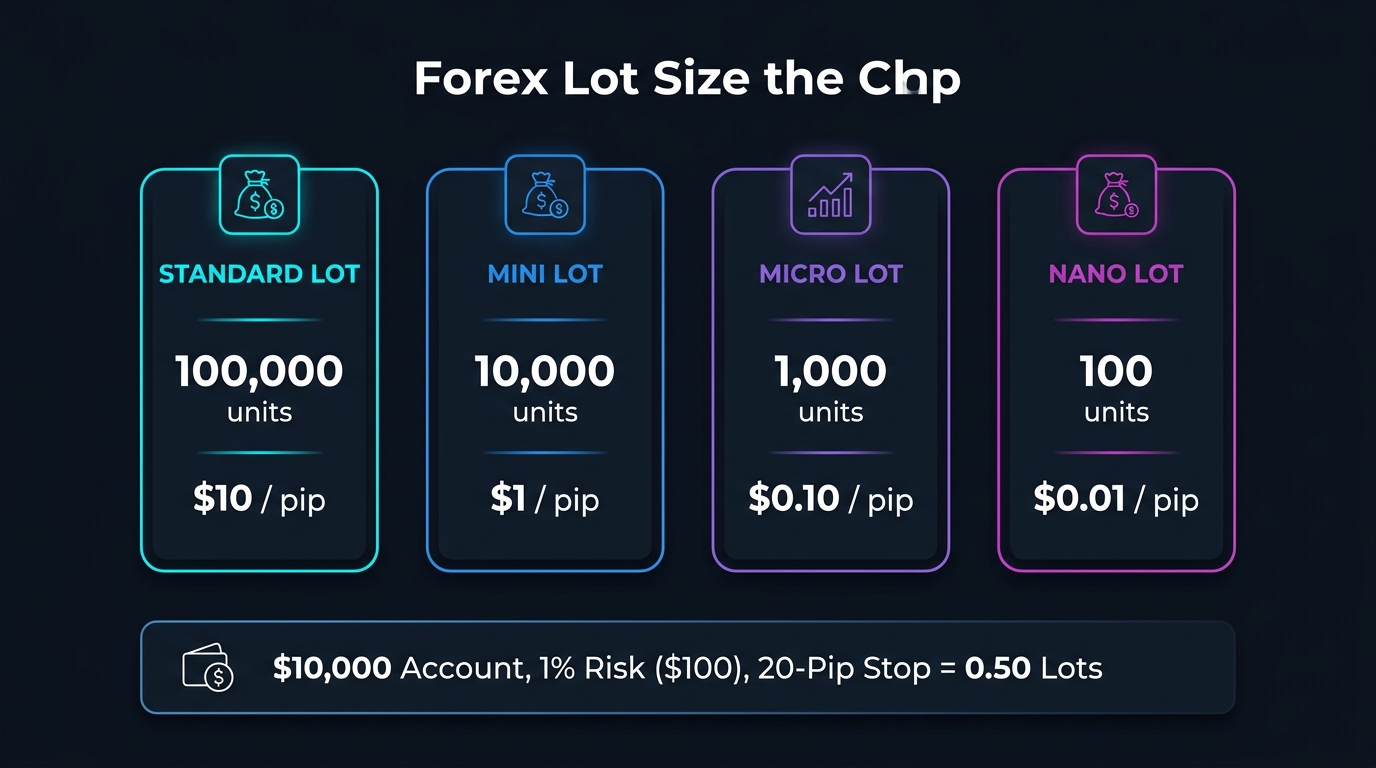
A lot is the standardized unit of trade size in forex. One standard lot equals 100,000 units of the base currency. Smaller denominations — mini lots (10,000 units) and micro lots (1,000 units) — allow traders with smaller accounts to participate while controlling position risk precisely.
What Is a Lot in Forex Trading?
Forex doesn’t trade in raw dollar amounts the way you might buy shares. Instead, all currency trades are executed in standardized blocks called lots. This standardization is what makes pip values predictable and position sizing calculable across the entire market — from retail traders on MetaTrader to institutional desks moving billions.
The standard lot is the baseline: 100,000 units of the base currency. If you’re trading EUR/USD, one standard lot means you’re buying or selling 100,000 euros. At a rate of 1.0850, that position is worth $108,500 on the other side. Obviously, that’s not money most retail traders have sitting around — which is where leverage comes in.
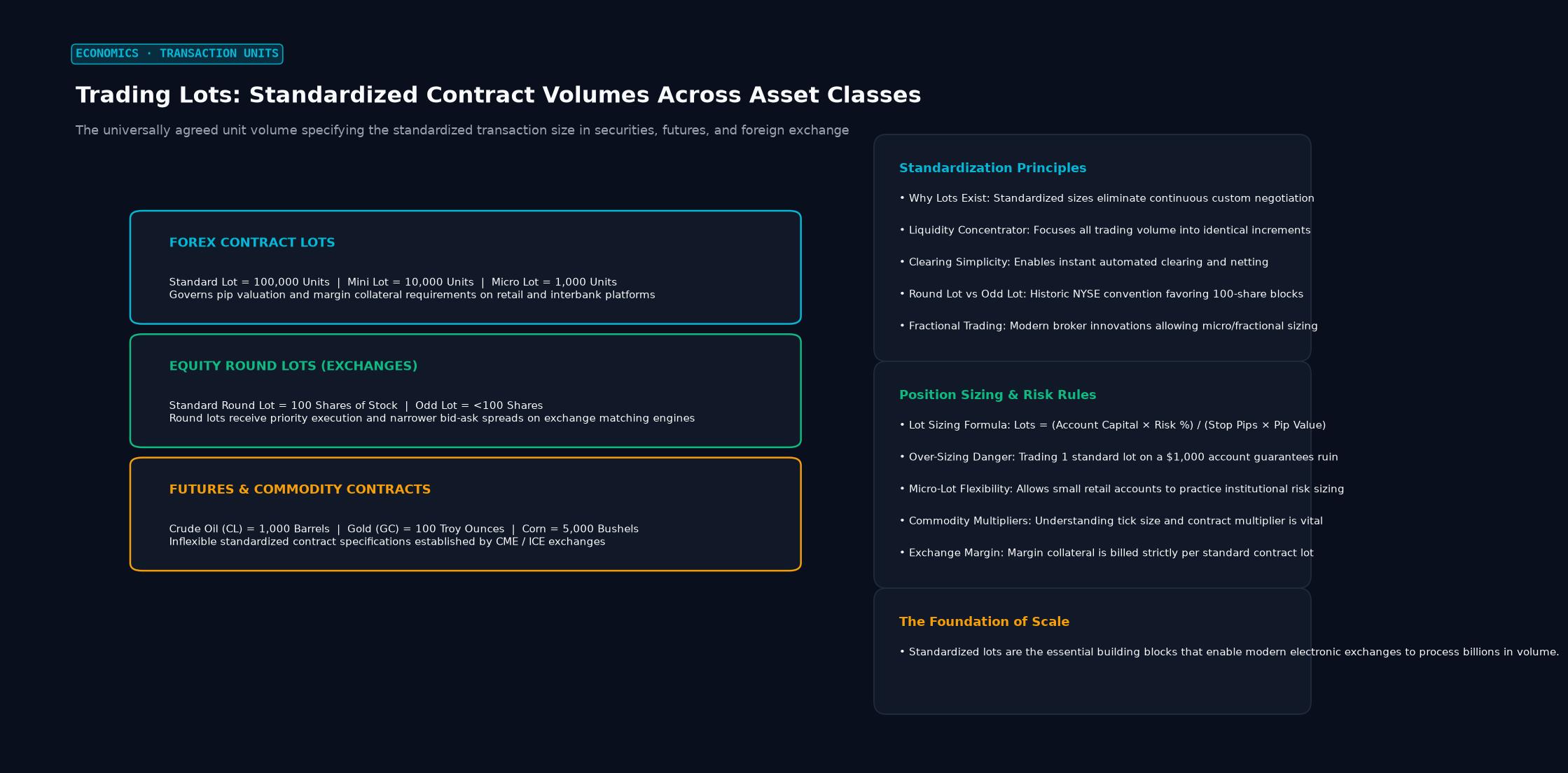 Figure: The universally agreed unit volume specifying the standardized transaction size in securities, futures, and foreign exchange
The Three Main Lot Sizes
| Lot Type | Units | Approx. Pip Value (USD pairs) |
|---|---|---|
| Standard Lot | 100,000 | ~$10 per pip |
| Mini Lot | 10,000 | ~$1 per pip |
| Micro Lot | 1,000 | ~$0.10 per pip |
These aren’t arbitrary numbers. They’re designed so that pip values fall on clean, easy-to-calculate figures for USD-quoted pairs. A 50-pip stop on a standard lot costs $500. The same stop on a mini lot costs $50. This makes position sizing and risk calculation straightforward even without a calculator.
Some brokers also offer nano lots (100 units, ~$0.01 per pip). These are primarily used by beginners learning to trade with real money consequences, or for testing automated systems live without meaningful capital risk.
Lot Size and Account Size
The most common mistake among new traders: using lot sizes that are too large for their account. Here’s the math that matters.
Say you have a $2,000 account and you want to risk no more than 1% per trade ($20). If your stop-loss is 20 pips away, you need pip value to equal $1 per pip. That means trading one mini lot — not a standard lot, not “two or three mini lots because the setup looks good.”
The calculation:
- Account risk = $20
- Stop distance = 20 pips
- Required pip value = $20 / 20 = $1 per pip = 1 mini lot
Trading a standard lot in the same scenario means you’re risking $200 on a trade — 10% of your account — on a single setup. That’s how accounts blow up, and it happens to traders of all experience levels when they override their own sizing rules.
Why Standard Lots Dominate Institutional Trading
At the institutional level, traders rarely think in micro lots. Bank desks, hedge funds, and proprietary trading firms operate in standard lots by default, often running positions in hundreds of lots simultaneously. When you see large round-number levels in the market holding as support or resistance, there’s frequently a significant institutional position nearby — placed in standard-lot blocks.
One practical implication: the spread cost of a standard lot trade is meaningfully different from a micro lot trade. A 1.5-pip spread on a standard lot costs $15 in absolute terms. The same spread on a micro lot costs $0.15. This is why professional traders are very spread-conscious — small differences in per-pip cost multiply dramatically at full lot sizes.
Nano Lots and Fractional Lots
Many modern brokers allow fractional lot sizing. Instead of choosing between 1.0, 0.5, or 0.1 lots, you might specify 0.37 lots for precise risk alignment. This flexibility is genuinely valuable for experienced traders who want to match position size exactly to their risk parameters rather than rounding to the nearest standard denomination.
If your broker doesn’t offer fractional lots below 0.01 (micro lot), that’s a real constraint when trading small accounts. A $500 account with 0.01 micro lot minimum can still work — but you’re limited to very tight stops or you’ll exceed 1% risk per trade.
Key Takeaways
- One standard lot = 100,000 units of base currency, ≈$10 per pip on USD pairs
- Mini lots (10,000 units) and micro lots (1,000 units) let smaller accounts trade with proper risk control
- Lot size should always be derived from your risk parameters, never chosen arbitrarily
- Fractional lot sizing gives precise control over position risk
FAQ
Can I trade less than a micro lot? At some brokers, yes. Nano lots (100 units, 0.001 in MetaTrader) are available at select brokers. Not all platforms support them.
Does lot size affect the spread I pay? The spread rate (in pips) is the same regardless of lot size. But the dollar cost scales directly — a 1.5-pip spread costs $15 per standard lot vs $0.15 per micro lot.
Ready to trade forex?
Open a free demo account with a regulated broker. Practice with virtual funds before risking real money.