RSD
RSD (Serbian Dinar) is the official currency of the Republic of Serbia, subdivided into 100 para and issued by the National Bank of Serbia (NBS).
What is the Serbian Dinar (RSD)?
The Serbian Dinar (ISO code: RSD, Serbian Cyrillic: српски динар, symbol: дин or RSD) is the official legal tender of the Republic of Serbia. Issued, managed, and defended by the nation’s central bank, the National Bank of Serbia (Narodna banka Srbije - NBS), the dinar is subdivided into 100 para. Para coins were officially withdrawn from physical cash circulation in 2008 due to cumulative inflation, and transactions are rounded to the nearest whole dinar.
The name “Dinar” traces its etymological lineage to the ancient Roman silver denarius, reflecting the Balkans’ long integration into Mediterranean and European monetary networks.
In global currency markets, the Serbian Dinar is classified as an emerging European frontier currency. While the NBS officially designates its exchange rate policy as a managed floating regime within an inflation-targeting framework, in practice the central bank operates a de facto stabilized arrangement closely tracking the European Union’s single currency (the Euro). Through continuous two-way interbank foreign exchange interventions, the NBS maintains the EUR/RSD exchange rate within an exceptionally narrow corridor.
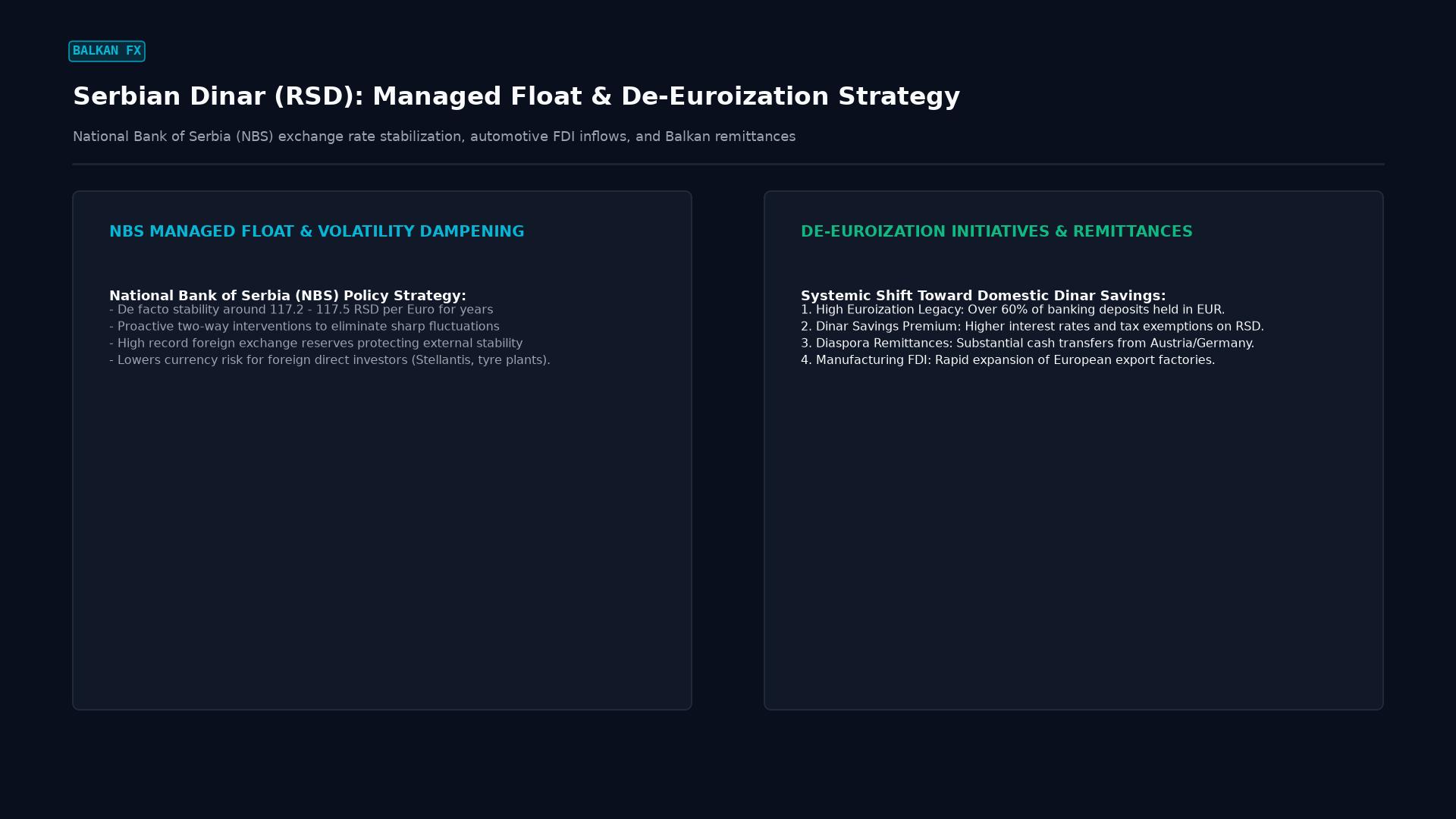 Figure: National Bank of Serbia (NBS) exchange rate stabilization, automotive FDI inflows, and Balkan remittances
Historical Context: From Medieval Silver to Post-Yugoslav Stability
The monetary history of the Serbian Dinar encompasses medieval glory, modern statehood, hyperinflationary trauma, and monetary stabilization.
Medieval Heritage (1214 to 1459)
The first historical record of the Serbian Dinar dates to 1214 during the reign of King Stefan Nemanjić (Stefan the First-Crowned).
- Capitalizing on rich silver mines at Brskovo, Novo Brdo, and Rudnik, medieval Serbia minted high-purity silver dinars that circulated widely across the Adriatic basin.
- The currency’s prominence was noted by Dante Alighieri in his Divine Comedy (Paradiso, Canto XIX), which referenced the King of Rascia (Serbia) for producing coins modeled after the Venetian silver matapan.
- Following the Ottoman conquest in 1459, the medieval dinar was superseded by Ottoman coinage.
1214: First Medieval Silver Dinar
Minted by King Stefan the First-Crowned
                      │
                      ▼
1868: Modern State Currency Reborn
Prince Mihailo Obrenović issues first modern bronze coins
                      │
                      ▼
1918-1991: Yugoslav Dinar Era
Kingdom of Serbs, Croats & Slovenes; Socialist Yugoslavia (SFRY)
                      │
                      ▼
1992-1994: Catastrophic Hyperinflation
Yugoslav wars, UN sanctions, and money printing;
Peak daily inflation of 65%; 500-billion-dinar banknotes
                      │
                      ▼
January 1994: The Avramović Stabilization Plan
Introduction of the "Super Dinar" pegged 1:1 to the Deutsche Mark
                      │
                      ▼
2003 / 2006: The Modern Serbian Dinar (CSD to RSD)
Re-established after dissolution of Yugoslavia and the State Union
The 1992–1994 Hyperinflationary Crisis
During the violent breakup of the Socialist Federal Republic of Yugoslavia (SFRY) and the imposition of international trade sanctions, the Federal Republic of Yugoslavia (Serbia and Montenegro) suffered one of the most extreme hyperinflationary episodes in world economic history:
- Between October 1993 and January 1994, prices doubled every 34 hours, with monthly inflation peaking at 313,000,000%.
- The government printed banknotes with denominations reaching 500,000,000,000 (500 billion) dinars.
- The national currency ceased to function as a store of value or unit of account, and citizens shifted entirely to the German Deutsche Mark (DEM) for survival and domestic commerce.
The Avramović Reform and the “Super Dinar”
On January 24, 1994, Dragoslav Avramović, an economist appointed to head the central bank, launched a stabilization program.
The government issued the Novi Dinar (popularly called the “Super Dinar”), anchored to strict statutory 1:1 convertibility with the Deutsche Mark:
$$\text{Fixed Parity (January 1994)}: 1 \text{ Novi Dinar} = 1 \text{ Deutsche Mark (DEM)}$$
The plan halted hyperinflation immediately, restored cash liquidity, and re-established basic price stability. Following the dissolution of the State Union of Serbia and Montenegro in 2006 (Montenegro having unilaterally adopted the Euro), the currency was officially established as the modern Serbian Dinar (RSD) under the sovereign oversight of the National Bank of Serbia.
Macroeconomic Drivers of the Serbian Dinar
The value and stability of the RSD are governed by strong trade ties with the European Union, large foreign direct investment flows, worker remittances, and central bank policy.
1. European Union Trade Integration and Manufacturing FDI
Serbia is integrated into the European industrial supply chain. The European Union accounts for over 60% of total Serbian merchandise exports, with Germany and Italy representing the country’s largest single trading partners.
+------------------------------------------------------------------------------------+
|                         SERBIAN INDUSTRIAL EXPORT SECTORS                          |
+-------------------+----------------------------------------------------------------+
| SECTOR            | INDUSTRIAL FOCUS & FOREIGN INVESTMENT                          |
+-------------------+----------------------------------------------------------------+
| Automotive Parts  | Major multinational manufacturing plants (Stellantis, Michelin,|
| & Wiring Harnesses| Continental, ZF Friedrichshafen, Leoni, Aptiv).                |
+-------------------+----------------------------------------------------------------+
| Electrical Mach.  | Industrial electrical equipment, home appliance components,    |
| & Electronics     | and specialized electronics assembly.                          |
+-------------------+----------------------------------------------------------------+
| Agri-Food Products| High-value agricultural exports: frozen raspberries (world top |
| & Grains          | exporter), fresh fruit, corn, and sunflower oil.               |
+-------------------+----------------------------------------------------------------+
| Information Tech. | Rapidly expanding software development, enterprise solutions,  |
| Services (BPO)    | and tech engineering outsourcing.                              |
+-------------------+----------------------------------------------------------------+
Over the past decade, Serbia has attracted foreign direct investment (FDI) inflows averaging between €3.5 billion and €4.5 billion annually, representing roughly 6% to 7% of national GDP. Foreign corporations convert euros into dinars to finance factory construction, acquire industrial leases, and pay domestic engineering salaries, creating structural upward pressure on the dinar.
2. Diaspora Remittance Cash Inflows
Personal remittances sent home by Serbians living and working abroad, primarily in Germany, Austria, Switzerland, the United States, and across the EU, represent a primary stabilizer of the balance of payments.
       Overseas Serbian Diaspora (Germany, Austria, Switzerland)
                                │
                                ▼
       Personal Remittances Inflows: €4.0B to €5.0B Annually
                                │
                                ▼
       Represents ~8% to 10% of National GDP
                                │
                                ▼
       Provides Structural Hard Currency Liquidity to Domestic Households
       Offsets Over 60% of the Merchandise Trade Deficit
These cash inflows provide non-debt-creating hard currency that cushions household consumption and supplies the domestic banking sector with consistent euro liquidity.
3. Energy Import Sensitivity
Serbia is a structural importer of crude oil and natural gas. Natural gas supplies flow primarily via pipeline routes (including the Balkan Stream link from TurkStream), while crude oil imports arrive through the JANAF Adriatic oil pipeline from Croatia.
Surges in global energy prices widen Serbia’s merchandise trade deficit, requiring larger foreign currency outflows to settle fuel bills and placing pressure on NBS reserves.
The “Dinarization” Strategy and Systemic Euroization
A defining feature of the Serbian financial sector is its historic degree of euroization (the widespread domestic use of the euro alongside the national currency).
+------------------------------------------------------------------------------------+
|                        SERBIAN FINANCIAL EUROIZATION METRICS                       |
+------------------------------------+------------------+----------------------------+
| METRIC                             | HISTORICAL PEAK  | CURRENT STABILIZED LEVEL   |
+------------------------------------+------------------+----------------------------+
| Total Bank Deposits in Foreign FX  | Over 80%         | ~60% to 65%                |
| Corporate & Retail Credit in FX    | Over 75%         | ~55% to 60%                |
| Public Sovereign Debt in FX        | Over 85%         | ~70%                       |
+------------------------------------+------------------+----------------------------+
Because generations of citizens experienced the 1990s hyperinflation, domestic depositors historically converted their savings into Deutsche Marks and later Euros.
To reduce this systemic vulnerability, the NBS and the Serbian government introduced a long-term Dinarization Strategy (Dinarizacija):
- Differentiated Reserve Requirements: Imposing significantly higher mandatory cash reserve requirements on commercial banks’ foreign currency deposits than on dinar deposits.
- Tax and Interest Incentives: Interest income earned on dinar-denominated savings accounts is 100% exempt from personal income tax, whereas interest on foreign currency deposits incurs a 15% withholding tax.
- Deepening the Sovereign Dinar Yield Curve: The Ministry of Finance systematically issues benchmark 5-, 7-, 10-, and 12-year treasury bonds denominated in dinars (Dinarske obveznice), attracting domestic pension funds and international investors.
NBS Monetary Policy and the De Facto Exchange Rate Anchor
The National Bank of Serbia operates an explicit Inflation-Targeting Framework governed by the Executive Board (Izvršni odbor):
$$\text{Headline Inflation Target} = 3.0% \pm 1.5% \quad (1.5% \text{ to } 4.5%)$$
The key policy rate (Referentna kamatna stopa) is the primary operational benchmark, steering 1-week reverse repo liquidity operations.
+------------------------------------------------------------------------------------+
|                         NBS TWO-WAY INTERVENTION MECHANICS                         |
+-------------------+----------------------------------------------------------------+
| MARKET CONDITION  | NBS INTERVENTION OPERATION                                     |
+-------------------+----------------------------------------------------------------+
| Appreciation Press| Strong FDI and remittance inflows push EUR/RSD down toward     |
| (EUR Drops/RSD Up)| 116.80. The NBS intervenes as a NET BUYER of Euros, absorbing   |
|                   | excess foreign currency and growing its official FX reserves.  |
+-------------------+----------------------------------------------------------------+
| Depreciation Press| Geopolitical shocks or winter energy import bills push EUR/RSD |
| (EUR Rises/RSD Dn)| up toward 117.80. The NBS intervenes as a NET SELLER of Euros, |
|                   | supplying liquidity to prevent pass-through imported inflation.|
+-------------------+----------------------------------------------------------------+
Why the NBS Maintains a Stabilized Exchange Rate
While the IMF classifies Serbia’s de jure regime as a managed float, the de facto reality is an exchange rate anchor against the Euro.
Because Serbia’s economy remains euroized, any sharp depreciation of the dinar would immediately:
- Spike imported inflation across food, consumer goods, and energy.
- Threaten financial stability by increasing the debt burden of unhedged households and corporations whose loans are indexed to the Euro.
Consequently, since 2017, the NBS has used its foreign exchange reserves to keep the EUR/RSD exchange rate tightly anchored in the 117.00 to 117.50 range.
Trading the RSD: Foreign Exchange Market Microstructure
In interbank and corporate foreign exchange trading, the dominant pair is EUR/RSD, expressing how many dinars are required to purchase one euro.
Direct Quotation:
EUR/RSD = 117.2000

Interpretation:
1 Euro = 117.2000 Serbian Dinars
Because the NBS manages the market, intraday volatility on EUR/RSD is minimal,
frequently trading within a 5-to-10-para daily band (117.15 to 117.25).- Onshore Interbank Market: All commercial banks in Serbia settle interbank foreign exchange transactions through the NBS electronic trading platform and RTGS payment system (IPS NBS / RTGS NBS).
- Physical Exchange Bureaus (Menjačnice): A regulated network of thousands of private licensed exchange bureaus operates across Serbian cities, providing retail citizens and tourists with foreign currency cash conversions.
- Offshore Derivatives: Because the dinar is not fully convertible on international retail platforms, global banks manage institutional dinar exposure via USD- or EUR-settled Non-Deliverable Forwards (NDFs).
Key Takeaways
- Official Currency of Serbia: The Serbian Dinar (RSD, symbols: дин, RSD) is administered and issued by the National Bank of Serbia (NBS).
- Medieval and Modern Lineage: First minted in 1214 under King Stefan Nemanjić, the modern currency was revived in 1868 and stabilized following the 1990s hyperinflation crisis through the Avramović Plan.
- De Facto Euro Anchor: While formally operating under a managed float with inflation targeting (3.0% ± 1.5%), the NBS stabilizes the EUR/RSD rate near 117.00 to 117.50 to anchor domestic financial stability.
- Industrial and FDI Anchor: Heavy European Union manufacturing investments (automotive, machinery, tech) generate consistent euro inflows that support the dinar.
- Diaspora Remittance Cushion: Personal remittances of €4.0B to €5.0B annually from European diaspora workers offset the structural merchandise trade deficit.
- Dinarization Strategy: The NBS provides tax exemptions on dinar savings and uses differentiated reserve requirements to reduce financial euroization and encourage local currency borrowing.
Frequently Asked Questions (FAQ)
Why does the EUR/RSD exchange rate barely move from month to month?
The EUR/RSD exchange rate exhibits minimal volatility because the National Bank of Serbia (NBS) actively manages the interbank market. Because many Serbian household mortgages and corporate commercial loans are denominated in or indexed to the Euro, a sharp depreciation of the dinar would trigger loan defaults and imported inflation. To maintain macroeconomic stability, the NBS intervenes directly as a buyer or seller of euros whenever the market drifts outside its preferred trading corridor (typically between 117.00 and 117.50 dinars per euro).
What is “dinarization,” and why is the Serbian central bank promoting it?
“Dinarization” (Dinarizacija) is a national monetary strategy designed to increase the use of the Serbian Dinar in domestic banking and contracts while reducing dependency on the Euro. Decades of historical inflation led citizens and businesses to hold bank deposits and write commercial contracts in euros. The NBS promotes dinarization by making interest earned on dinar deposits completely tax-free (compared to a 15% tax on euro savings), charging banks lower reserve requirements on dinar funds, and encouraging local currency sovereign debt issuance.
Can international traders buy physical Serbian Dinars on global retail forex brokers?
No. The Serbian Dinar is not freely tradable or physically deliverable on standard retail forex trading platforms. The dinar does not clear through Continuous Linked Settlement (CLS) systems and is subject to domestic foreign exchange regulations. International institutional investors and hedge funds access financial exposure to the dinar through offshore Non-Deliverable Forwards (NDFs) or by opening custodial accounts with licensed domestic commercial banks in Belgrade to purchase local dinar-denominated government treasury bonds (Dinarske obveznice).
Ready to trade forex?
Open a free demo account with a regulated broker. Practice with virtual funds before risking real money.